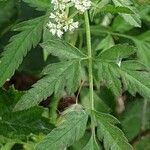
Torilis arvensis
ماستونک · Hedge parsley · Spreading hedge-parsley · Canada hedgeparsley · Spreading hedgeparsley
Description
Source: leafsnapTorilis arvensis, commonly known as hedge parsley or field hedge parsley, is a biennial plant that belongs to the Apiaceae family. Originally native to Europe and Asia, it is now found worldwide. The plant can grow up to 1 meter tall and features a slender stem with small white flowers that bloom from June to September. The leaves of Torilis arvensis are finely divided, giving them a fern-like appearance. The flowers are small, white or pinkish, and arranged in umbels at the ends of long stalks. The fruit is an oval-shaped burr covered with hooked spines that easily cling to clothing or animal fur. Torilis arvensis thrives in moist soils found in open fields, meadows, hedgerows, roadsides, and waste places, but it can also grow in dry soils. In some areas, it is considered an invasive species due to its rapid spread through its burrs. This plant has been used medicinally for centuries, primarily for its anti-inflammatory properties, which make it useful in treating skin conditions such as eczema and psoriasis. It also contains flavonoids, which have antioxidant properties that help combat oxidative stress caused by free radicals. In summary, Torilis arvensis is an intriguing biennial herbaceous plant with notable medicinal properties. However, its ability to spread rapidly through burrs that cling to clothing or animal fur has led some countries to classify it as an invasive species. This rapid spread can cause problems during harvest season, as the burrs can mix with crops, leading to contamination and economic losses.
🌳 Although spreading hedge parsley seldom makes headlines, its modest presence shelters fascinating biodiversity. As a refuge for many insects, it sustains a micro-ecosystem that helps preserve the fragile balance of our biosphere. This unanticipated role reveals the plant's quiet yet vital effect on ecological networks.
🎭 Helpful knowledge
Care Guide
💧 Water Every 7 days
Spreading hedgeparsley, originally from temperate regions, flourishes in moderately moist soil. It prefers regular weekly watering, but care should be taken to avoid overwatering, which can lead to root rot. Typically cultivated outdoors, spreading hedgeparsley benefits when rainfall coincides with its watering needs during crucial growth stages.
How should I water my Spreading hedgeparsley plant in the most effective way?
To water Spreading hedgeparsley, you have a few options. You can use a garden hose with a spray nozzle, a watering can, or almost any other common watering tool. Luckily, Spreading hedgeparsley isn't too picky when it comes to water. It can survive with rainwater, tap water, or even filtered water. But it's best to avoid watering from above, as this can harm the leaves and flowers and may cause disease. Instead, a drip irrigation system is often the most effective way to water this plant. These systems distribute water evenly and directly to the soil. If you have a Spreading hedgeparsley in a container, you can use a similar watering method but with different tools. Simply use a cup, watering can, or tap to apply water directly to the soil of the container-grown plant.
What should I do if I give my Spreading hedgeparsley too much or too little water?
To remedy underwatering for Spreading hedgeparsley, simply water it more regularly when you notice it lacks moisture. Overwatering, on the other hand, can lead to more serious problems if not spotted early. Overwatered Spreading hedgeparsley can become diseased and eventually die. To prevent this, choose a suitable location for growing that receives plenty of sunlight to dry the soil and has good drainage to prevent water from pooling and causing waterlogged soil. If you overwater Spreading hedgeparsley in a pot, consider transferring it to a new pot with better drainage or more holes. When repotting, use loose soil and an efficient draining pot.
How often should I give water to my Spreading hedgeparsley?
To keep your Spreading hedgeparsley healthy, it's important to water it regularly during the growing season. In the spring, watering once a week should be sufficient. However, as the weather gets hotter, you may need to increase the watering to two or three times a week. It's important not to overwater the plant as this can harm it. Keep the soil moist but not soaked, regardless of how often you water. If you have Spreading hedgeparsley in a pot, you'll need to water it more frequently. The soil in pots can dry out faster than in the ground, so plan to water a container-grown plant a few times per week, compared to just once a week for an in-ground plant.
How much water does my Spreading hedgeparsley require?
There are a few different ways to determine how much water to give your Spreading hedgeparsley. Some gardeners choose to feel the soil for moisture and water until the top six inches are moist. Alternatively, you can use a set measurement of about two gallons per week, adjusting based on temperature and soil dryness. However, be careful not to overwater if your plant needs less. When growing in a container, water until all layers of dry soil are moist or until water exits the drainage holes.
How can I know if I'm giving enough water to my Spreading hedgeparsley?
Properly watering your Spreading hedgeparsley can be a bit challenging. These plants have deep roots that need to be watered on a weekly basis. However, Spreading hedgeparsley are highly vulnerable to root rot, which can occur if they are overwatered. Overwatering can also lead to browning of the plant. On the other hand, underwatering is less likely to be a problem as these plants can survive without regular watering for a while. But if you go too long without watering, the plant will start to wilt and its leaves will become dry.
☀️ Light Partial sun
Spreading hedge parsley does best in places that receive steady but not intense sunlight for most of the day. Native to environments where it can flourish in either dappled light or full sun, it tolerates a broad range of sun exposure; however, prolonged exposure to scorching light can impede its growth.
What are the sunlight requirements for spreading hedgeparsley?
Spreading hedgeparsley, or Torilis arvensis, thrives under various sunlight conditions, from partial sun, requiring about 3-6 hours of sunlight, to full sun, needing more than 6 hours of sunlight. It's vital to observe the movement of sunlight in your garden to ensure that the plants receive a balanced mix of light and shade. This ensures the plants' happiness and health. When selecting a location for spreading hedgeparsley, consider spots that offer consistent but not overly intense rays throughout the day. This plant can endure extensive sun exposure but might suffer if subjected to prolonged periods of intense sunlight.
How does artificial lighting support indoor spreading hedgeparsley plants?
For indoor spreading hedgeparsley plants that cannot receive enough natural sunlight, especially during winter or in less sunny spaces, artificial lighting is a crucial alternative. Choosing the right type of artificial light, such as LED lights, can be beneficial because they can be customized to provide specific wavelengths needed by the plants. Full sun plants require 30-50W/sq ft of artificial light, partial sun plants need 20-30W/sq ft, and full shade plants need 10-20W/sq ft. The light source should be placed 12-36 inches above the plant to mimic natural sunlight conditions and should be left on for 8-12 hours per day to ensure optimal growth.
What are the symptoms of light deficiency in spreading hedgeparsley?
When spreading hedgeparsley does not receive adequate light, several symptoms may arise. These include the development of smaller new leaves, leggy or sparse growth, early leaf drop, halted new growth, and the appearance of lighter-colored or chlorotic leaves. Extreme sunlight exposure can cause sunscald, leaf curling, wilting, and leaf scorching. Recognizing these signs early on is crucial for the health and recovery of the plant.
What solutions can mitigate light deficiency symptoms in spreading hedgeparsley?
To address light deficiency symptoms in spreading hedgeparsley, gradual adaptation to sunlight is key. For indoor plants, gradually moving them to sunnier spots or using artificial light such as desk lamps or professional grow lights for 8 hours daily can help. Outdoors, moving plants to sunnier locations gradually helps them adapt without the risk of sunburn. Reducing obstructions, like pruning trees that block sunlight, and transplanting smaller plants during their dormant period to sunnier spots can also be beneficial for ground-planted spreading hedgeparsley. It's important to note that parts of the plant that have been severely affected may not recover, but new growth should be healthy with improved light conditions.
🌡️ Temperature 0–35°C
Spreading hedge parsley is native to mild climates and grows best in temperatures from 68 to 95 °F (20 to 35 °C). To promote optimal growth, avoid substantially colder or hotter conditions, and adjust conditions seasonally if necessary.
What is the ideal climate for growing Spreading hedgeparsley?
Spreading hedgeparsley, scientifically known as Torilis arvensis, is indigenous to moderate climates, flourishing best in temperatures ranging from 68 to 95 °F (20 to 35 °C). This plant has a strong cold resistance, making it suitable for a variety of environments. To ensure its optimal growth, it is recommended to maintain temperatures within this range and adjust care according to seasonal changes. Although it has significant cold resistance, and special frost protection isn't usually necessary, it is important to take measures if temperatures are expected to drop below -35°C. Preparing the plant for winter by watering it abundantly before the first freeze to keep the soil moist can help prevent winter and early spring drought.
How does low temperature affect Spreading hedgeparsley and what are the recommended actions?
Spreading hedgeparsley thrives best in temperatures above 20°C and shows considerable cold tolerance, typically showing no noticeable changes during winter if kept above 0°C. However, exposure to temperatures below -35°C might result in reduced sprouting or none at all in the following spring. In cases where the plant fails to sprout in spring, it is advised to remove the non-sprouting parts to encourage new growth and maintain plant health.
What should be done if Spreading hedgeparsley is exposed to high temperatures?
During the summer months, it is important to keep the Spreading hedgeparsley below 35°C to avoid heat stress. Exposure to temperatures above 41°C can lead the leaves to become lighter, curl, become prone to sunburn, or in severe cases, cause the plant to wilt and dry out completely. To mitigate these effects, trim away the damaged parts of the plant. To protect it from excessive heat, relocate it to a shaded area or use a shade cloth to shield it from the midday and afternoon sun. Ensuring the soil remains moist by watering the plant in the morning and evening can also help prevent heat damage.
💨 Humidity normal (40-60%)
This plant will thrive in moderate humidity, which is probably the level in your home. However, misting it a few times a week can be very beneficial. Make sure the room has good ventilation.
🪴 Soil 6-7
🌱 Fertilizer
Spreading hedge parsley benefits from frequent, light applications of fertilizer to encourage healthy leaf growth. You should fertilize Spreading hedge parsley about once a month during the summer. Nitrogen is essential for foliage, and adding nitrogen-rich sources helps Spreading hedge parsley thrive.
🪴 Pot & Repot
✂️ Pruning
🌿 Propagating
🐛 Diseases & pets
☠️ Toxicity
Characteristics
- Plant Type
- Herb
- Life Cycle
- Annual
- Genus
- Torilis
- Family
- Apiaceae
- Hardiness Zone
- 3-10
- Mature Height
- 13 cm to 91 cm
- Mature Spread
- 61 cm
- Leaf Color
- Green, Blue
- Leaf Type
- Deciduous
- Flower Color
- White
- Flower Size
- 0.25 cm
- Bloom Time
- Late spring, Early summer, Mid summer
- Planting Time
- Spring
- Harvest Time
- Mid summer