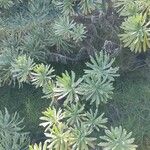
Tournefortia gnaphalodes
Bay lavender · White lavendel · White lavender · Sea rosemary
Description
Source: wikipedia (CC BY-SA)Tournefortia gnaphalodes, the sea lavender, bay lavender, sea rosemary, iodine bush, or beach heliotrope, is a species of flowering plant in the family Boraginaceae. It is native to Florida, Mexico, Central America, the Caribbean, Bermuda, northeastern Colombia, and Venezuela. A semi‑succulent evergreen shrub reaching 5 ft (1.5 m), it is typically found in coastal areas. Occasionally cultivated as an ornamental, it is often used for dune stabilization.
🎭 Safety, Affection, Desire
Care Guide
💧 Water
Sea rosemary flourishes in coastal dunes, where it is exposed to high salinity and occasional sea spray. It thrives in dry conditions and should be watered once a week. Known for its impressive ability to withstand saltwater, sea rosemary is an excellent choice for outdoor coastal gardens. It benefits from natural rainfall and can tolerate saline environments.
☀️ Light Full sun
Sea rosemary comes from open habitats, like sunny meadows and forest edges, which offer plenty of light. It grows best in full sun but can also tolerate partial sun, adjusting well to different light levels.
What are the sun requirements for Sea Rosemary (Tournefortia gnaphalodes)?
Sea Rosemary, or Tournefortia gnaphalodes, thrives in conditions that match its sun requirements precisely. For 'Full sun', it requires more than 6 hours of sunlight a day to flourish. However, it can also grow well in 'Partial sun', which means about 3-6 hours of sunlight daily. It's important to observe how sunlight moves through your garden to find spots with the perfect balance of light and shade, ensuring the best growth environment for your Sea Rosemary, keeping in mind its well-being.
🌡️ Temperature 20–37.8°C
Sea rosemary comes from tropical areas, where the weather is usually warm and humid. Consequently, it is adapted to high heat and moisture. It does not tolerate sudden temperature shifts and prefers a constant temperature, so avoiding indoor temperature fluctuations is important. It typically cannot withstand cold and needs higher temperatures to grow. If the surrounding temperature falls too low, the plant may stop growing or even die.
💨 Humidity
🪴 Soil 6-7
🌱 Fertilizer
The best time to fertilize a Sea rosemary is in early spring as it breaks dormancy. This encourages overall growth and flower production. Fertilizing improves foliage, stems, and branches, and promotes large, vibrant, long-lasting flowers. It also helps move nutrients from the roots to the blooms and enhances the plant's health and disease resistance.
🪴 Pot & Repot
✂️ Pruning
Sea rosemary boasts silver-green foliage and is highly tolerant of salt, making it an excellent choice for coastal areas. To encourage healthy growth and maintain a well-structured canopy that allows for good airflow, it's important to prune this plant from early to late winter. Focus on trimming any damaged branches and performing regular light pruning to enhance its resilience.
🌿 Propagating
🐛 Diseases & pets
☠️ Toxicity
Characteristics
- Plant Type
- Shrub
- Life Cycle
- Perennial
- Genus
- Tournefortia
- Family
- Boraginaceae
- Hardiness Zone
- 10-12
- Mature Height
- 0.61 m to 1.52 m
- Mature Spread
- 1.83 m to 6.1 m
- Leaf Color
- Silver, Gray
- Leaf Type
- Evergreen
- Flower Color
- White
- Flower Size
- 0.51 cm to 0.51 cm
- Bloom Time
- Late spring, Summer, Fall
- Planting Time
- Spring, Summer, Autumn
- Harvest Time
- Mid summer, Late summer, Fall, Early winter
- Native Area
- Colombia, Belize, Cuba, Honduras, Mexico, Guatemala, Venezuela, Nicaragua, Jamaica