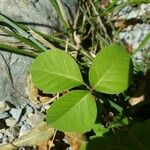
Toxicodendron rydbergii
Rydberg's poison-ivy · Western poison-ivy · Poison Ivy · Rydberg's Toxicodendron
Description
Source: leafsnapToxicodendron rydbergii, commonly known as western poison ivy, is a woody vine or shrub native to western North America. It belongs to the Anacardiaceae family and is closely related to other toxic plants such as poison oak and sumac. This plant can grow up to 3 meters tall and features glossy green leaves divided into three leaflets. These leaves contain urushiol oil, which can cause allergic reactions in humans through skin contact or inhalation of smoke from burning plants. Toxicodendron rydbergii thrives in moist habitats like stream banks, forests, and meadows, but it can also survive in dry regions such as deserts. In the spring, it produces small greenish-white flowers that later develop into small white berries. Despite its toxicity, Toxicodendron rydbergii holds ecological importance by providing food for birds such as quails and grouse, which are immune to its poisonous effects. To avoid severe allergic reactions, humans should steer clear of Toxicodendron rydbergii, whether by direct contact with its leaves or exposure to smoke from burning plants.
🌳 Western poison ivy functions as an ecological indicator because it is sensitive to environmental changes. Its presence or absence can offer clues about the health of an ecosystem, especially with respect to air pollution and habitat disturbances. Researchers and conservationists can rely on western poison ivy as a natural gauge for monitoring ecosystem integrity and guiding conservation efforts.
🎭 Faithfulness, Marital Love, Affection
Care Guide
💧 Water Every 7 days
Western poison ivy thrives in areas with moderate water availability and requires weekly watering. As a deciduous plant, it sheds its leaves during dry seasons to conserve water, which helps it survive in its native habitat where rainfall is consistent.
How should I water my Western poison ivy effectively?
To properly water the Western poison ivy, use filtered water at room temperature. Tap water may have harmful particles, so filtered water is preferred. It is important to use room temperature or slightly warmer water because the Western poison ivy is accustomed to warm environments and cold water can be a bit of a shock. Avoid watering from above as it can lead to problems with the foliage. Instead, water the soil directly until it is thoroughly soaked. This method benefits the plant by providing moisture to the roots and helping them spread and absorb necessary nutrients from the soil.
What should I do if I give my Western poison ivy plant too much water or too little water?
Overwatering and underwatering can both harm your Western poison ivy plant, but overwatering is more commonly seen. Too much water can cause the stems and leaves to wilt and turn yellow. It can also lead to diseases like root rot, mold, and mildew, which can be fatal for the plant. While underwatering is less common for this type of poison ivy, it can still happen. In such cases, the leaves become brittle and brown. It's important to be vigilant for signs of overwatering and take action promptly. Some diseases caused by overwatering, such as root rot, may be irreversible if not addressed quickly. If you notice early signs of overwatering, reduce your watering schedule and check the quality of the soil. If the soil doesn't drain well, replace it with a loose, well-draining potting mix. On the other hand, if signs of underwatering are present, simply increase your watering frequency until the symptoms improve.
How often do I need to water my Western poison ivy?
If your Western poison ivy is in a pot or outdoors in the ground, you can use a simple method to determine if it needs water. For potted plants, stick your finger into the soil and if the top two to three inches are dry, it's time to water. The same goes for plants in the ground - if the first few inches of soil have dried out, it's time to give it some water. In the spring and early fall, once a week watering is often sufficient, but during hot weather, you may need to water twice or more per week. However, it's worth noting that mature, well-established Western poison ivy plants have a good ability to withstand drought.
How much water does my Western poison ivy require?
When watering your Western poison ivy, don't hold back on the amount of water you give. Make sure the top two to three inches of soil are dry, and then give the plant a deep watering, enough to saturate the soil completely. You should see excess water flowing out of the drainage holes at the bottom of the pot. If there's no excess water draining, then you haven't watered it enough. However, be careful not to let water accumulate inside the soil, as that can harm the plant. On the other hand, if water isn't draining properly, it could mean that the soil doesn't drain well, which is bad for the plant's health and should be avoided. If the plant is outside, it only needs 1 inch of rainfall per week.
How do I water my Western poison ivy at different stages of growth?
The water needs of Western poison ivy can vary depending on its growth stages. In the first few years of its life or when it is transplanted to a new location, it will require more water than usual. During these stages, Western poison ivy focuses on growing new roots to support future growth, which requires more moisture. As it matures, it will need less water. The bloom period is another stage when it may require additional water as flower development utilizes a significant amount of moisture.
☀️ Light Full sun
Western poison ivy requires ample sunlight to thrive, reflecting its native habitat where light is plentiful. This high light requirement remains consistent through its various growth stages. Too much light can stress the plant, while too little can hinder its development.
What are the sunlight requirements for Western poison ivy (Toxicodendron rydbergii)?
Western poison ivy thrives in conditions that replicate its natural habitat, which means it requires a significant amount of sunlight for healthy growth. The plant needs full sun, which is above 6 hours of direct sunlight per day, to flourish and maintain its growth stages consistently. Even in different growth phases, the strong need for sunlight remains constant. However, it's essential to note that while excess light can stress the plant, insufficient sunlight exposure may stunt its growth.
How does artificial lighting support the growth of Western poison ivy indoors?
For indoor Western poison ivy plants, when natural sunlight is insufficient—especially during winter or in less sunny locations—artificial lighting can provide a vital growth support. Indoor plants benefit from adequate lighting, which promotes faster, healthier growth. It's advisable to select the right type of artificial light, like LED lights, that can be customized to your plant's needs. Full sun plants require 30-50W/sq ft of artificial light, partial sun plants 20-30W/sq ft, and full shade plants 10-20W/sq ft. Positioning the light source 12-36 inches above the plant and mimicking natural daylight hours, usually 8-12 hours of light per day, can significantly enhance plant growth.
What are the symptoms of inadequate or excessive light exposure in Western poison ivy?
Inadequate light exposure can lead to symptoms such as smaller new leaves, leggy or sparse growth, faster leaf drop, slower or no new growth, and lighter-colored new leaves, which suggest a lack of chlorophyll and essential nutrients. On the other hand, excessive sunlight exposure can result in chlorosis, where leaves lose their green color, sunscald causing damage to leaves or stems, leaf curling as a defense mechanism to minimize water loss, wilting due to increased transpiration and water loss, and leaf scorching characterized by brown, dry edges on leaves. These indicators highlight the plant's struggle to adapt to its lighting environment.
What solutions can be implemented to manage light exposure for Western poison ivy?
To manage light exposure for Western poison ivy effectively, gradual steps should be taken. For indoor plants, gradually move them to a sunnier location each week until they receive the required sunlight, or use artificial lights for at least 8 hours a day. For outdoor plants, avoid sudden changes in light intensity by gradually moving them to sunnier spots. Additionally, reducing obstructions like pruning branches or transplanting smaller plants to sunnier locations can help maximize sunlight exposure. It's critical to remember that while affected parts may not recover, new growth, after increased light exposure, will appear healthy.
🌡️ Temperature 0–35°C
Western poison ivy favors temperatures from 32 to 95 ℉ (0 to 35 ℃) and is found in temperate environments. It adjusts to seasonal temperature changes and can withstand colder conditions in winter.
What temperature range is suitable for Western poison ivy?
Western poison ivy, known botanically as Toxicodendron rydbergii, thrives in a temperature range from 32 to 95°F (0 to 35°C). It is well-adapted to temperate environments and possesses strong cold resistance, allowing it to tolerate the varying temperatures across seasons without needing special frost protection measures. However, in anticipation of winter temperatures dropping below its growth limit, it's recommended to prepare the plant for cold by covering it with soil or straw and watering it abundently before the first freeze, to ensure the soil remains moist and enters a frozen state, helping prevent drought and water scarcity during the winter and early spring.
How does Western poison ivy react to low and high temperatures, and what are the solutions?
For Western poison ivy, low temperatures below its growth limit may not show immediate damage during winter, but could result in decreased or no sprouting in spring. The solution is to remove any non-sprouting parts in spring. As for high temperatures, when it exceeds the plant's tolerance, the leaves may turn lighter, prone to curling and sunburn, and the plant can wilt and dry out. To combat this, trim away the damage, relocate the plant for better shade, or use a shade cloth, especially during midday and afternoon. It's also beneficial to water the plant in the morning and evening to maintain moist soil.
💨 Humidity
🪴 Soil 5-7
🌱 Fertilizer
Typically one fertilizer application in spring is enough for Western poison ivy, though repeated feedings can maximize growth. Apply fertilizer about every month to six weeks. Feeding improves the leaves' appearance and function, encouraging uniform color and a healthy texture. It also promotes root development and nutrient uptake, supporting the plant's long-term health.
🪴 Pot & Repot
✂️ Pruning
🌿 Propagating
🐛 Diseases & pets
☠️ Toxicity
Characteristics
- Plant Type
- Herb, Shrub
- Life Cycle
- Perennial
- Genus
- Toxicodendron
- Family
- Anacardiaceae
- Hardiness Zone
- 3-10
- Mature Height
- 0.91 m to 3.05 m
- Mature Spread
- 0.91 m to 2.13 m
- Leaf Color
- Green, Yellow, Red, Bronze
- Leaf Type
- Deciduous
- Flower Color
- Yellow, White, Green
- Flower Size
- 0.76 cm
- Bloom Time
- Late spring, Early summer, Mid summer
- Planting Time
- Spring, Summer, Autumn
- Harvest Time
- Mid summer
- Native Area
- Mexico