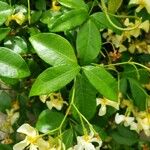
Trachelospermum asiaticum
Asiatic jasmine · Asian-jasmine
Description
Source: leafsnapTrachelospermum asiaticum, commonly known as Asian Jasmine or Confederate Jasmine, is a species of evergreen vine that belongs to the Apocynaceae family. Native to East Asia, this plant is found in countries such as China, Japan, and Korea. Asian Jasmine features glossy, dark green, oval-shaped leaves that grow in opposite pairs along its stem. From late spring to early summer, it produces small, sweetly fragrant white flowers, which are followed by small black fruits. Due to its attractive foliage and fragrant blooms, Asian Jasmine is a popular ornamental plant. It can serve as a ground cover or be trained to grow on trellises or walls, adding vertical interest to gardens or landscapes. For optimal growth, Asian Jasmine prefers well-drained soil with moderate moisture and exposure from partial shade to full sun. It is relatively low-maintenance but may require occasional pruning to control its growth. Beyond its ornamental appeal, Trachelospermum asiaticum has been utilized in traditional medicine for treating fever, coughs, headaches, and skin conditions, thanks to its anti-inflammatory properties. Overall, Trachelospermum asiaticum is an attractive evergreen vine with fragrant white flowers, making it an excellent choice for gardeners seeking low-maintenance plants with ornamental value.
🌳 Asiatic jasmine is widely valued not only for its decorative use in landscaping but also for the pleasant scent of its flowers. That fragrance is sometimes extracted for use in perfumery, indicating the plant's potential for commercial aromatic products. Its hardy nature and quick ground-covering ability make it a popular option for erosion control and greening projects.
Care Guide
💧 Water Every 7 days
Asiatic jasmine flourishes in humid conditions, as it needs consistent moisture and well-drained, hydrated soil. To maintain its evergreen nature and ensure it retains its leaves throughout the year, a weekly watering routine is ideal. This plant is often grown outdoors in temperate climates, where it benefits from regular rainfall that helps with irrigation.
What should I do if I give Asiatic jasmine too much or too little water?
An overwatered Asiatic jasmine may have yellow, wilting leaves and a dull, unhealthy appearance with mushy stems. If these signs are present, it's best to adjust your watering schedule. Wilting can also be a sign of under watering, characterized by crispy, dry leaves. In this case, check the soil and provide a thorough watering when dry. However, excessive water can lead to a damaged root system, resulting in dry, yellow leaves. Once the plant recovers, the yellowing will stop. When growing Asiatic jasmine indoors, check the moisture levels and avoid overwatering. Look out for black spots, and if present, allow the soil to dry out for a few days. Overwatering can cause root rot, so it's important to transfer the plant to a different pot if slimy, discolored roots are observed. Avoid soggy soil to prevent root rot. When planting Asiatic jasmine outdoors, check the soil moisture by digging a little deeper. If the soil is too dry, adequate watering is necessary for the plant's recovery.
How often should I give water to my Asiatic jasmine plant?
The Asiatic jasmine prefers deep and infrequent watering. If you have them planted in pots, it's important to soak them in a gallon of water each time because pots have limited water storage and the soil dries out faster. In cold regions, watering is needed every 3 to 5 days. It's best to water early in the morning when the soil is dry, whether you have the plants outdoors or indoors. You can also check the soil inside to determine if watering is needed. When the top 2-3 inches of soil is dry, it's time to give the plant a full watering. On hot days, check the moisture daily as the heat can quickly dry out the pot's soil. If you have a garden, irrigation of the soil is necessary. In hot climates, water the plants once a week when about 2 to 3 inches of soil becomes too dry. Take into account the amount of rainwater and avoid adding more water to prevent root rot. If there is ample rainfall, additional watering may not be required. Asiatic jasmine typically grows during spring and fall. Outdoors, add 3 to 4 inches of mulch to conserve water. Sandy soil needs more frequent watering due to faster drainage, while clay soil requires less watering to avoid root rot. You can mark the date on the calendar when you water and watch for drooping leaves as a sign that watering may be needed soon.
How much water does my Asiatic jasmine plant need?
Here are some tips for watering Asiatic jasmine: 1. If you have Asiatic jasmine plants in pots, make sure to water them deeply until you see water dripping from the bottom. Then, wait for the soil to dry before watering again. 2. You can use a water calculator or a moisture meter to determine the amount of water your plant receives in a week. 3. It's important to provide plenty of water, especially during the flowering period. However, allow the moisture to evaporate afterwards to prevent root rot. 4. If you have Asiatic jasmine planted outdoors and there is adequate rainfall, you may not need to water it additionally. 5. When your Asiatic jasmine is young or newly planted, it's important to ensure it receives 1-2 inches of rain per week. 6. As your Asiatic jasmine continues to grow, it can rely solely on rainfall. However, during very hot weather or when there is no rainfall for 2-3 weeks, consider giving it a thorough watering during cooler times of the day to prevent heat damage. 7. Additional watering may be necessary during persistent dry spells.
Do I need to water my Asiatic jasmine more or less depending on the time of year or the weather?
To care for Asiatic jasmine, it is important to consider its water needs. In general, the plant should be watered when there is a lack of rainfall or persistent dry weather. During the spring and fall growing seasons, the soil should be kept consistently moist but not soggy. Alternating between dry and moist soil conditions will promote healthy growth. In the summer, hot weather may cause water to evaporate quickly, so watering may be required more frequently to keep the soil moist. However, during winter, less water is needed as the plant goes dormant and drops its leaves. It is recommended to use well-draining soil and terracotta pots to aid in the evaporation of excess water. Once the plant begins to leaf out and go dormant, watering can be skipped as it can rely on fall and winter rains. Good drainage is essential, especially during winter, to prevent waterlogging. When planted in pots, Asiatic jasmine has limited root growth and should be watered adequately, especially in summer. Deep soaking the plant's entire root system once or twice a week, depending on the weather, is preferred over shallow sprinkles that can promote fungal growth and fail to reach the roots. Avoid allowing the plant to dry out completely, even during dormancy in fall or winter. Likewise, avoiding excessive water that can cause waterlogging is important, as poor drainage can lead to plant death during winter. Applying mulch is recommended to reduce stress, conserve water, and encourage healthy blooming.
What do I need to watch out for when watering my Asiatic jasmine in different seasons, climates, or during different times it's growing?
If you plant Asiatic jasmine in the ground, it mainly relies on rainfall. However, if there's no rain for 2-3 weeks, you may need to water the plants deeply. When watering in the summer, do it in the morning to avoid stressing the roots with a large temperature difference. Avoid watering when it's too hot outside. Start mulching in the spring when the ground is not too cold. The age of the plants matters, as lack of water is a common reason for newly planted ones to fail to grow. Once they're established, reduce watering. In the fall and winter, decrease watering, especially if the soil retains water. Dry winds in winter can dry them out, and newly planted ones can be at risk of drought during windy seasons. Potted plants dry out faster, so they require more watering. When they bloom less and leaves start to dry up, they need more water. Avoid letting potted plants sit in water by not using containers with saucers, bowls, or trays. Overwatering in the fall can cause mottled or yellowish foliage. Prevent overwatering regardless of the climate or season. During flowering months, you may increase watering frequency, but once fully grown, give them a rest. Water them adequately every 3 to 5 days without following a strict schedule. Check soil moisture by sticking your finger in the pot or using a moisture meter. Avoid overwatering or underwatering to prevent root rot and potential plant death.
☀️ Light Partial sun
Asiatic jasmine favors locations with moderate sunlight rather than heavy shade or continuous full sun. It tolerates a wide range of light conditions that promote healthy growth, although extreme levels can have a negative effect. Its native habitats typically exhibited varied light patterns.
What are the sunlight requirements for Asiatic Jasmine (Trachelospermum asiaticum)?
Asiatic Jasmine requires partial sun to full sun conditions to thrive optimally. Partial sun exposure means the plant should receive about 3-6 hours of sunlight daily, while full sun exposure requires more than 6 hours of sunlight each day. It's important to watch how sunlight moves through your garden, choosing locations that provide the right balance of light and shade, which is crucial for the plant's health and happiness.
What are the essentials for growing Asiatic Jasmine?
Asiatic Jasmine is versatile and appreciates moderate sun exposure but can suffer in heavy shade or constant sunlight. Its growth is healthiest when it experiences a range of light conditions, mimicking its native habitats. For indoor plants, adequate lighting is crucial, especially in less sunny spaces or during winter. Artificial lighting, such as LED lights, can be a solution, offering the necessary wavelengths of light for optimal growth. The amount of artificial light needed varies based on whether the plant needs full sun (30-50W/sq ft), partial sun (20-30W/sq ft), or full shade (10-20W/sq ft).
What symptoms indicate insufficient light for Asiatic Jasmine?
Several symptoms may indicate that Asiatic Jasmine is receiving insufficient light. These include smaller new leaves, leggy or sparse growth, faster leaf drop, slower or halted new growth, paler new leaves, chlorosis (yellowing leaves due to a breakdown in chlorophyll), sunscald, leaf curling, wilting due to excessive water loss, and leaf scorching. It's important to recognize these signs early to mitigate any damage and promote healthier growth.
What solutions are available for light-related issues in Asiatic Jasmine?
To address insufficient light, gradually adapt your Asiatic Jasmine to receive 3-6 hours of direct sunlight by moving it to sunnier spots each week. For large indoor plants or those hard to move, consider artificial lighting for at least 8 hours daily. When moving plants outdoors, avoid sudden changes in light intensity to prevent sunburn. If sunlight is blocked by obstructions like trees, prune them to allow more light to reach your plants. For smaller plants, consider transplanting during the plant's dormant period to a location with ample sunlight and good drainage. Remember, while parts of the plant damaged by low light might not recover, new growth should be healthy with improved light conditions.
🌡️ Temperature 15–37.8°C
Asiatic jasmine is a temperate woody plant that prefers temperatures between 59 and 100℉ (15 and 38℃). Its native habitat, in terms of temperature needs, is warm and humid. During cooler seasons like fall and winter, it may benefit from being adjusted to lower temperatures.
What temperature range is ideal for Asiatic jasmine?
Asiatic jasmine, scientifically known as Trachelospermum asiaticum, thrives in a temperature range of 59 to 100°F (15 to 38°C). Its preference for warm and humid conditions means that it is well-suited to environments that mimic its native growth settings. Despite its strong cold resistance, during the cooler seasons of fall and winter, an adjustment to lower temperatures is beneficial, but it generally does not require special frost protection measures unless winter temperatures are expected to dip below -15°C.
How should Asiatic jasmine be protected during very cold winters?
In anticipation of very cold winters, where temperatures are expected to fall below -15°C, Asiatic jasmine may need additional protection to ensure its survival and health. This can be accomplished by wrapping the plant's trunk and branches with insulating materials such as non-woven fabric or cloth. Additionally, it is advisable to water the plant abundantly before the first freeze of autumn. Keeping the soil moist allows it to enter a frozen state that helps prevent drought and water scarcity for the plant during the colder months and into the early spring.
What are the signs of cold temperature stress in Asiatic jasmine, and how can it be managed?
When Asiatic jasmine experiences temperatures below -15°C, it may not show immediate signs of distress during the winter, but come spring, the branches can become brittle and dry, failing to produce new shoots. To manage this, it's advisable to prune away any dead branches that haven't produced new leaves in the spring, allowing for healthier growth and the emergence of new shoots.
How does high temperature affect Asiatic jasmine, and what are the solutions?
During the summer, it's crucial to ensure that Asiatic jasmine is not exposed to temperatures above 38°C. Exposure to temperatures exceeding 43°C can cause the leaves to lighten in color, tips to become dry and withered, and increase the plant's susceptibility to sunburn. To protect and care for a plant affected by high temperatures, trim away the sunburned and dried-up parts. Moving the plant to a shaded location, particularly away from the midday and afternoon sun, or using a shade cloth can provide the necessary protection. Additionally, watering the plant in the morning and evening will help keep the soil adequately moist.
💨 Humidity normal (40-60%)
This plant will thrive in moderate humidity, which is probably the level in your home. However, misting it a few times a week can be very beneficial. Make sure the room has good ventilation.
🪴 Soil 6-7
🌱 Fertilizer
Fertilize your Asiatic jasmine in early spring to encourage healthy growth. Regular feeding boosts overall health, producing vigorous growth, greater resilience in harsh conditions, and improved resistance to pests and diseases. Keep a consistent fertilization schedule for your Asiatic jasmine to maintain foliage that is vibrant, richly colored, and lush.
Why should I put plant food on my Asiatic jasmine plant?
No matter the type of Asiatic jasmine you have, regularly fertilizing it will promote overall health. Having an adequate supply of nutrients encourages stronger growth, making your plant more resilient to challenging conditions and better capable of combating diseases and pests. The foliage of your Asiatic jasmine is particularly beautiful, so it's important to maintain its condition. This involves following a consistent fertilization schedule tailored to your specific plant, which will result in vibrant and lush leaves.
When should I fertilize my Asiatic jasmine?
To properly fertilize your Asiatic jasmine, there are two key times to keep in mind. Firstly, during late winter or early spring, providing fertilizer will give your Asiatic jasmine the necessary nutrients for healthy growth once the weather warms up. Additionally, if you live in a warm climate, it can be beneficial to provide a second round of fertilizer in early fall. This not only adds more nutrients to the soil for the next growing season but also helps your Asiatic jasmine withstand the cold winter without any damage to its foliage. By fertilizing earlier, you ensure that the new branches have enough time to grow and endure the winter.
When is the best time to not put fertilizer on my Asiatic jasmine?
There are specific times of the year when it is not recommended to fertilize your Asiatic jasmine. The first time is during the early and mid-winter months when the plant is dormant and does not require feeding. Additionally, it is not advisable to fertilize during the late spring and summer, as the hotter and drier weather during these seasons can negatively affect the plant's response to fertilization. To prevent any issues, it is best to follow a fertilization schedule that includes feeding only in early spring and early fall.
What kind of fertilizer does my Asiatic jasmine plant require?
Asiatic jasmine plants primarily require nitrogen as their main nutrient, but this doesn't mean that phosphorus and potassium should be disregarded. In fact, a balanced fertilizer like 10-10-10, which contains all three nutrients, is beneficial for Asiatic jasmine. However, a more precise nutrient ratio tends to promote optimal growth. Generally, fertilizers with a slightly higher nitrogen content, such as 10-6-4, tend to work better. You can choose between granular or liquid-based fertilizers when applying them to your plants.
How can I feed my Asiatic jasmine?
To fertilize your Asiatic jasmine, there are two options you can consider: using granular fertilizer or liquid fertilizer. If you choose to use granular fertilizer, simply sprinkle it on the soil at the right time. The slow-release nature of granular fertilizer means that nutrients will be gradually released into the soil over time. Before applying the fertilizer, it's generally recommended to lightly water your Asiatic jasmine. Using liquid fertilizer is less common, but it is another viable option. To use this method, mix the fertilizer with water and then pour the mixture onto the soil around the base of your Asiatic jasmine. Additionally, it can be helpful to perform a soil test before fertilizing to determine if any adjustments to the soil's pH are necessary.
🪴 Pot & Repot 2-3 years
In early spring, repot Asiatic jasmine, selecting a container only slightly larger than the existing one and with adequate drainage. Use a well-draining potting mix and position the root ball at the same level as before. Gently loosen any root-bound roots. After repotting, water thoroughly and place the plant in a warm, shady spot. Regular pruning keeps the plant’s size in check and encourages new growth.
✂️ Pruning
Asiatic jasmine is an evergreen ground cover that benefits from pruning in early spring. This encourages growth and helps maintain its shape. Use sharp shears to trim overgrown stems and remove deadwood. Regular pruning keeps the foliage dense, while excessive pruning during peak growth periods can cause stress to the plant.
🌿 Propagating
🐛 Diseases & pets
☠️ Toxicity
Characteristics
- Plant Type
- Vine
- Life Cycle
- Perennial
- Genus
- Trachelospermum
- Family
- Apocynaceae
- Hardiness Zone
- 7-12
- Mature Height
- 0.15 m to 6.1 m
- Mature Spread
- 3.05 m
- Leaf Color
- Green
- Leaf Type
- Evergreen
- Flower Color
- White
- Flower Size
- 2.54 cm
- Bloom Time
- Early summer, Mid summer
- Planting Time
- Spring, Autumn
- Harvest Time
- Mid summer, Late summer
- Native Area
- Malaysia, Vietnam, Japan, Myanmar, Laos, South Korea, Thailand, China