Trapa natans
Water-chestnut · Bullnut · Common Water-chestnut · Water Nut · Water Caltrop
Description
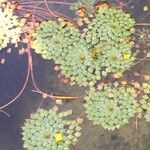
Source: leafsnapTrapa natans, commonly known as water chestnut or water caltrop, is an aquatic plant species in the Trapaceae family. Native to Europe and Asia, it has been introduced to other parts of the world as an ornamental plant. The plant is notable for its triangular, serrated floating leaves, which are attached to long stems that can grow up to 5 meters in length. The most distinctive feature of Trapa natans is its fruit, which resembles a chestnut or bull's head with two sharp horns. This fruit grows underwater on long stalks and can reach up to 5 cm in diameter. Inside, it contains a single edible seed that is rich in protein, carbohydrates, and vitamins B1 and B2. Trapa natans plays an important role in aquatic ecosystems by providing habitat for fish and other aquatic animals. It also improves water quality by absorbing excess nutrients from the water column. However, despite its ecological benefits, Trapa natans can be invasive due to its ability to rapidly spread through vegetative reproduction via runners or rhizomes. This invasive behavior has led some countries, such as Australia and New Zealand where it was introduced for ornamental purposes, to classify it as a noxious weed. Overall, Trapa natans remains an interesting species, not only for its unique appearance but also for its dual role in ecosystems—both positively as a habitat provider and negatively as an invasive species.
🎭 Treat me fairly.
Care Guide
💧 Water Every 7 days
☀️ Light Full sun
Light exposure strongly affects water chestnut growth; it thrives in locations that receive sunlight for most of the day, though it can still survive in places with midday shade. Excessive or inadequate light can lower its vigor and negatively affect its overall health.
What are the sunlight requirements for Water Chestnut plants?
Water Chestnut plants require specific conditions for optimal growth, including sunlight exposure. They thrive best in full sun, which means they need above 6 hours of sunlight daily. However, they can also grow in partial sun, receiving about 3-6 hours of sunlight. It's important to observe your garden throughout the day to choose spots that provide the perfect balance of light and shade, ensuring the well-being of your plants.
How do artificial lights support the growth of indoor Water Chestnut plants?
For indoor Water Chestnut plants, especially when natural sunlight is scarce, artificial lighting becomes crucial. This lighting should emulate natural sunlight conditions. LED lights are recommended due to their customizability to meet the specific light wavelength needs of plants. Full sun plants should receive 30-50W/sq ft of artificial light, partial sun plants need 20-30W/sq ft, and full shade plants require 10-20W/sq ft. The light source should be placed 12-36 inches above the plant, and the duration should mimic natural daylight hours, typically 8-12 hours per day for most plants.
What are the symptoms of insufficient or excessive light exposure in Water Chestnut plants?
Water Chestnut plants may display several symptoms in response to inadequate or excessive light. Insufficient light can lead to smaller leaves, leggy growth, early leaf drop, slowed or halted growth, and lighter-colored leaves indicating a lack of chlorophyll. Excessive light can cause chlorosis, sunscald, leaf curling, wilting, and leaf scorching, all of which impact the plant's health and photosynthetic capability. These symptoms highlight the importance of providing the right amount of light for healthy growth.
What solutions can be applied for Water Chestnut plants facing insufficient sunlight?
For Water Chestnut plants not receiving enough light, a stepwise approach to increasing sunlight exposure is advised. Indoors, move plants to sunnier locations gradually, aiming for at least 6 hours of direct sunlight, or use artificial light sources, such as desk lamps or plant grow lights, for 8 hours daily. Outdoors, relocate plants to sunnier spots progressively to avoid sunburn. It's also recommended to remove obstructions like branches that block sunlight, or transplant smaller plants to brighter locations. Note that parts of the plant already affected may not recover, but new growth will be healthier with improved light access.
🌡️ Temperature 10–37.8°C
Water chestnut is native to habitats with temperatures between 68 and 100.4 °F (20 and 38 ℃). It flourishes in these warm conditions. Seasonal changes may require adjustments to preserve this preferred temperature range.
What is the native temperature range for water chestnut?
Water chestnut thrives in warm conditions, with its native temperature range being between 68 to 100.4 °F (20 to 38 °C). It is important to adjust care depending on the season to maintain temperatures within this range for optimal growth.
Does water chestnut require special frost protection during winter?
Water chestnut has strong cold resistance, so special frost protection measures are not usually necessary during winter. However, if temperatures are expected to drop below -25°C, it's important to provide cold protection by covering the plant with materials such as soil or straw. Additionally, watering the plant abundantly before the first freeze in autumn to keep the soil moist is recommended to help prevent drought and water scarcity during winter and early spring.
How does water chestnut react to low temperatures?
Water chestnut is cold-tolerant, preferring temperatures above 20°C and should be kept above 0°C during winter. If temperatures fall below -25°C, there may not be noticeable changes during winter, but there could be decreased sprouting or no sprouting in spring. To address this, any parts that have failed to sprout by spring should be removed.
What are the effects of high temperature on water chestnut?
During summer, it's important to keep the water chestnut's temperature below 38°C. Exceeding 43°C can lead to the plant's leaves becoming lighter in color, prone to curling, susceptible to sunburn, and, in severe cases, the entire plant may wilt and dry up. To mitigate these issues, trim away sunburned and dried-up parts, move the plant to a shaded location or use a shade cloth to protect it from midday and afternoon sun. Additionally, watering the plant in the morning and evening helps keep the soil moist.
💨 Humidity
🪴 Soil
🌱 Fertilizer
🪴 Pot & Repot
✂️ Pruning
To control the invasive growth of water chestnuts, regular pruning is necessary from early to late spring. Remove any dead stems to encourage healthy growth and prevent them from obstructing the water's surface. This practice not only promotes ecological balance but also aligns with horticultural guidelines for optimal maintenance.
🌿 Propagating
🐛 Diseases & pets
☠️ Toxicity
Characteristics
- Plant Type
- Herb
- Life Cycle
- Perennial, Annual
- Genus
- Trapa
- Family
- Lythraceae
- Hardiness Zone
- 6-12
- Mature Height
- 3.66 m to 4.57 m
- Mature Spread
- 2.44 m to 4.88 m
- Leaf Color
- Green, Red
- Leaf Type
- Deciduous
- Flower Color
- White
- Flower Size
- 2.54 cm
- Bloom Time
- Summer, Early fall
- Planting Time
- Spring
- Harvest Time
- Late summer, Fall
- Native Area
- Sri Lanka, Turkey, Sweden, Angola, Austria, Slovakia, Namibia, Pakistan, Nigeria, Croatia, Slovenia, Guinea-Bissau, Belarus, Uganda, Tanzania, Kenya, Zimbabwe, Russia, Germany, Indonesia, Cambodia, Cameroon, Equatorial Guinea, Mozambique, Koppen, Ghana, Romania, Latvia, South Korea, Botswana, Central African Republic, France, Malawi, Tunisia, Czech Republic, Philippines, South Africa, Bulgaria, Bangladesh, Laos, Zambia, Sudan, Poland, Greece, Ukraine, Chad, China, Serbia, Lithuania, Italy, Kazakhstan, Spain, Switzerland, Vietnam, Myanmar, Bosnia and Herzegovina, Iran, Albania, Azerbaijan, Algeria, Hungary, Congo (DRC), Thailand, Gabon