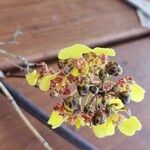
Trichocentrum cebolleta
Care Guide
💧 Water
Oncidium cebolleta thrives in environments with high humidity and consistent moisture. To keep it healthy, water the plant twice a week. As an epiphytic orchid, it requires a well-draining growing medium to prevent waterlogging. Additionally, it's important to maintain stable temperature and humidity levels indoors for optimal growth.
☀️ Light Partial sun
Oncidium cebolleta prefers environments with plenty of light that are not excessively strong. While it can endure both brighter illumination and low-light situations, it does best in a partially sunny setting similar to its native habitat. Too much or too little light can hinder optimal growth and reduce its health and vigor.
What are the sunlight requirements for Oncidium cebolleta?
Oncidium cebolleta thrives in conditions that provide enough light but not too intense, making it ideal for partial sun, about 3-6 hours of sunlight daily. However, it can also adapt to full sun with over 6 hours of sunlight. It's important to observe the movement of sunlight through your garden to find spots that offer a good balance of light and shade, ensuring the plants remain happy.
How should I light my Oncidium cebolleta indoors?
For indoor conditions, if natural sunlight is insufficient, especially during winter or in less sunny areas, artificial lights are essential for optimal growth. LED lights are recommended as they can provide specific wavelengths needed by the plants. Full sun plants require 30-50W/sq ft, partial sun plants need 20-30W/sq ft, and full shade plants need 10-20W/sq ft of artificial light. It's crucial to position the artificial light source 12-36 inches above the plant and ensure it mimics natural daylight hours, typically 8-12 hours per day for most plants.
What are the signs of improper lighting for Oncidium cebolleta?
Improper lighting can result in several symptoms in Oncidium cebolleta. Insufficient light may lead to smaller new leaves, leggy or sparse growth, faster leaf drop, slowed or halted growth, and pale or irregularly colored new leaves, indicating a lack of chlorophyll. Too much sunlight can cause chlorosis, sunscald, leaf curling, wilting, and leaf scorching. These signs indicate the plant is struggling with the current lighting conditions and requires adjustments.
What solutions can address lighting issues for Oncidium cebolleta?
To address lighting issues for Oncidium cebolleta, gradually shift the plant to sunnier spots each week until it receives the proper amount of sunlight (3-6 hours daily) for outdoor or ground plants. Use artificial lighting for large or immovable indoor plants, keeping it on for at least 8 hours daily or consider professional grow lights. To maximize sunlight for ground plants, prune any branches blocking the light or transplant smaller plants during their dormant period to a location with ample sunlight. Note that parts of the plant affected by previous poor light conditions might not recover, but new growth will be healthy with proper light exposure.
🌡️ Temperature 20–37.8°C
Oncidium cebolleta grows best in warm conditions. It favors moderately high temperatures, but not extreme heat and humidity. Sunlight helps warm the plant and stimulates flowering. However, long periods of direct sun in summer can cause sunburn, so the amount of sunlight it receives that season should be limited. The plant typically fares poorly in cold, so it needs adequate protection and warmer temperatures in winter to avoid freezing.
💨 Humidity
🪴 Soil 5-6
🌱 Fertilizer
Correct feeding is essential for the health and appearance of Oncidium cebolleta. Fertilize Oncidium cebolleta in summer, applying fertilizer once a month throughout the season. Nutrients supply the energy for growth and help maintain the plant’s tissues. Fertilization improves Oncidium cebolleta’s floral display, ensuring the best blooms.
🪴 Pot & Repot
When repotting Oncidium cebolleta, select a pot that is only slightly larger and has good drainage; a clear orchid pot is preferred. Use a well-draining, orchid-specific mix containing bark or moss. Carefully clean the roots and remove any that are dead or rotting. Repot after flowering, typically in spring or fall, water thoroughly, and place the plant in bright, indirect light. Avoid disturbing the roots once it has been repotted.
✂️ Pruning
Oncidium cebolleta features long, thin pseudobulbs and vibrant flowers. To encourage growth, prune the plant during its dormancy period, which occurs from late winter to early spring. Remove any dead leaves and spent flower spikes to improve air circulation. Keep trimming to a minimum to preserve the plant's natural shape, which will lead to healthier blooms and vigorous growth.
🌿 Propagating
🐛 Diseases & pets
☠️ Toxicity
Characteristics
- Plant Type
- Herb
- Life Cycle
- Perennial
- Genus
- Trichocentrum
- Family
- Orchidaceae
- Hardiness Zone
- 10-12
- Mature Height
- 20 cm to 30 cm
- Mature Spread
- 15 cm to 25 cm
- Leaf Color
- Dark Green
- Leaf Type
- Evergreen
- Flower Color
- Yellow, Orange
- Flower Size
- 2.03 cm to 3.05 cm
- Bloom Time
- Late spring, Summer, Early fall, Mid fall
- Planting Time
- Spring, Summer, Autumn
- Harvest Time
- Late summer, Fall, Early winter, Mid winter