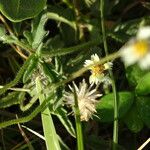
Tridax procumbens
Tridax daisy · Coat-buttons · Dagad-phul · Tridax · Mexican daisy
Description
Source: leafsnapTridax procumbens, commonly known as coat buttons or tridax daisy, is a small annual herbaceous plant from the Asteraceae family. Native to tropical America, this plant has spread worldwide due to its medicinal properties and ornamental value. The plant generally grows prostrate, reaching up to 30 cm in height. It produces small yellow flowers that bloom in clusters at the ends of its branches from summer through fall. The leaves are simple, opposite, and toothed, with three lobes. Tridax procumbens is valued for its medicinal properties, as it contains various bioactive compounds such as flavonoids, alkaloids, and tannins, which exhibit anti-inflammatory and antimicrobial effects. Additionally, the plant's attractive flowers make it a popular choice for gardens and landscaping projects. Beyond its medicinal and ornamental uses, Tridax procumbens also serves important ecological roles, such as stabilizing soil on slopes or disturbed areas prone to erosion. Overall, Tridax procumbens is a versatile plant with various applications, making it an important species in many parts of the world.
🎭 Faithful affection, Tenderness, Purity
Care Guide
💧 Water Every 3 days
Coatbuttons thrive in tropical regions with consistent moisture, preferring soil that is evenly moist but not waterlogged. To encourage lush growth, water the plant weekly. As a sun-loving outdoor plant, coatbuttons efficiently use water during the growing season, which helps promote vibrant flowering even in high temperatures.
How should I water my Coatbuttons plant?
To effectively water the Coatbuttons plant, it is recommended to use filtered water at room temperature. This is because tap water may contain harmful particles. Since the Coatbuttons plant is native to warm environments, it is advised to avoid using cold water as it can be a shock to its system. Additionally, it is best to avoid overhead watering to prevent foliage issues. Instead, gently pour the filtered room temperature water onto the soil until it is completely soaked. This helps to moisturize the roots, allowing them to spread through the soil and absorb the necessary nutrients.
What should I do if I give my Coatbuttons plant too much or too little water?
Coatbuttons can suffer from both overwatering and underwatering, but overwatering is a more common problem. When the plant gets too much water, its stems and leaves may wilt and turn yellow. Overwatering over time can cause root rot, mold, and mildew, which can kill the plant. Underwatering is less common because Coatbuttons can withstand drought. However, when underwatering happens, the leaves become brittle and brown. It's important to recognize the signs of overwatering early on. If you notice them, reduce watering immediately and check the soil's drainage. Replace the soil if it doesn't drain well. If signs indicate dehydration, water the plant more regularly until the signs subside.
How often should I water my Coatbuttons? can be rewritten as: How often should I water my Coatbuttons plant?
If your Coatbuttons plant is in a pot, the most accurate way to determine if it needs water is to stick your finger into the soil. If the top two to three inches of soil feel dry, it's time to water it. If you grow your Coatbuttons plant outside in the ground, you can use the same method to test the soil. Once again, if the first few inches of soil have dried out, it's time to water it. Usually, during spring and early fall, you'll need to water this plant about once a week using this method. However, in extremely hot weather, you may have to increase watering to about twice a week or even more. It's worth noting that mature, well-established Coatbuttons plants are quite resilient and can withstand drought conditions admirably.
How much water does my Coatbuttons need?
When watering your Coatbuttons, don't be hesitant to give it a good amount of water. Make sure the first two to three inches of soil are dry before watering. It's best to completely soak the soil, allowing excess water to flow out through the drainage holes in the pot. If you don't see water draining out, you may have not given enough water. However, be careful not to let water accumulate in the soil, as this can harm the plant. On the other hand, if water doesn't drain out, it may indicate poorly draining soil, which is not good for the plant's health. If the plant is outside, one inch of rain per week is enough.
How do I water my Coatbuttons at different times as they grow?
The water needs of the Coatbuttons can vary depending on its growth stages. In the early years or after transplanting, it requires more water to support the development of new roots. These roots need extra moisture to ensure optimal growth. As the plant matures, it will require less water. Additionally, during the bloom period, the Coatbuttons may need more water due to increased moisture demands for flower development.
☀️ Light Full sun
Coatbuttons prefers abundant light, which supports its vigorous growth. Its hardiness does not depend on any specific light conditions. Consequently, balanced light exposure is important to prevent harmful effects such as reduced vigor or suppressed flowering caused by too much or too little light.
What are the sunlight requirements for Coatbuttons?
Coatbuttons, known botanically as Tridax procumbens, thrives under full sun, necessitating above 6 hours of sunlight daily for optimal growth. It’s recommended to observe the movement of sunlight through your garden to find spots that offer a good balance of light and shade, ensuring the plants remain happy and healthy.
How essential is light for the growth of Coatbuttons?
Light exposure is crucial for the prosperous growth of Coatbuttons, as the plant has an affinity for abundant light. Its resilience does not depend on specific light conditions, but balanced exposure is necessary to avoid issues such as reduced vitality or inhibited blooming due to either overexposure or underexposure. When natural sunlight is insufficient, especially during winter or in less sunny spaces, artificial lighting can be a significant aid in promoting faster and healthier growth.
How can artificial lighting be used for Coatbuttons?
For Coatbuttons grown indoors where natural sunlight might be lacking, artificial lighting serves as an excellent alternative. LED lights are recommended due to their ability to provide specific wavelengths needed for plant growth. Full sun plants require 30-50W/sq ft, partial sun plants need 20-30W/sq ft, and full shade plants 10-20W/sq ft of light. The light source should be placed 12-36 inches above the plant to mimic natural sunlight, and most plants will need 8-12 hours of light per day.
What are the symptoms of inadequate lighting for Coatbuttons?
Symptoms of light deficiency in Coatbuttons include smaller new leaves compared to older ones, leggy or sparse growth, faster leaf drop, slower or no new growth, lighter-colored new leaves, chlorosis or yellowing of leaves, sunscald, leaf curling, wilting, and leaf scorching. These symptoms indicate the plant's struggle in inadequate light conditions.
What solutions are available for light-related issues in Coatbuttons?
To address insufficient sunlight, gradually move Coatbuttons to sunnier locations until they receive at least 6 hours of direct sunlight daily. For indoor plants, consider using artificial light if relocating the plant is not feasible. Outdoor plants should be moved gradually to avoid sunburn. Minimizing obstructions like pruning trees can help improve sunlight exposure. If necessary, transplant smaller plants during their dormant period to a location with better sunlight and drainage. Although parts of the plant that suffered from insufficient light might not recover, new growth should be healthy with increased light exposure.
🌡️ Temperature 15–41.1°C
Coatbuttons is native to habitats where temperatures usually range from 59 to 106°F (15 to 41 ℃). It favors warmer climates and can tolerate seasonal changes. In colder periods, supplying warmer conditions is advised for its healthy growth.
What is the native climate for Coatbuttons?
Coatbuttons is native to environments that typically range from 59 to 106°F (15 to 41 °C). It thrives in warmer climates and can adjust to seasonal fluctuations. This plant is extremely heat-loving, so colder temperatures can be harmful. To ensure healthy growth, it's advised to maintain a warmer condition during the colder seasons.
How should Coatbuttons be cared for in autumn and winter?
In the autumn, it is recommended to bring outdoor-grown Coatbuttons indoors to protect it from the cold. The plant should be placed near a bright window but kept at a distance from heaters to avoid excessive dryness. During winter, maintaining temperatures above 15°C is beneficial for the plant’s growth. It's important to ensure that the temperature does not approach -5°C or lower as such conditions are detrimental to the plant.
What are the symptoms of low temperature exposure in Coatbuttons?
Coatbuttons prefers warm temperatures and is not tolerant of low temperatures. It thrives best when the temperature is above 15°C. During winter, it should be kept above -5°C to prevent damage. Exposure to temperatures below -10°C may cause the leaves to lighten in color, and after frost damage, the color can gradually turn brown or black. Symptoms such as wilting and drooping may also occur.
How can damage from low temperatures be addressed?
To manage frost damage, the frost-damaged parts should be trimmed off and the plant should be moved indoors to a warm environment for protection. Placing the plant near a south-facing window ensures ample sunlight. Additionally, it's important to avoid placing the plant near heaters or air conditioning vents to prevent excessive dryness.
What are the symptoms of high temperature exposure in Coatbuttons?
During summer, the temperature for Coatbuttons should be kept below 41°C. Exposure to temperatures exceeding 45°C can make the plant's leaves lighter in color and increase susceptibility to sunburn.
💨 Humidity
🪴 Soil 5-7
🌱 Fertilizer
Proper fertilization is vital for Coatbuttons' health and appearance. Fertilize Coatbuttons in the summer, repeating every month throughout the season. Nutrients fuel growth and help maintain the plant's structures. Fertilization improves Coatbuttons' flower display, ensuring the best blooms.
🪴 Pot & Repot
✂️ Pruning
🌿 Propagating
🐛 Diseases & pets
☠️ Toxicity
Characteristics
- Plant Type
- Herb
- Life Cycle
- Perennial
- Genus
- Tridax
- Family
- Asteraceae
- Hardiness Zone
- 8-13
- Mature Height
- 40 cm
- Mature Spread
- 49 cm
- Leaf Color
- Green
- Leaf Type
- Semi-evergreen
- Flower Color
- Yellow, White
- Flower Size
- 1.02 cm to 1.52 cm
- Bloom Time
- All year round
- Planting Time
- Spring, Autumn
- Harvest Time
- All year round
- Native Area
- Belize, Honduras, Mexico, Guatemala, Peru, Panama, Jamaica, Colombia, Bahamas, Cuba, Bolivia, Venezuela, Guyana, El Salvador, Nicaragua, Ecuador, Costa Rica