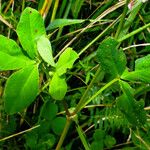
Trifolium hybridum
شبدر · Alsike clover · Swedish clover · Hybrid clover · Alsike
Description
Source: leafsnapTrifolium hybridum, commonly known as alsike clover, is a perennial plant belonging to the legume family. Native to Europe and Asia, it has been introduced and naturalized in many parts of the world. The plant can grow up to 60 cm tall and features trifoliate leaves with serrated edges. Its flowers, which are pink or white, are arranged in dense clusters at the ends of long stems. Alsike clover is commonly used as a forage crop for livestock due to its high protein content, palatability, and ability to fix nitrogen from the atmosphere into the soil. Additionally, it has traditional medicinal uses for treating various ailments such as coughs, colds, fevers, and digestive disorders. However, alsike clover can be toxic to livestock if consumed in large quantities because it contains cyanogenic glycosides, which can lead to a condition known as "alsike clover poisoning." Therefore, it should be managed carefully when used as a feed crop. Overall, Trifolium hybridum, or alsike clover, is an important plant species with various uses, but it requires proper management when utilized for animal feed purposes.
🌳 Often called fodder, alsike clover also functions as a bioindicator, quietly indicating the soil concentrations of heavy metals like copper and zinc. Its particular sensitivity to these elements makes it a valuable tool in environmental monitoring, allowing scientists to detect contaminated areas early.
🎭 A four-leaf clover brings great luck, and people say that wearing one in your hat will let you see fairies.
Care Guide
💧 Water Every 3 days
Alsike clover flourishes in moderate climates with consistent moisture. It requires weekly watering but should not be overwatered to prevent waterlogging. The plant is resilient to short periods of dryness and benefits from natural rainfall during its growing season, which encourages lush growth.
How should I water my Alsike clover?
To properly water the Alsike clover, it is recommended to use filtered water at room temperature. This is because tap water may contain harmful particles for the plant's health. It is important to use water at room temperature or slightly warmer since the Alsike clover is adapted to warm environments and cold water can be a shock to its system. To prevent foliage complications, avoid overhead watering and instead, apply the filtered room temperature water directly to the soil until it is thoroughly soaked. This method benefits the plant by moistening the roots and aiding their spread through the soil to gather essential nutrients.
What do I do if I give my Alsike clover too much water or too little water?
Overwatering is a more common problem for Alsike clover and can cause wilting, yellowing, and diseases like root rot, mold, and mildew. Underwatering is less common, but can make the leaves brittle and brown. To prevent damage from overwatering, it's important to recognize early signs and reduce watering. If the soil drains poorly, replace it with a well-draining mix. If underwatering occurs, simply water more regularly until the plant improves.
How frequently do I need to water my Alsike clover?
If your Alsike clover plant is in a pot, the most accurate way to determine if it needs water is by sticking your finger into the soil. If the first two to three inches of soil are dry, it's time to water it. The same method can be used if you grow your Alsike clover outdoors in the ground. Once again, if you find that the top few inches of soil are dry, it's time to water it. Typically, during spring and early fall, watering once a week is sufficient. However, during extremely hot weather, you may need to water twice a week or more. Nevertheless, mature and well-established Alsike clover has a remarkable ability to tolerate drought.
How much water does my Alsike clover require?
To properly water your Alsike clover, make sure the first two to three inches of soil are dry. Give it a good, thorough watering, making sure to soak the entire soil. The water should be enough to cause excess water to drain from the pot's drainage holes. If you don't see any excess water draining, you may have underwatered the plant. Be careful not to let water accumulate in the soil, as this can harm the plant. Additionally, if the water doesn't drain well through the pot, it could indicate poorly draining soil, which is bad for the plant's health. In outdoor settings, one inch of rain per week is enough for the plant.
How do I water my Alsike clover at different stages of growth?
The water requirements of Alsike clover can vary depending on its growth stages. In the first few years of its life or after being transplanted, it will require more water. During this time, the plant focuses on developing new roots to support future growth, and these roots benefit from slightly higher moisture levels. However, as the clover matures over a few seasons, it will require less water. Additionally, during the bloom period, when the plant is producing flowers, it may need extra water as flower development requires significant moisture.
☀️ Light Full sun
Der Alsike clover benötigt täglich eine erhebliche Menge ungehinderter Sonneneinstrahlung, um zu gedeihen. Sein ursprünglicher Lebensraum zeigt Merkmale, die seine Lichtbedürfnisse offenbaren. Zu viel oder zu wenig Besonnung stört seine Entwicklung und führt zu insgesamt schlechter Gesundheit. Jede Wachstumsphase ist an ausgedehnte sonnige Perioden angepasst, daher bremst unzureichende Sonneneinstrahlung das Wachstum.
What are the sunlight requirements for Alsike clover?
Alsike clover requires a significant amount of daily unobstructed solar exposure to thrive. It flourishes in full sun, needing more than 6 hours of sunlight, but can also adapt to partial sun, with about 3-6 hours of sunlight. The plant's original habitat reveals its significant solar needs, and both over or underexposure can detrimentally affect its growth. Each of its growth phases demands considerable sunny periods, and inadequate solar exposure can retard growth. Observing how sunlight moves through your garden and choosing spots that offer an optimal balance of light and shade is crucial for ensuring the plant's well-being.
What artificial lighting requirements do Alsike clover have?
When natural sunlight is insufficient, especially during winter or in less sunny spaces, artificial light offers a vital solution. Indoor Alsike clover plants require adequate artificial lighting for optimal growth, which can promote faster, healthier growth compared to natural light conditions. LED lights are a popular choice because they can be customized to provide specific wavelengths needed by plants. Full sun plants need 30-50W per square foot of artificial light, partial sun plants require 20-30W per square foot, and full shade plants need 10-20W per square foot. The artificial light source should be placed 12-36 inches above the plant to mimic natural sunlight, and most plants need 8-12 hours of light per day.
What are the symptoms of light deficiency in Alsike clover?
Symptoms of light deficiency in Alsike clover include smaller new leaves compared to the ones that have matured, leggy or sparse growth, faster leaf drop, slower or no new growth, paler new leaves indicating a lack of chlorophyll, chlorosis, sunscald, leaf curling, wilting, and leaf scorching. These symptoms indicate either insufficient or excessive sunlight exposure. Insufficient sunlight leads to reduced growth and paleness in new leaves, while excessive sunlight can cause damages like chlorosis, sunscald, leaf curling, wilting, and leaf scorching.
What are the solutions for Alsike clover experiencing light-related issues?
For Alsike clover experiencing light-related issues, ensure optimal growth by gradually moving plants to a location where they get at least 6 hours of direct sunlight a day. Use south-facing windows for maximum natural light, and keep curtains open. If natural sunlight is insufficient or the plant is not easily movable, consider artificial lighting. For outdoor plants, avoid sudden changes in light intensity to prevent sunburn, and for ground planted Alsike clover, reduce sunlight obstructions by pruning or relocating the plant to a sunnier spot. Remember, parts of the plant affected by insufficient sunlight may not recover, but new growth should be healthy with improved light exposure.
🌡️ Temperature 0–35°C
Alsike-Klee gedeiht in seinem natürlichen Lebensraum bei Temperaturen von 68 bis 95 °F (20 bis 35 ℃). In unterschiedlichen Jahreszeiten können Temperaturanpassungen erforderlich sein, um dieses bevorzugte Klima zu simulieren.
What is the ideal temperature range for Alsike clover?
Alsike clover thrives best in its native environment where the ideal temperatures range between 68 and 95 °F (20 to 35 °C). To ensure the plant thrives, it might be necessary to adjust temperatures seasonally to simulate its preferred climate conditions.
Does Alsike clover need frost protection during winter?
Alsike clover has a strong resistance to cold, so special frost protection measures are usually not required during winter. However, if temperatures are expected to drop below -40°C, it becomes important to protect the plant. This can be done by covering it with soil or straw. Watering the plant abundantly before the first freeze of autumn to ensure the soil remains moist and subsequently freezes, helps the plant against drought and water scarcity during the winter and early spring.
How does Alsike clover handle low temperatures?
Alsike clover is quite cold-tolerant, thriving best when the temperature remains above 20°C and should be kept above 0°C during winter. If temperatures fall below -40°C, while there might not be visible changes during winter, the decrease in sprouting or a complete lack of sprouting might be observed during spring. To alleviate this, any non-sprouting parts should be removed in spring.
What should be done if Alsike clover experiences high temperatures?
During the summer, it's essential to ensure that the temperature around Alsike clover stays below 35°C. When temperatures exceed 41°C, you might notice the leaves becoming lighter in color, curling, becoming prone to sunburn, and in severe cases, the entire plant might wilt and dry up. To manage this, trim away the damaged parts, move the plant to a shade from midday and afternoon sun, or use a shade cloth. Additionally, water the plant in the morning and evening to keep the soil moist.
What is the botanical name of Alsike clover?
The botanical name of Alsike clover is Trifolium hybridum.
💨 Humidity
🪴 Soil 6-7
🌱 Fertilizer
The best time to fertilize an Alsike clover is in early spring, as it comes out of dormancy and starts active growth. Fertilization supplies essential nutrients for healthy development. While Alsike clover has relatively low fertilizer needs, yearly fertilization can improve its survival and produce better, longer-lasting flowers.
🪴 Pot & Repot
✂️ Pruning
Pruning alsike clover from early to late spring boosts its growth significantly. By removing damaged stems and thinning out overcrowded areas, you improve airflow, which reduces the risk of disease. Regular pruning not only encourages denser foliage and more abundant flowering but also helps maintain the health and visual appeal of the alsike clover.
🌿 Propagating
🐛 Diseases & pets
☠️ Toxicity
Characteristics
- Plant Type
- Herb
- Life Cycle
- Perennial, Annual
- Genus
- Trifolium
- Family
- Fabaceae
- Hardiness Zone
- 2-10
- Mature Height
- 20 cm to 49 cm
- Mature Spread
- 20 cm to 40 cm
- Leaf Color
- Green
- Leaf Type
- Semi-evergreen
- Flower Color
- White, Pink
- Flower Size
- 2.54 cm
- Bloom Time
- Late spring, Early summer, Mid summer
- Planting Time
- Spring, Summer
- Harvest Time
- Mid summer
- Native Area
- Turkey, Austria, Slovakia, Montenegro, Croatia, Slovenia, Morocco, Belarus, Russia, Iraq, Estonia, Romania, Latvia, Moldova, France, Tajikistan, Czech Republic, Bulgaria, Armenia, Greece, Ukraine, Serbia, Lithuania, Italy, Kazakhstan, Spain, Switzerland, Iran, Albania, Azerbaijan, Algeria, Hungary