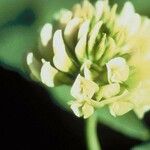
Trifolium stoloniferum
Running buffalo clover
Description
Source: leafsnapTrifolium stoloniferum, known commonly as running buffalo clover, is a perennial plant species belonging to the Fabaceae family. Native to North America, it is found predominantly in the eastern and central regions of the United States. The plant grows prostrately, sending out runners that can extend up to 3 feet in length. Its leaves are trifoliate, each composed of oval-shaped leaflets that are green on top and slightly hairy underneath. The pinkish-purple flowers bloom from May to August, attracting bees and other pollinators. Running buffalo clover prefers moist soils in open woodlands or prairies but can also tolerate drier conditions. It serves as an important forage plant for livestock due to its high protein content. However, the species has become rare because of habitat loss from agriculture and urbanization. The plant was once thought to be extinct until it was rediscovered by botanist E.J. Palmer in 1983 at the Fort Campbell Military Reservation near Clarksville, Tennessee. Since then, various organizations, such as the US Fish & Wildlife Service, have initiated conservation efforts to protect this endangered species through habitat restoration programs. Ecologically, Trifolium stoloniferum plays an important role as a food source for wildlife. Additionally, it holds cultural significance among Native American tribes, who used it medicinally for ailments such as coughs and sore throats due to its high mucilage content, which soothes irritated tissues when ingested or applied topically to skin wounds or burns.
Care Guide
💧 Water Every 7 days
☀️ Light Partial sun
Running buffalo clover naturally occurs in habitats such as forest understories or rocky areas, where it is found in shaded conditions. It favors partial sun but can also grow in full sun or full shade, demonstrating its hardy and adaptable nature.
How much sunlight does Running buffalo clover require?
Running buffalo clover (Trifolium stoloniferum) thrives in conditions of both full and partial sunlight. For full sun exposure, it requires more than 6 hours of sunlight daily, whereas for partial sun, it needs about 3-6 hours of sunlight. It's important to observe the pattern of sunlight moving through your garden to identify spots that offer an ideal mix of light and shade, ensuring the plants' optimal growth and happiness.
What are some tips for identifying the ideal location for Running buffalo clover in the garden?
To find the ideal location for Running buffalo clover in your garden, closely watch how sunlight moves through the area over the day. This will help you understand which spots receive full sun, meaning more than 6 hours of direct sunlight, and which areas are characterized by partial sun, with about 3-6 hours of sunlight. Choosing the right spot that provides a good balance of light and shade is crucial in ensuring the health and happiness of your Running buffalo clover.
🌡️ Temperature 5–32.2°C
Running buffalo clover can adapt to a broad range of temperatures, but its range may still be constrained by different combinations of moisture and heat. It does best in warm summer climates with sufficient rainfall or irrigation. Extended periods of cloudy, rainy weather, as well as prolonged high temperatures, can increase the plant's risk of death. In winter, giving proper protection from cold can improve its chances of survival.
What is the botanical name of the Running Buffalo Clover?
The botanical name of the Running Buffalo Clover is Trifolium stoloniferum.
💨 Humidity
🪴 Soil 6-7
🌱 Fertilizer
The best time to fertilize Running buffalo clover is in early spring, as it comes out of dormancy and begins active growth. Fertilization supplies key nutrients for healthy growth. Although Running buffalo clover has relatively low fertilization needs, yearly fertilization can enhance its survival and promote better, longer-lasting flowers.
🪴 Pot & Repot
✂️ Pruning
Running buffalo clover is a hardy, low-growing plant that resembles regular clover. The best time to prune its runners and thin it out for healthy growth is in early spring. Regular maintenance not only enhances air circulation and reduces the risk of disease but also keeps the plant looking neat. Be sure to use clean, sharp tools for effective pruning.
🌿 Propagating
🐛 Diseases & pets
☠️ Toxicity
Characteristics
- Plant Type
- Herb
- Life Cycle
- Perennial
- Genus
- Trifolium
- Family
- Fabaceae
- Hardiness Zone
- 5-8
- Mature Height
- 20 cm to 40 cm
- Mature Spread
- 30 cm to 61 cm
- Leaf Color
- Green, Dark Green
- Leaf Type
- Deciduous
- Flower Color
- White, Pink
- Flower Size
- 1.02 cm to 2.03 cm
- Bloom Time
- Late spring, Early summer, Mid summer
- Planting Time
- Spring, Summer, Autumn
- Harvest Time
- Mid summer, Late summer, Early fall