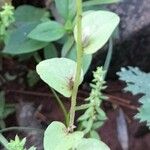
Triodanis perfoliata
Clasping Venus' looking-glass · Clasping Venus's-looking-glass · Venus' looking-glass · Clasping-Leaf Venus'-Looking-Glass · Claspingleaf Venus'-looking-glass
Description
Source: leafsnapTriodanis perfoliata, commonly known as Venus's Looking Glass, is an herbaceous annual plant in the Campanulaceae family. Native to North America, it thrives in various habitats, including fields, meadows, and open woods. The plant can grow up to 60 cm tall and features a branching stem with opposite leaves that are perfoliate, meaning the stem appears to pass through the leaf. The small flowers, about 1 cm in diameter, have five blue-purple petals fused at their base to form a bell-shaped corolla. These blooms appear from May through September and attract bees for pollination. The fruit is a capsule containing numerous small seeds that are dispersed by wind or water. Triodanis perfoliata has been traditionally used by Native Americans for its medicinal properties to treat a range of ailments, including coughs, colds, fever, and sore throat, due to its anti-inflammatory effects. Additionally, it is used as an ornamental plant in gardens for its attractive flowers but can become invasive if not properly controlled.
🌳 Clasping Venus's looking glass has an ecological role beyond its appearance; it functions as an indicator species for serpentine soils. These soils are marked by high concentrations of heavy metals like nickel and chromium and a distinct mineral composition that many plant species find inhospitable. Yet clasping Venus's looking glass prospers in these conditions, highlighting the specialized nature of its habitat preferences and its potential for studies in phytoremediation and mining site reclamation.
🎭 Insincere praise
Care Guide
💧 Water Every 7 days
Clasping Venus's looking glass thrives in the moderate moisture levels found in temperate regions. It benefits from consistent watering and good drainage. Ideally, you should water it weekly. It is often grown outdoors to take advantage of natural rainfall, which helps maintain the right moisture balance for optimal growth.
How should I water my Clasping Venus's looking glass plant?
There are various ways to water Clasping Venus's looking glass, such as using a garden hose with a spray nozzle or a watering can. This plant is not too particular about the type of water it receives, as it can survive on rainwater, tap water, or filtered water. It is best to avoid watering this plant from above as it can harm the leaves and flowers and potentially cause disease. A drip irrigation system is often recommended for watering this plant, as it ensures even and direct watering to the soil. When it comes to watering a Clasping Venus's looking glass in a container, you can use a cup, watering can, or tap to directly water the soil.
What should I do if I give too much water or not enough water to my Clasping Venus's looking glass plant?
To remedy underwatering for Clasping Venus's looking glass, simply water it more regularly when you notice it lacking moisture. Overwatering can have more severe consequences, such as disease and death of the plant. To prevent this, choose a sunny location with good drainage to help dry the soil and prevent waterlogging. If your potted plant is overwatered, consider changing to a new pot with better soil drainage and sufficient drainage holes. When repotting, use loose soil and an efficiently draining pot.
How often do I need to water my Clasping Venus's looking glass plant?
To keep your Clasping Venus's looking glass healthy, make sure to water it regularly during the growing season. Start by watering once a week in spring, and as it gets hotter, you may need to increase that to two or three times a week. However, be careful not to overwater as it can harm the plant. It's important to keep the soil moist but not soaking wet. If your Clasping Venus's looking glass is in a pot, you'll need to water it more frequently compared to if it was planted in the ground. The soil in pots tends to heat up and dry out faster, so watering a few times per week is usually necessary.
How much water does my Clasping Venus's looking glass plant need?
There are a few ways to decide how much water to give your Clasping Venus's looking glass plant. One method is to feel the soil and water until the top six inches are moist. Another option is to use a standard measurement, such as two gallons per week, depending on the temperature and how quickly the soil dries out. However, be careful not to overwater if your plant needs less than two gallons. Growing the plant in a container requires a different approach. In this case, water enough to moisten all the dry layers of soil. You can check by sticking your finger in the soil or until you see water draining from the pot.
How can I know if I'm giving enough water to my Clasping Venus's looking glass?
Avoiding overwatering your Clasping Venus's looking glass can be challenging. These plants have deep roots that need weekly watering, but they are also prone to root rot and browning if overwatered. Underwatering is less of a concern as these plants can survive without additional watering, but if you go too long without watering, they may wilt and develop dry leaves.
☀️ Light Partial sun
Clasping Venus's looking glass is a flexible plant that grows best in moderate sunlight but can adjust to higher or lower light levels. Too much sun can bleach its leaves, while too little light may disturb its healthy growth. This tolerance for a range of light conditions reflects the adaptable characteristics of its original habitat.
What are the sunlight requirements for Clasping Venus's looking glass?
Clasping Venus's looking glass thrives in a range of sunlight conditions, from partial sun, requiring about 3-6 hours of sunlight, to full sun or full shade, which means the plant needs more than 6 hours of sunlight. It's important to observe how sunlight moves through your garden to ensure you pick the perfect spot that offers the right balance of light and shade, contributing to the plant's health and happiness.
How does Clasping Venus's looking glass adapt to different light conditions?
Clasping Venus's looking glass is an adaptable plant that flourishes best in moderate sunlight but is versatile enough to adjust to both lower and higher light intensities. In conditions of excessive sunlight, the plant's leaves may show signs of bleaching, whereas insufficient light could affect its normal growth process. This adaptability is a characteristic derived from its native habitat, making it a resilient choice for various growing conditions.
Can artificial lighting be used for Clasping Venus's looking glass, and how?
Yes, artificial lighting can be an effective supplement for Clasping Venus's looking glass, especially when natural light is not sufficient, such as in winter or less sunny spaces. Optimal growth can be achieved by using LED lights, which are customizable to provide specific wavelengths of light that the plant needs. The amount of light required varies with the type of plant: full sun plants need 30-50W/sq ft, partial sun plants 20-30W/sq ft, and full shade plants 10-20W/sq ft. Position the light source about 12-36 inches above the plant and ensure it receives 8-12 hours of light daily to mimic natural sunlight conditions.
What symptoms indicate Clasping Venus's looking glass is receiving inadequate light?
When Clasping Venus's looking glass does not receive enough light, several symptoms can emerge, including smaller new leaves, leggy or sparse growth, faster leaf drop, slower or ceased new growth, and lighter-colored or chlorotic new leaves. Excessive sunlight exposure may cause sunscald, leaf curling, wilting, and leaf scorching. Recognizing these signs early can help you adjust the plant's light conditions to prevent further stress.
How can you address light-related issues for Clasping Venus's looking glass both indoors and outdoors?
To address light-related issues for Clasping Venus's looking glass, gradual adaptation to changing light conditions is key. For indoor plants, progressively relocate them to sunnier spots each week until reaching 3-6 hours of sunlight daily or use artificial lighting, like desk lamps or professional grow lights, for at least 8 hours a day. Outdoors, acclimate the plants by shifting them to brighter locations weekly to avoid sunburn. Reduced sunlight obstruction through pruning or relocating plants can also benefit growth. Note, while adjusting light exposure can encourage healthy new growth, parts of the plant already damaged by light stress may not recover.
🌡️ Temperature 0–37.8°C
Clasping Venus's looking glass is a plant species native to temperate environments. It thrives at temperatures between 68 and 100 °F (20 to 38 °C). Adjust conditions to match the ambient seasonal temperatures. Excessive cold may impede growth.
What is Clasping Venus's looking glass?
Clasping Venus's looking glass, botanically known as Triodanis perfoliata, is a plant species native to temperate environments. It is well adapted to thrive in temperatures ranging from 68 to 100 °F (20 to 38 °C). This plant exhibits strong cold resistance, indicating that it generally does not require special frost protection measures during winter. For optimal growth, it's important to adjust environmental conditions based on the ambient seasonal temperatures.
How do you protect Clasping Venus's looking glass in extreme cold?
Although Clasping Venus's looking glass possesses strong cold resistance, it is crucial to provide extra protection if winter temperatures are expected to plummet below -40°C. This protection can be effectively provided by covering the plant with insulating materials such as soil or straw. Moreover, abundantly watering the plant before the first freeze in autumn to ensure the soil remains moist into the winter can aid in preventing drought and water scarcity during the colder months.
What are the symptoms of improper temperature conditions for Clasping Venus's looking glass?
In conditions of low temperature, specifically below -40°C, Clasping Venus's looking glass may show no visible signs of distress during winter but might exhibit decreased sprouting or failure to sprout in the spring. In contrast, high temperatures above 38°C, especially exceeding 43°C, can cause the leaves to lighten in color, become prone to curling and sunburn, and in severe cases, lead to the wilting and drying of the plant.
How do you deal with temperature-related issues in Clasping Venus's looking glass?
For issues related to low temperatures resulting in poor or no sprouting, removing the affected parts in spring is advisable. If the plant has experienced high temperatures causing sunburn or drying, it's beneficial to trim away the sunburned and dried parts. Additionally, providing shade during the midday and afternoon sun, either by moving the plant to a shaded area or using a shade cloth, and ensuring the soil is kept moist with morning and evening watering can help mitigate the damage.
💨 Humidity
🪴 Soil 6-7
🌱 Fertilizer
Clasping Venus's looking glass does well with regular, dilute fertilizer applications to encourage healthy leaf development. Fertilize Clasping Venus's looking glass about once a month during the summer. Nitrogen is essential for foliage, and supplying nitrogen-rich sources helps Clasping Venus's looking glass thrive.
🪴 Pot & Repot
✂️ Pruning
The Clasping Venus's Looking Glass is a plant with distinctive purple, bell-shaped flowers and clasping leaves. For optimal growth and appearance, prune it from early to late spring. This involves deadheading spent blooms and thinning out overcrowded stems to maintain its health and shape. Always use clean tools to ensure precise cuts, and avoid heavy pruning during its peak blooming period to preserve its display. Be sure to consult local guidelines for any specific variations in care.
🌿 Propagating
🐛 Diseases & pets
☠️ Toxicity
Characteristics
- Plant Type
- Herb
- Life Cycle
- Annual, Biennial, Perennial
- Genus
- Triodanis
- Family
- Campanulaceae
- Hardiness Zone
- 2-11
- Mature Height
- 15 cm to 46 cm
- Mature Spread
- 13 cm to 15 cm
- Leaf Color
- Green, Purple, Lavender
- Leaf Type
- Deciduous
- Flower Color
- Purple, Lavender
- Flower Size
- 1.27 cm
- Bloom Time
- Late spring, Early summer, Mid summer
- Planting Time
- Summer
- Harvest Time
- Early summer, Mid summer