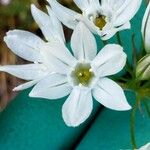
Triteleia hyacinthina
Fool's-onion · White brodiaea · Wild hyacinth · Hyacinth brodiaea · White triteleia
Description
Source: leafsnapTriteleia hyacinthina is a species of flowering plant known by the common names white brodiaea, white tripletlily, hyacinth brodiaea, and fool's onion. It is native to western North America from British Columbia to Idaho to central California. Its habitat includes grassland and vernally moist areas such as meadows and vernal pools. It is a perennial herb growing from a corm. It produces two or three basal leaves up to 40 centimeters (16 in) long by 2 centimeters (0.79 in) wide. The inflorescence arises on an erect stem up to 60 centimeters (24 in) tall and bears an umbel-like cluster of many flowers. Each flower is a funnel-shaped bloom borne on a pedicel up to 5 centimeters (2.0 in) long. The flower is white, often tinged purple along the tubular throat, with six green-veined tepals. There are six stamens with white, yellow, or occasionally blue anthers. The bulb is edible but does not smell like an onion.
Care Guide
💧 Water
Fool's onion flourishes in well-drained soils with consistent moisture. It prefers moderate hydration and can tolerate brief dry spells, but it should be watered weekly. As an outdoor plant in grasslands, it benefits from seasonal rainfall, which supports its bulbous growth during the active growing season.
How should I water my Fool's onion plant?
To properly water the Fool's onion, it is important to follow a few guidelines. Firstly, use filtered water that is at room temperature. This is because tap water may contain harmful particles for the plant's health. Secondly, make sure the water is not cold as the Fool's onion is accustomed to warm environments, and cold water can be a shock to its system. Additionally, avoid watering from above as this can lead to problems with the foliage. Instead, gently and thoroughly saturate the soil with the filtered room temperature water. This is beneficial as it helps moisten the roots and allows them to spread and gather the necessary nutrients from the soil.
What should I do if I give my Fool's onion too much or too little water?
Overwatering is a more common issue for Fool's onions and can cause wilting, yellowing leaves, and diseases like root rot, mold, and mildew. Underwatering is less common, but it can result in brittle, brown leaves. It's important to recognize the signs of overwatering early on to prevent irreversible damage. Reduce watering immediately if you notice these signs and consider using well-draining soil. If your Fool's onion is underwatered, simply water more regularly until the signs of drought stress disappear.
How frequently should I water my Fool's onion?
If your Fool's onion plant is in a pot, you can check if it needs water by sticking your finger into the soil. If the top two to three inches of soil feel dry, it's time to water it. If you have the Fool's onion plant growing outdoors in the ground, you can use the same method to test the soil. When you feel the top few inches of soil dry, it's time to water it. Generally, during spring and early fall, you'll need to water this plant about once a week. However, during extremely hot weather, you may need to water it twice or more per week. It's worth mentioning that mature, well-established Fool's onion plants can handle drought quite well.
How much water does my Fool's onion plant need?
To water your Fool's onion effectively, don't hold back on the amount of water you give. Wait until the top two to three inches of soil are dry, then water the plant thoroughly. Make sure to water enough so that the soil is completely soaked and excess water runs out of the drainage holes at the bottom of the pot. If you don't see excess water draining, you might have under-watered the plant. However, be cautious not to let water accumulate in the soil, as this can harm the plant. If water doesn't drain properly through the pot, it may indicate poorly draining soil, which is bad for the plant's health. If the plant is outdoors, 1 inch of rain per week should be enough.
How do I water my Fool's onion at different stages of growth?
The water requirements of the Fool's onion can vary depending on its growth stages. In the first few years of its life, or when newly transplanted, it needs more water than usual. This is because the plant focuses on developing new roots to support future growth, and these roots perform best with slightly more moisture. As the Fool's onion matures, it requires less water. Another stage that may require additional watering is during the bloom period, as flower development utilizes a significant amount of moisture.
☀️ Light Full sun
Fool's onion performs best in conditions that are continuously and abundantly exposed to sunlight. Its native growing environment is noted for ample sun exposure. Yet, a lack or surplus of sunlight does not markedly affect it. Its various growth stages do not have particular sunlight requirements.
What are the sunlight requirements for Fool's onion?
Fool's onion requires full sun conditions, which means it needs above 6 hours of sunlight daily to thrive best. Ideally, the plant should be situated in a location that ensures a balanced exposure to light and shade, as suggested by observing how sunlight moves through your garden. This plant originates from habitats that are generously bathed in sunlight, indicating its preference for abundant light exposure. However, it exhibits a remarkable tolerance to variations in light intensity, showing resilience in both insufficient and excessive sunlight conditions, without specific requirements for different growth stages.
How does artificial lighting benefit indoor Fool's onion plants?
For indoor Fool's onion plants, artificial lighting serves as a crucial alternative when natural sunlight is lacking, especially during winter or in less sunny indoor spaces. Proper artificial lighting can promote faster and healthier growth, mimicking natural sunlight conditions. LED lights are recommended for their capacity to provide specific wavelengths needed for optimal plant growth. Full sun plants require 30-50W/sq ft of artificial light, partial sun plants 20-30W/sq ft, and full shade plants 10-20W/sq ft. The light source should be placed 12-36 inches above the plant to best emulate natural sunlight. It's also vital to adjust the duration of light exposure to mimic natural daylight hours, with most plants benefiting from 8-12 hours of light per day.
What are common symptoms of light deficiency in Fool's onion?
Symptoms of light deficiency in Fool's onion include smaller new leaves, leggy or sparse growth, premature leaf drop, slowed or halted new growth, lighter-colored new leaves, and general weak appearance. These signs indicate the plant's struggle under inadequate lighting conditions, where it might enter a survival mode, conserving resources and reducing growth activities. Additionally, excessive sunlight exposure can lead to chlorosis, sunscald, leaf curling, wilting, and leaf scorching, reflecting the plant's distress and the breakdown of essential functions such as photosynthesis.
How can you address lighting issues for Fool's onion?
To optimize growth for Fool's onion, gradually acclimate the plant to receive at least 6 hours of direct sunlight daily, especially if moving outdoor plants to sunnier spots or addressing indoor lighting conditions. Utilize south-facing windows to ensure maximum sunlight exposure for indoor plants and consider supplementing with artificial light sources like desk, ceiling lamps, or professional grow lights for at least 8 hours a day. Outdoor and ground-planted Fool's onions should be gradually introduced to sunnier locations to avoid sunburn. Pruning surrounding obstructions or transplanting to areas with better sunlight and drainage can significantly benefit the plant's health and growth. Note that parts of the plant affected by insufficient sunlight may not recover, but new growth following improved light exposure will be healthy.
🌡️ Temperature 5–32.2°C
Fool's onion is native to habitats where temperatures range from 41 to 89.6 °F (5 to 32 ℃). It typically prefers milder conditions. In non-native locations, seasonal adjustments may be needed to align with these preferences.
What is the indigenous environment suitable for Fool's Onion?
Fool's Onion, scientifically named Triteleia hyacinthina, thrives in environments with a temperature range of 41 to 89.6 °F (5 to 32 °C), favoring milder climates. It exhibits strong cold resistance, implying that special frost protection measures are not typically required. However, in regions where winter temperatures may plummet below -30°C, protective measures involving covering the plant with soil or straw are advisable. To combat potential drought and water shortages through the colder months, watering the plant abundantly before the first freeze of autumn is recommended to ensure the soil remains moist and enters winter in a frozen state.
How does Fool's Onion respond to low temperatures?
Fool's Onion is well-adapted to cold environments and performs optimally when the temperature stays above 5°C. Throughout the winter, it is crucial to maintain the temperature above -25°C to ensure the plant's health. When exposed to temperatures below -30°C, Fool's Onion may not exhibit immediate damage but could face issues with sprouting in the spring. In cases where temperatures have fallen significantly below its threshold, removing non-sprouting parts in the spring can help manage or mitigate the damage.
What should be done if Fool's Onion is subjected to high temperatures?
Fool's Onion prefers temperatures below 32°C during the summer months. Exposure to temperatures above 35°C can result in the plant's leaves becoming lighter, curling, and being prone to sunburn, which might lead to complete wilting and drying. To address this, the affected sunburned and dried-up parts should be removed. Relocating the plant to a shaded area or employing a shade cloth can provide necessary relief from the intense midday and afternoon sun. Additionally, watering the plant during cooler parts of the day, such as morning and evening, helps maintain soil moisture and supports the plant's well-being under high temperature conditions.
💨 Humidity
🪴 Soil 6-7
🌱 Fertilizer
For Fool's onion, the primary time to apply fertilizer is in early spring when flowers are forming. The right fertilizer encourages better blooms and helps Fool's onion produce lovely flowers. Fertilizing in early spring ensures excellent flowers during the season and provides energy for dormant growth phases.
Why is it necessary to fertilize my Fool's onion?
The Fool's onion is mainly made up of leaves, and fertilization is important for making sure these leaves are both attractive and functional. Proper fertilization will give your Fool's onion consistently colored and healthy textured leaves. Fertilization also has benefits below the surface by promoting new root growth and maintaining existing roots. This means that fertilization not only improves the plant's health in the present, but also enhances its ability to absorb nutrients from the soil in the future.
When should I fertilize my Fool's onion?
If you grow your Fool's onion outdoors, it will start growing new leaves in early spring, which is a sign to start fertilizing. Usually, one application of fertilizer in spring is enough for the plant to thrive. However, if you want to maximize growth, you can fertilize multiple times in spring and early summer. If you choose this option, feed your Fool's onion approximately once every month to a month and a half.
When is it not a good idea to fertilize my Fool's onion?
During late fall and winter, your Fool's onion goes into a dormant phase and stops producing new growth. During this time, it is not recommended to fertilize your Fool's onion. In spring and summer, if you choose to fertilize multiple times, it is important to gradually reduce the rate of fertilization as summer approaches. This is because the growth rate of your Fool's onion slows down during this time. In general, it is not a good idea to fertilize your Fool's onion during extremely hot weather or when the soil is very dry. Fertilizing in these conditions can cause stress to your Fool's onion and result in premature death.
What kind of fertilizer should I use for my Fool's onion plant?
Choosing the best fertilizer for a Fool's onion is actually quite simple. These plants do well with a general-purpose garden fertilizer that contains equal amounts of nitrogen, phosphorus, and potassium. Look for a fertilizer with a ratio of 10-10-10 or something similar for best results. Avoid fertilizers with high nitrogen content if you're unsure. The most recommended fertilizers for Fool's onions usually come in granular form, which makes them easy to apply to the soil. Ideally, opt for slow-release granular fertilizers. Additionally, feeding your Fool's onion with organic soil amendments like compost can also be beneficial.
How do I give my Fool's onion the nutrients it needs?
To ensure optimal growth for your Fool's onion, start fertilizing it once you notice the first leaves emerging in early spring. Use a granular slow-release fertilizer with a balanced formula and apply it to the soil around the base of the plant. You can repeat this process later in the season if desired. When reapplying fertilizer, avoid applying it directly to the plant and instead focus on the soil near the base. This may require moving some leaves to access the soil above the roots. Additionally, it's advisable to water the Fool's onion both before and after feeding it.
🪴 Pot & Repot
✂️ Pruning
Fool's onion has star-shaped flowers and grass-like leaves, thriving with light pruning from early to late spring. To encourage growth and blooming, remove any spent flowers and damaged leaves. Pruning not only improves air circulation but also reduces the risk of disease and helps maintain the plant's appearance. However, it is important to minimize disturbance to active growth during this process.
🌿 Propagating
🐛 Diseases & pets
☠️ Toxicity
Characteristics
- Plant Type
- Herb
- Life Cycle
- Perennial
- Genus
- Triteleia
- Family
- Asparagaceae
- Hardiness Zone
- 4-8
- Mature Height
- 20 cm to 61 cm
- Mature Spread
- 20 cm
- Leaf Color
- Green, Blue
- Leaf Type
- Deciduous
- Flower Color
- White, Lavender
- Flower Size
- 1.27 cm to 2.03 cm
- Bloom Time
- Mid spring, Late spring
- Planting Time
- Spring, Summer, Autumn
- Harvest Time
- Early summer, Mid summer