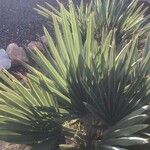
Trithrinax campestris
Campestre palm
Description
Source: leafsnapTrithrinax campestris, commonly known as the blue needle palm or caranday palm, is a species of palm tree native to South America. This slow-growing plant can reach heights of up to 10 meters and features a trunk covered in blue-gray needles. Its fan-shaped leaves can grow up to 1 meter long. In the spring and summer, the plant produces small yellow flowers, which are followed by small black fruits. Renowned for its hardiness and ability to withstand drought conditions, the blue needle palm is an excellent choice for landscaping in arid regions. It thrives in well-drained soil and full sun exposure but can also tolerate partial shade. This versatile plant has several uses. It serves as an ornamental tree for landscaping purposes and as a source of fiber for making brooms or baskets. While the fruits are edible, they are not commonly consumed. Overall, Trithrinax campestris is an attractive and resilient palm tree species that enhances any landscape with its beauty while requiring minimal maintenance.
Care Guide
💧 Water Every 7 days
The Caranday palm flourishes in the arid regions of South America, thanks to its remarkable drought tolerance and ability to store water within its structure. Although it is mainly grown outdoors, it only needs to be watered every one to two weeks. Its unique leaf structure helps regulate water loss, which enhances its adaptation to its native climate.
☀️ Light Full sun
The Caranday palm comes from open habitats, like sunny meadows and forest edges, that offer plenty of light. It performs best in Full Sun but can also tolerate Partial Sun, showing good adaptability to different light conditions.
What are the sunlight requirements for Caranday palm?
The Caranday palm, or Trithrinax campestris, requires full sun, defined as over 6 hours of sunlight daily, to thrive but can also tolerate partial sun, which is about 3-6 hours of sunlight. It's essential to observe the movement of sunlight through your garden to ensure your plants receive the ideal balance of light and shade, ensuring their wellbeing.
How does the Caranday palm adapt to different lighting conditions?
Originating from open environments like sunny meadows and forest edges, the Caranday palm is well-adapted to full sunlight but can also manage partial sun conditions. This adaptability allows it to grow in various lighting conditions adequately. For indoor plants struggling with natural light, artificial lighting can be a solution, with LED lights being recommended for their customizable light wavelengths. The amount of artificial light needed varies depending on the plant's natural light needs, with full sun plants requiring 30-50W/sq ft, partial sun 20-30W/sq ft, and full shade plants needing 10-20W/sq ft.
What are the symptoms of light deficiency in Caranday palm?
When the Caranday palm doesn't receive enough light, it may show several symptoms such as smaller new leaves, leggy or sparse growth, faster leaf drop, slower or halted growth, and lighter-colored new leaves. Excessive sunlight can cause issues like chlorosis, sunscald, leaf curling, wilting, and leaf scorching. These symptoms indicate that the plant is struggling with its current light conditions, either needing more light or suffering from too much direct light.
How can I address poor lighting conditions for my Caranday palm?
To improve growth under poor lighting conditions, gradually expose your Caranday palm to more sunlight until it gets at least 6 hours of direct light daily, especially if it's indoors. Use south-facing windows or consider artificial lighting solutions, like desk lamps or professional grow lights, for at least 8 hours a day. For outdoor plants, gradually move them to spots with better light to avoid shock. Note that parts of the plant damaged by insufficient light may not recover, but new growth should be healthy with improved lighting. Minimizing obstructions and transplanting smaller plants to sunnier locations can also aid in ensuring they get enough sunlight.
🌡️ Temperature 15–35°C
Caranday palm is fairly adaptable to heat, tolerating high temperatures and significant temperature swings. In hot weather, attention to watering and provision of appropriate shade are necessary to prevent sunburn. Conversely, the Caranday palm has limited tolerance for low temperatures. It can endure some cold, but excessively low temperatures can result in frost damage.
What is the name of the plant being described?
The plant being described is known as Caranday palm.
What is the botanical name of Caranday palm?
The botanical name of Caranday palm is Trithrinax campestris.
💨 Humidity
🪴 Soil 6-7
🌱 Fertilizer
The timing of fertilizing the Caranday palm is important. Apply fertilizer in early spring and continue once a month until early summer. Fertilizer encourages attractive blooms and supplies energy during both dormant and active growth periods.
🪴 Pot & Repot 1-2 years
Repot your caranday palm every 1-2 years in early spring. Use a slightly larger pot with well-draining soil for the best results. After repotting, water the plant moderately to help reduce stress. Ensure it receives consistent moisture and indirect light to promote optimal recovery and growth. This will create a healthy environment for this robust palm.
✂️ Pruning
The Caranday palm, known for its sturdy trunk and stiff, fan-like leaves, thrives with minimal care. Light pruning is beneficial, especially when you remove dead fronds in early spring to maintain the plant's health and appearance. Making clean cuts during pruning helps prevent infections and promotes better air circulation, which enhances the palm's vitality, resilience, and ornamental value. Be sure to consult local guidelines for specific care instructions tailored to your area.
🌿 Propagating
🐛 Diseases & pets
☠️ Toxicity
Characteristics
- Plant Type
- Tree
- Life Cycle
- Perennial
- Genus
- Trithrinax
- Family
- Arecaceae
- Hardiness Zone
- 8-10
- Mature Height
- 3.96 m
- Mature Spread
- 2.13 m
- Leaf Color
- Green, Gray, Silver
- Leaf Type
- Evergreen
- Flower Color
- Yellow
- Flower Size
- 0.51 cm to 1.02 cm
- Bloom Time
- Early summer, Mid summer
- Planting Time
- Spring, Summer, Autumn
- Harvest Time
- Late summer, Early fall, Mid fall
- Native Area
- Brazil