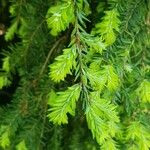
Tsuga canadensis
Eastern hemlock · Canada Hemlock · ᏃᏄ · Black Hemlock · Canadian Hemlock
Description
Source: leafsnapTsuga canadensis, commonly known as the Eastern Hemlock, is a coniferous tree species native to eastern North America. This slow-growing evergreen can reach up to 70 feet in height and 40 feet in width. The Eastern Hemlock is characterized by its conical shape and dense foliage, which provides excellent shade and shelter for wildlife. The needles of the Eastern Hemlock are short and flat, measuring about 1 inch long. They are dark green on top with two white stripes on the underside. The tree's cones are small, measuring about 0.75 inches long. Eastern Hemlocks prefer moist soils and shady environments but can tolerate some sun exposure. They are commonly found in forests along streams or on slopes where they help prevent soil erosion. The wood of Tsuga canadensis is highly valued for its strength and durability, making it an important timber species for construction purposes, such as building homes or furniture. Unfortunately, the Eastern Hemlock is threatened by an invasive insect called the hemlock woolly adelgid. This pest feeds on the tree's sap, causing significant damage and potentially leading to the tree's death if left untreated. Overall, Tsuga canadensis plays an important role in eastern North American forests, providing habitat for wildlife while also being used by humans for various purposes, such as construction materials and ornamental landscaping. Despite being threatened by the hemlock woolly adelgid, proper management strategies can help protect these trees from extinction. Effective management includes researching new ways to control these pests and promoting conservation efforts. Sustainable development practices that benefit both humans and nature can be achieved through collaborative efforts between local communities and government agencies.
🌳 Often praised for its rich dark green foliage, the eastern hemlock has purposes beyond simple ornamentation. Its bark can be processed to produce tannin, which was once a common ingredient in hide tanning. Although modern synthetic substitutes have replaced it, the eastern hemlock was important to leather production. Its wood is also valued for making rustic furniture, demonstrating the tree’s range of uses.
🎭 Eliminate sexual urges *poison*
Care Guide
💧 Water Every 7 days
Eastern hemlock thrives in moist, cool environments similar to its native forest floor. To maintain damp soil without causing waterlogging, it should be watered every 1-2 weeks. Although it has moderate drought tolerance, its needle-like foliage, being evergreen, efficiently retains water. This characteristic further reduces its watering needs, especially in cooler or shaded areas.
How should I water my Eastern hemlock tree?
Watering your Eastern hemlock is a simple task. To do so, just turn on your garden hose and slowly soak the soil. For larger trees, the high volume of water required can be easily provided using a garden hose. However, for smaller trees, you can use a watering can or a smaller watering tool. It's important to avoid overhead watering as it can lead to disease, especially for young trees.
What should I do if I give too much or too little water to my Eastern hemlock?
Overwatering can happen if the soil is not able to drain well, causing Eastern hemlock trees to decline. To fix this, you can either improve the soil's drainage or move the tree to a better location. If you have the tree in a pot, you may need to use looser soil in a container that drains better. Diseases can also affect an overwatered plant and should be treated promptly. For an underwatered tree, simply water it more often until it regains its health. To determine if the tree is overwatered, check the foliage, particularly the new growth, for discoloration or easy breakage. Standing water or slow drainage in the growing area can also indicate excessive moisture. Underwatered trees may have sparse, brown leaves, which could be due to too much rain or high temperatures. Considering these factors will help you assess the situation correctly.
How frequently should I water my Eastern hemlock?
A mature Eastern hemlock is able to survive with minimal water, mainly relying on rainfall. During the hottest months, watering once a week may be necessary, but in other seasons, there may be no need to water at all. Newly planted hemlock trees require regular watering to establish their roots and maintain consistent soil moisture. However, avoid overwatering, as Eastern hemlocks are not tolerant of standing water. It is better to err on the side of not watering too much rather than risking overwatering.
How much water does my Eastern hemlock tree require?
During the height of summer, it's necessary to water your Eastern hemlock, usually with one inch of water per week. However, the amount can vary if it has rained. If it has rained one inch or more, no additional watering is needed. Newly planted Eastern hemlock require more water during the establishment period, which means watering once every one to two weeks for the first few growing seasons.
How do I water my Eastern hemlock throughout the year?
The Eastern hemlock tree requires the most water during the summer when it's hottest. During this time, it's best to give the plant water once a week if there's no rainfall. However, the tree can usually survive without water during other seasons. In spring and fall, if it's unusually hot, you may need to provide some water, though this is rare. Unlike many other plants, the Eastern hemlock doesn't go into full dormancy in winter, so it continues to grow even during the coldest months. However, the tree's water needs during winter remain low because the cool temperatures don't dry out the soil quickly.
☀️ Light Full sun
Eastern hemlock prefers bright, intense light but also tolerates partial shade and full shade. Its native habitat offers these light conditions, which encourage healthy growth. Too much light can be harmful, while too little light usually does not notably affect its health.
What are the sunlight requirements for Eastern hemlock?
Eastern hemlock thrives best in full intensity light exposure but can also adapt to semi-lit or completely shadowed areas, mimicking its native environment which promotes healthy growth. While overexposure to light can be detrimental, underexposure doesn't significantly impact its health. For its proper care, it's essential to ensure the plant receives above 6 hours of sunlight for full sun, and about 3-6 hours of sunlight for partial sun or full shade areas. Observing how sunlight moves through your garden will help you choose optimal spots that ensure a balance of light and shade to keep your plants happy.
How can artificial lighting be used for indoor Eastern hemlock plants?
Indoor Eastern hemlock plants require adequate lighting for optimal growth, especially when natural sunlight is insufficient. Artificial lights, such as LED lights, are crucial as they can be customized to provide specific wavelengths needed by the plants. For full sun plants, 30-50W/sq ft of artificial light is necessary; partial sun plants require 20-30W/sq ft, and full shade plants need 10-20W/sq ft. The light source should be placed 12-36 inches above the plant to mimic natural sunlight, and it's important to mimic natural daylight hours, with most plants needing 8-12 hours of light per day.
What are the symptoms of light deficiency in Eastern hemlock?
Eastern hemlock displays several symptoms when subjected to light deficiency, indicating its need for more sunlight or better light conditions. Symptoms include smaller new leaves, leggy or sparse growth, faster leaf drop, slower or no new growth, lighter-colored new leaves, chlorosis, sunscald, leaf curling, wilting, and leaf scorching. These symptoms reflect the plant's struggle in suboptimal lighting, showcasing its sensitivity to heat and its requirement for abundant sunlight for healthy outdoor growth.
What solutions can help Eastern hemlock plants with insufficient sunlight?
To address light insufficiency for Eastern hemlock, there are several strategies one can employ. Indoors, gradually moving plants to sunnier spots each week until they receive at least 6 hours of direct sunlight daily is advised, utilizing a south-facing window for natural light, or artificial light sources for at least 8 hours a day. Outdoors, it's similarly essential to gradually acclimate plants to sunnier locations to prevent sunburn, focusing on gradual exposure increase. Removing obstructions or transplanting smaller plants during their dormant periods to sunnier locations with good drainage can also significantly benefit their growth and health. It's crucial to remember that parts of the plant damaged by insufficient sunlight might not recover, but new growth following improved light exposure will be healthy.
🌡️ Temperature 0–32.2°C
The eastern hemlock grows in a temperate climate and favors a temperature range of 32 to 90 ℉ (0 to 32 ℃). It flourishes in cooler conditions and can tolerate winter frosts. During the summer months, providing shade is recommended to prevent excessive heat exposure.
What climate does the Eastern Hemlock (Tsuga canadensis) thrive in?
The Eastern Hemlock, or Tsuga canadensis, grows best in a temperate climate, favoring a temperature range of 32°F to 90°F (0°C to 32°C). It is well-suited to cooler conditions and is highly tolerant of winter frosts. In order to protect the tree from excessive heat, especially during the summer months, providing shade is recommended. Despite its high cold tolerance, avoiding additional frost protection in winter is advised. However, to help the tree during the winter and early spring, watering it generously before the first freeze of autumn to ensure the soil remains moist can be beneficial.
How does the Eastern Hemlock react to low temperatures?
Eastern Hemlock shows a remarkable tolerance to low temperatures, capable of withstanding winter conditions above -35°C. However, if temperatures drop below this threshold, the tree may not show immediate damage during the winter, but by spring, its branches may turn brittle and dry, and it might fail to produce new shoots. The solution to this issue is relatively simple: in spring, it is advisable to prune away any dead branches that have not developed new leaves.
What should be done if the Eastern Hemlock is exposed to high temperatures?
Eastern Hemlock does not tolerate high temperatures well. When exposed to temperatures exceeding 32°C, the tree may lose leaves significantly, and in extreme cases, it could wither and die. To alleviate this, the recommendations include trimming away sunburned and dried-up parts of the plant. It's also beneficial to relocate the tree to a shaded area or employ a shade cloth to protect it from the midday and afternoon sun. Ensuring the soil remains moist by watering the tree during the morning and evening can also help manage heat stress.
💨 Humidity
🪴 Soil 5-6
🌱 Fertilizer
Eastern hemlock has specific nutrient needs and does not require heavy fertilization. Fertilizing in spring is best for encouraging optimal growth. Providing nutrients improves its health, strengthens its resistance to pests and diseases, and helps sustain its long lifespan.
Why should I put fertilizer on my Eastern hemlock?
To promote the healthy growth of Eastern hemlock, it is recommended to fertilize in the spring. It is important to keep in mind that the plant has a long lifespan and requires support. By adding nutrients to the soil, the plant's health can improve, enhancing its ability to resist typical pests and diseases that may hinder growth or reduce its lifespan.
When should I fertilize my Eastern hemlock?
Sometimes, the growing medium lacks sufficient nutrients for healthy growth. However, Eastern hemlock is unique compared to garden annuals and perennials because it does not need a lot of extra nutrients. The ideal time to fertilize Eastern hemlock is in spring, before new growth emerges.
When is it best not to put fertilizer on my Eastern hemlock?
While some plants benefit from regular fertilization, the Eastern hemlock does not. It actually thrives when it doesn't receive an excess of nutrients. Applying too much fertilizer can actually harm it and lead to decline. To support the health of the Eastern hemlock, only use fertilizer in spring and avoid doing so in the other three seasons (summer, fall, and winter). Additionally, refrain from adding any organic matter to the soil during these seasons.
What kind of fertilizers should I use for my Eastern hemlock?
The age of your plant determines the type of fertilizer it needs. However, Eastern hemlock trees don't require excessive nutrients. Choose a balanced plant food that promotes healthy root development and growth. Avoid fertilizers with high nitrogen contents.
How can I put plant food on my Eastern hemlock?
When fertilizing Eastern hemlock, the timing and method are both crucial. It is best to apply the fertilizer once in the spring, specifically around the base of the plant. Be careful to avoid getting any fertilizer on the trunk. If you are using granulated fertilizer, cover the pellets with a thin layer of soil. This will help ensure that the fertilizer is properly absorbed into the soil.
🪴 Pot & Repot 2-3 years
When repotting an Eastern hemlock, select a container 1-2 inches (2.5–5.1 cm) larger with good drainage. Use a well-draining potting mix. Repot in spring or fall, making sure the root ball sits slightly below the rim of the pot. Water thoroughly after repotting and place it in a warm spot with indirect sunlight.
✂️ Pruning
To promote healthy growth and prevent sap loss, prune eastern hemlock from early to late winter. Start by removing any damaged branches, then lightly trim the tree to shape it. This method improves airflow, reduces pests, and supports the plant's vitality. For specific techniques, consult horticultural resources.
🌿 Propagating
🐛 Diseases & pets
☠️ Toxicity
Though often confused with the poisonous hemlocks, the Canadian hemlock tree is non-toxic to humans and pets. These trees are not in the same family as the Conium or Cicuta genus and do not contain harmful toxins.
Characteristics
- Plant Type
- Tree
- Life Cycle
- Perennial
- Genus
- Tsuga
- Family
- Pinaceae
- Hardiness Zone
- 3-7
- Mature Height
- 31.09 m to 53.04 m
- Mature Spread
- 7.01 m to 10.97 m
- Leaf Color
- Green, Yellow
- Leaf Type
- Evergreen
- Flower Color
- Yellow, Green, Red
- Flower Size
- 2.54 cm
- Bloom Time
- Late spring, Early summer
- Planting Time
- Spring, Autumn
- Harvest Time
- Mid summer, Late summer, Early fall
- Native Area
- Eastern North America