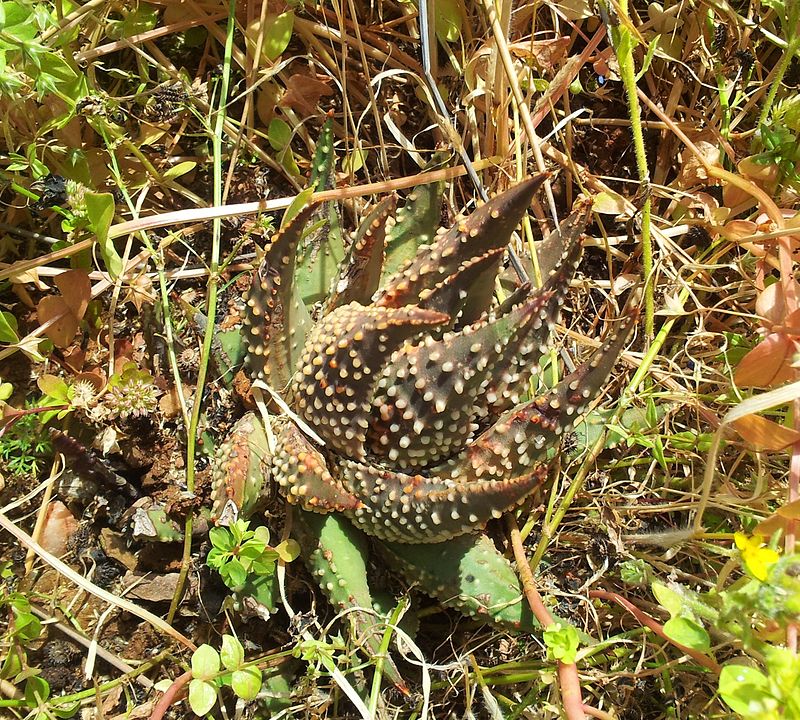
Tulista pumila
Pearl haworthia · Pearl plant
Description
Source: leafsnapThe Haworthia pumila or Tulista pumila is a South African succulent also referred to as the Pearl Plant. This plant features rosettes of thick, fleshy, triangular leaves dotted with raised tubercles. The white tubercles contrast deeply against the leaves' olive-green to deep greenish-brown color. In the summer, it blooms with tall spikes of green to brownish-white flowers that have a waxy texture.
Care Guide
💧 Water Every 2-3 weeks
Tulista pumila thrives in dry conditions and is highly tolerant of drought, needing water only once every three weeks. It is commonly grown indoors, where a controlled environment helps prevent overwatering. To avoid root rot and replicate its natural habitat, it's crucial to use well-draining soil.
☀️ Light Full sun
Native to dry areas, Big Fataloe performs best in full sun; its native habitat is marked by intense sunlight and little shade. It can also tolerate partial sun, offering some flexibility in its growth.
🌡️ Temperature 20–37.8°C
Although Big Fataloe can tolerate some heat, it mainly flourishes and grows in cooler seasons and goes dormant in summer. In hot summer temperatures, provide shade to prevent scorching from strong sunlight. Watering should be reduced or stopped during the hottest season to avoid root rot. Big Fataloe shows vigorous growth in winter and spring. If temperatures do not fall too low, it will continue to grow steadily.
💨 Humidity
🪴 Soil 6-7
🌱 Fertilizer
For Big Fataloe, light applications of fertilizer once or twice a year during the growing season are enough. Avoid fertilizing in winter or in summer, when it is dormant. Cut back on fertilizer for plants that have been repotted and wait a couple of months after repotting before you fertilize. Fertilizing helps maintain healthy growth and promotes blooms.
🪴 Pot & Repot Every 2 years
When repotting Big Fataloe, choose a pot just a bit bigger than the current one that has good drainage. Fill it with a gritty, well-draining succulent or cactus mix. Gently lift the plant from its old container, brush off excess soil, and set it in the new pot at the same depth. Wait a few days before watering so any damaged roots can heal. Repot during spring or fall and place the plant in a brightly lit spot.
✂️ Pruning
As with most succulents, the Pearl Plant does not require extensive pruning to stimulate healthy growth. You can simply trim off any dead or damaged leaves as you see them, keeping the plant neat. When it starts to outgrow its pot, transfer the Pearl Plant to a new, slightly larger but shallow pot with fresh soil. Repotting these plants is best done during the spring or early summer.
🌿 Propagating
🐛 Diseases & pets
☠️ Toxicity
Tulista pumila, also known as the Pearl Plant, is generally considered non-toxic to people and pets. This succulent can coexist happily as a houseplant with children and pets.
Characteristics
- Plant Type
- Succulent
- Life Cycle
- Perennial
- Genus
- Tulista
- Family
- Asphodelaceae
- Hardiness Zone
- 9-11
- Mature Height
- 30 cm
- Mature Spread
- 10 cm
- Leaf Color
- Dark Green, Forest Green
- Leaf Type
- Evergreen
- Flower Color
- White, Pink
- Flower Size
- 1.02 cm to 1.52 cm
- Bloom Time
- Mid spring, Late spring
- Planting Time
- Spring, Summer
- Harvest Time
- Early summer, Mid summer
- Native Area
- South Africa