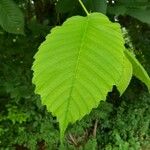
Ulmus americana
American elm · White elm · Თელა · Water elm · Homenó'e
Description
Source: leafsnapUlmus americana, generally known as the American elm or, less commonly, as the white elm or water elm, is a species of elm native to eastern North America, naturally occurring from Nova Scotia west to Alberta and Montana, and south to Florida and central Texas. The American elm is an extremely hardy tree that can withstand winter temperatures as low as −42 °C (−44 °F). Trees in areas unaffected by Dutch elm disease (DED) can live for several hundred years. A prime example of the species was the Sauble Elm, which grew beside the banks of the Sauble River in Ontario, Canada, to a height of 43 m (140 ft), with a d.b.h of 196 cm (6.43 ft) before succumbing to DED; when it was felled in 1968, a tree-ring count established that it had germinated in 1701. For over 80 years, U. americana had been identified as a tetraploid, i.e. having double the usual number of chromosomes, making it unique within the genus. However, a study published in 2011 by the Agricultural Research Service of the USDA revealed that about 20% of wild American elms are diploid and may even constitute another species. Moreover, several triploid trees known only in cultivation, such as 'Jefferson', are possessed of a high degree of resistance to DED, which ravaged American elms in the 20th century. This suggests that the diploid parent trees, which have markedly smaller cells than the tetraploid, may too be highly resistant to the disease.
💡 The renowned Swedish botanist Carl Linnaeus named Ulmus americana. This species was first described in his 1753 book, Species Plantarum, which is considered the starting point for the binomial system of botanical nomenclature and the scientific naming of plants.
🌳 The American Elm, or american elm, is not only an impressive sight but also very useful. The fibrous strength of the young bark was skillfully used by Native Americans for binding. That same fibrous nature of the american elm was used to make playful items like rope swings, bringing joy to children. Beyond its bark, the american elm's dense, attractive wood was favored for furniture and decorative home paneling, reflecting its historical importance and practicality.
🎭 Shades, gloom, grief, the spirit realm
Care Guide
💧 Water Every 7 days
Native to the moist soils of Eastern North America, the American elm thrives with consistent moisture levels, though it does not tolerate waterlogging. It generally requires watering every 1-2 weeks. Although commonly grown outdoors, this tree can adapt well to urban environments, where it needs sufficient hydration during its active growth cycle.
When Should I Water My American Elm?
Watering your American elm is crucial for its health, targeting the top 1 to 2 inches of soil to be dry before watering again. The plant's leaf condition, such as wilting or losing vibrancy, also signals the need for water, as does its pre-flowering stage to avoid bud drop. Be cautious of watering in high temperatures and sunlight exposure as it increases the tree's water needs. Over-watering can lead to root diseases, while under-watering may cause wilting or even death. Understanding these signs will help manage the irrigation schedule effectively, promoting its growth and health.
How Should I Water My American Elm?
The optimal watering technique for an American elm involves watering deeply and infrequently, encouraging a strong root system and preventing overwatering. When using a watering can, opt for one with a fine spray nozzle to evenly distribute water at the base of the plant, avoiding foliage to minimize fungal disease risk. A moisture meter can be instrumental in determining the right time for watering, keeping the soil sufficiently moist but well-drained. Mulching and regular monitoring of soil moisture help ensure the American elm's watering needs are adequately met.
How Much Water Does American Elm Really Need?
An American elm requires thorough watering to satisfy its deep root system, generally around 3 to 5 liters per session every 7 to 10 days, depending on factors like pot and plant size. Signs of proper hydration include vibrant, healthy leaves, and strong, upright stems. It's crucial to avoid over and under-watering to prevent root rot and ensure the plant's vitality. Ensure the potting mix is well-draining and monitor soil moisture regularly. Adjust watering based on environmental conditions to maintain optimal moisture levels.
What Kind of Water is Best for American Elm?
Rainwater or filtered water is preferable for American elm, due to their neutral to slightly acidic pH. Distilled water can also be a good choice. If using tap water, letting it sit for 24 hours can help dissipate chlorine. American elm shows sensitivity to chlorine and fluoride, so tap water should have low fluoride levels. Excess minerals from hard water can be harmful, so consider using a water softener. Room temperature water is ideal, avoiding shock to the roots or promoting harmful bacterial growth.
How Do American Elm's Watering Needs Change with the Seasons?
The watering needs for an American elm vary with the seasons. During spring, with increased growth, keep the soil somewhat moist. In summer, higher temperatures require consistent soil moisture due to increased evaporation. Reduce watering frequency in autumn as growth slows, allowing the soil to partially dry out. In winter, during dormancy, water needs significantly decrease; aim to keep the soil from drying out completely, watering sparingly due to low evaporation rates in cold weather.
☀️ Light Full sun
American elm does best in full sun but can grow satisfactorily in partly shaded locations. Light promotes its healthy development and advances its stages of growth. Its native habitat, which is rich in sunlight yet includes shaded areas, demonstrates its adaptability to light conditions. Too much or too little light can impede its growth.
What are the sunlight requirements for American elm?
American elm thrives in full sun, requiring above 6 hours of sunlight daily, but can also grow adequately in partial sun with about 3-6 hours of sunlight. It's important to watch how sunlight moves through your garden and choose spots that provide a balance of light and shade, ensuring the plant's happiness and healthy development. Its adaptability to light is rooted in its origin habitat, which is abundant in sunlight but also has shaded areas.
How does artificial lighting benefit indoor American elm plants?
Indoor American elm plants require adequate lighting for optimal growth, especially when natural sunlight is insufficient, such as in winter or less sunny spaces. Artificial lights, particularly LED lights customized to provide specific wavelengths needed by the plant, offer a vital solution. For optimal growth, full sun plants need 30-50W/sq ft, partial sun plants 20-30W/sq ft, and full shade plants 10-20W/sq ft of artificial light. The light source should be placed 12-36 inches above the plant, and the duration should mimic natural daylight hours, typically 8-12 hours per day.
What are some symptoms of inadequate light exposure in American elm?
American elm may show symptoms of light deficiency when placed in suboptimal lighting, including smaller new leaves, leggy or sparse growth, faster leaf drop, slower or no new growth, lighter-colored new leaves, chlorosis, sunscald, leaf curling, wilting, and leaf scorching. These symptoms indicate the plant is not receiving enough sunlight to maintain healthy growth and perform photosynthesis effectively.
What solutions can be implemented for American elm struggling with inadequate sunlight?
To address inadequate sunlight for indoor American elm, gradually move the plant to a sunnier location each week until it receives at least 6 hours of direct sunlight daily, ideally using a south-facing window. For larger or non-movable plants, consider using artificial light for at least 8 hours daily. For outdoor plants, move them gradually to sunnier locations to avoid shock and sunburn. Minimize obstructions like trees by pruning and, for smaller plants, consider transplanting during their dormant period to a location with ample sunlight. Note that parts of the plant affected by insufficient sunlight may not recover, but new growth will be healthy after increasing light exposure.
🌡️ Temperature 5–35°C
The American elm is a temperate woody species that does best in temperatures from 41 to 95 °F (5 to 35 °C). Being native to North America indicates it can endure both warm and cold conditions. In winter, protect it from frost by wrapping the trunk with burlap or other insulating material.
What temperature range is optimal for the American elm?
The American elm thrives in a temperature range of 41 to 95°F (5 to 35°C), indicating its ability to tolerate both hot and cold temperatures native to North America. Special attention is needed to protect the tree from frost damage by wrapping its trunk in burlap or insulating material when winter temperatures are expected to drop below -30°C, despite its strong cold resistance.
How should I protect my American elm from cold weather?
To protect your American elm during cold weather, especially if temperatures are expected to drop below -30°C, it's important to wrap its trunk and branches with insulating materials such as non-woven fabric or cloth. Before the onset of the first freeze, water the plant abundantly to ensure the soil remains moist and freezes, which helps prevent drought and water scarcity for the plant during the winter and early spring.
What are the signs of low-temperature damage in American elm?
Low-temperature damage in American elm usually doesn't show immediately but can result in brittle and dry branches by spring, with no new shoots emerging if winter temperatures fall below -30°C. If kept above -25°C during winter, the American elm remains cold-tolerant and thrives best.
How can I help my American elm recover from low-temperature damage?
To help your American elm recover from low-temperature damage, prune away any dead branches that have failed to produce new leaves in the spring. This essential maintenance helps the tree to direct its energy towards the growth of healthy new shoots.
What are the signs of high-temperature damage in American elm?
Signs of high-temperature damage in American elm include leaves becoming lighter in color, with tip dryness and withering, and an increased susceptibility to sunburn when temperatures exceed 38°C (100.4°F) during the summer. It is best kept below 35°C (95°F) to avoid these issues.
💨 Humidity
🪴 Soil 6-7
🌱 Fertilizer
Fertilize your American elm in early spring to encourage healthy growth. Regular feeding improves overall health, producing vigorous growth, increased tolerance of adverse conditions, and enhanced resistance to pests and diseases. Keep to a defined fertilization schedule for your American elm to maintain richly colored, vibrant foliage and a lush appearance.
Why should I put fertilizer on my American elm tree?
Regular fertilization is key to helping any type of American elm thrive. By providing the proper nutrients, you can promote vigorous growth and enhance the plant's ability to withstand harsh conditions and combat diseases and pests. Since the foliage of your American elm is visually appealing, it's important to maintain it. To achieve this, establish a consistent fertilization routine tailored to your specific American elm. This will result in vibrant, deeply colored leaves and an overall lush appearance.
When should I fertilize my American elm tree?
To ensure the healthy growth of your American elm, it's recommended to fertilize it during late winter or early spring. This provides the tree with the necessary nutrients to thrive as the weather warms up. If you live in a warm climate region, it's also beneficial to offer an additional fertilizer feeding during early fall. This not only adds nutrients for the following growing season but also strengthens the tree, making it more capable of surviving the winter cold without foliage damage. Fertilizing earlier in the season will give the new branches enough time to grow and withstand the cold winter.
When is it not a good idea to fertilize my American elm?
There are certain times of the year when you should avoid fertilizing your American elm tree. The first instance is in the early and mid-winter months when the tree is dormant and does not require any feeding. It is also not recommended to fertilize the tree in late spring or throughout the summer. This is because the weather is usually hotter and drier during this period, which can negatively affect the tree's response to fertilization. To prevent any problems, it is best to follow a fertilization schedule that only involves feeding in early spring and early fall.
What kind of fertilizer does my American elm tree require?
The most important nutrient for an American elm is usually nitrogen, but that doesn't mean phosphorus and potassium are not important. In fact, your American elm needs a good amount of all three main nutrients, which is why a balanced fertilizer like a 10-10-10 can be effective. However, a more specifically balanced ratio of nutrients tends to promote optimal growth for an American elm. Fertilizers that are slightly higher in nitrogen, like a 10-6-4 ratio, often work well. You can choose between granular or liquid-based fertilizers when fertilizing.
How can I apply fertilizer to my American elm tree?
To fertilize your American elm tree, you have a couple of options. One option is to use granular fertilizer. Simply sprinkle the fertilizer on the soil at the right time, and its slow-release formula will gradually release nutrients into the soil. It's a good idea to water your tree lightly before applying the fertilizer. Alternatively, you can use liquid fertilizer, although this is not as common. To use liquid fertilizer, mix it with water and pour it around the base of your tree. If you're unsure about the pH level of your soil, it may be helpful to perform a soil test before fertilizing.
🪴 Pot & Repot Every 12 months
✂️ Pruning
The American elm is a deciduous tree known for its vase-like shape and gracefully arching branches. It's best to prune the tree in early spring to remove dead wood, shape its structure, and enhance air circulation. When pruning, aim to maintain a strong central leader and evenly spaced limbs to promote healthy growth and overall vitality.
🌿 Propagating
🐛 Diseases & pets
☠️ Toxicity
Ulmus americana is usually not toxic to people, pets and livestock. Although severe reactions are quite uncommon, Ulmus americana has been reported as a sensitizer. Usually most common reactions simply include eye and skin irritation.
Characteristics
- Plant Type
- Tree
- Life Cycle
- Perennial
- Genus
- Ulmus
- Family
- Ulmaceae
- Hardiness Zone
- 4-9
- Mature Height
- 17.98 m to 35.05 m
- Mature Spread
- 11.89 m to 21.03 m
- Leaf Color
- Green, Yellow
- Leaf Type
- Deciduous
- Flower Color
- Tan, Brown
- Flower Size
- 2.54 cm
- Bloom Time
- Early spring, Mid spring
- Planting Time
- Spring, Summer, Autumn, Winter
- Harvest Time
- Mid summer
- Native Area
- Mexico