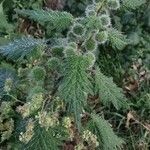
Urtica pilulifera
گزنه · Roman nettle · סִרְפַּד הַכַּדּוּרִים
Description
Source: leafsnapUrtica pilulifera, commonly known as Roman nettle or pill nettle, is a perennial herb that belongs to the Urticaceae family. Native to Europe and Asia, this plant thrives in a variety of habitats, including meadows, fields, waste areas, and roadsides. The plant can grow up to 60 cm in height and features a square stem covered with stinging hairs. Its leaves are opposite, ovate, and have serrated edges. The flowers are small, greenish-white, and arranged in clusters along the stem. For centuries, Urtica pilulifera has been valued for its medicinal properties, particularly its anti-inflammatory effects. Traditionally, it has been used to treat arthritis, rheumatism, allergies, and skin conditions such as eczema. In addition to its medicinal uses, the plant also has culinary applications. The young leaves can be cooked like spinach or eaten raw in salads, while the seeds have been used as a pepper substitute. Despite its stinging hairs, which can irritate the skin upon contact, Urtica pilulifera remains an important medicinal herb due to its numerous health benefits.
Care Guide
💧 Water Every 7 days
The Roman nettle thrives in moderate humidity and requires weekly watering because of the consistent rainfall in its native habitat. As an evergreen plant, it keeps its leaves all year round, so it needs enough water to maintain healthy leaf growth.
How should I water my Roman nettle?
To water Roman nettle, you have several options. You can use a garden hose with a spray nozzle, a watering can, or any other common watering tool. This plant isn't too picky about the water source, as it can thrive with rainwater, tap water, or filtered water. However, it's best to avoid watering from overhead, as it can harm the leaves, flowers, and potentially cause diseases. A drip irrigation system is often the most effective method, as it ensures even and direct watering to the soil. If you have a container-grown Roman nettle, you can use a cup, watering can, or tap to water it directly at the soil level.
What should I do if I give my Roman nettle too much or too little water?
The solution for underwatering Roman nettle is simple - water it more consistently when you notice it lacks moisture. However, overwatering can be a more serious problem if not detected early. Overwatered Roman nettle can become susceptible to diseases that cause it to decline and eventually die. To prevent this, it's important to choose an appropriate growing location with ample sunlight to dry the soil and effective drainage to avoid excessive water accumulation. If you have overwatered your potted Roman nettle, it may be necessary to transfer it to a new pot. The previous container may have had poor soil drainage or insufficient drainage holes. When repotting your overwatered Roman nettle, use loose soils and a pot that drains efficiently.
How often do I need to water my Roman nettle?
Roman nettle requires regular watering throughout the growing season. In the spring, watering once per week is sufficient. However, as the season progresses and temperatures increase, you may need to water two to three times per week. It's important not to exceed this rate as it can harm the plant. Regardless of watering frequency, keep the soil relatively moist but not wet. It's worth noting that watering Roman nettle in a pot differs slightly. The soil in pots can heat up and dry out faster than ground soil, so you'll need to increase the frequency. Generally, watering a container-grown Roman nettle a few times per week is necessary, compared to just once per week for an in-ground plant.
How much water does my Roman nettle plant need?
Determining the appropriate amount of water for your Roman nettle can be approached in different ways. One method involves feeling the soil to gauge its moisture level and watering until the top six inches are moist. Another approach is to use a specific measurement, such as two gallons per week, taking into account factors like temperature and soil dryness. However, following strict guidelines may result in overwatering if your plant requires less water. When growing Roman nettle in a container, it is necessary to use a different method. The soil should be watered enough to moisten all dry layers, which can be determined by feeling the soil or observing a slight trickle of excess water from the drainage holes.
How do I know if I'm giving my Roman nettle enough water?
Taking care of Roman nettle can be a bit tricky when it comes to watering. These plants need weekly watering due to their deep roots, but they are highly prone to root rot. Overwatering can also cause browning of the leaves. Underwatering is less of a concern as Roman nettle can survive without much watering for a while, but be careful not to go too long without giving it water as it may start to wilt and develop dry leaves.
☀️ Light Partial sun
Roman nettle comes from habitats with dappled light, such as forest understories or rocky sites that provide natural shade. It does well in partial sun but can also tolerate full sun conditions.
🌡️ Temperature 10–35°C
Roman nettle can tolerate a wide span of temperatures, but its distribution may still be constrained by various combinations of moisture and heat. It does best in warm summer climates with sufficient rainfall or watering. Extended periods of cloudy, rainy weather, as well as prolonged high temperatures, can raise the chance of Roman nettle dying. In winter, adequate protection from cold can increase the plant’s survival rate.
💨 Humidity
🪴 Soil 5-7
🌱 Fertilizer
Roman nettle benefits from regular, diluted fertilizer applications to encourage healthy leaf development. Fertilize Roman nettle roughly once per month throughout the summer. Nitrogen is important for foliage, and adding nitrogen-rich fertilizers helps Roman nettle thrive.
🪴 Pot & Repot
✂️ Pruning
The Roman nettle is characterized by its nettled leaves and clustered flowers, and it thrives when pruned with care. Essential pruning techniques include removing dead stems and trimming the plant to reduce its height, which encourages bushier growth. It is best to prune the Roman nettle in early to late spring, during its active growth period. This timing helps improve air circulation, control pests, and boost the plant's overall vitality.
🌿 Propagating
🐛 Diseases & pets
☠️ Toxicity
Characteristics
- Plant Type
- Herb
- Life Cycle
- Annual
- Genus
- Urtica
- Family
- Urticaceae
- Hardiness Zone
- 6-9
- Mature Height
- 61 cm
- Mature Spread
- 30 cm to 61 cm
- Leaf Color
- Dark Green
- Leaf Type
- Deciduous
- Flower Color
- Yellow, Green
- Flower Size
- 0.20 cm to 0.25 cm
- Bloom Time
- Late spring, Early summer, Mid summer
- Planting Time
- Spring, Autumn
- Harvest Time
- Mid summer, Late summer, Early fall
- Native Area
- Saudi Arabia, Libya, Egypt, Turkey, Tunisia, Slovakia, Montenegro, Cyprus, Bulgaria, Greece, Croatia, Morocco, Yemen, Lebanon, Russia, Serbia, Iraq, Syria, Italy, Spain, France, Iran, Albania, Algeria, Portugal