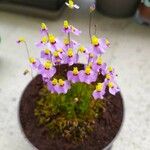
Utricularia bisquamata
Description
Source: leafsnapUtricularia bisquamata is a small annual carnivorous plant that belongs to the genus Utricularia. It is native to southern Africa, where it can be found in Angola, Lesotho, Madagascar, Namibia, and South Africa. U. bisquamata grows as a terrestrial plant in damp, sandy or peaty soils among mosses by streams or wet depressions at altitudes from near sea level to 1,200 m (3,937 ft) in South Africa and up to 2,250 m (7,382 ft) in Angola. It was originally described and published by Franz Paula von Schrank in 1824.
Care Guide
💧 Water
Utricularia bisquamata flourishes in humid, moist environments and needs consistent moisture to thrive. Watering the plant twice a week is ideal, but make sure there is proper drainage to prevent overwatering. Using rainwater is beneficial, as its purity and balanced pH can enhance the plant’s growth.
☀️ Light Partial sun
Cape Bladderwort comes from habitats with plenty of sunlight, such as open bogs and sunny wetlands. It prefers full sun but can also tolerate partial sun.
🌡️ Temperature 20–37.8°C
Cape Bladderwort does best in moderate temperatures, similar to what most people find comfortable. It grows well in conditions that are neither too hot nor too cold. The main problem with high temperatures is the chance of sunburn, so giving it some shade in summer is advised to avoid excessive heat. When temperatures fall, the plant becomes dormant. To maintain continuous growth, winter temperatures need to be kept higher. Frost can damage the plant and should be avoided.
💨 Humidity
🪴 Soil 5-6
🌱 Fertilizer
🪴 Pot & Repot 2-3 years
When repotting Cape Bladderwort, select a pot 1-2 inches (2.5–5.1 cm) larger with ample drainage. Use a well-draining potting mix. Repot in spring or fall, ensuring the root ball is slightly lower than the rim of the flower pot. Water thoroughly after repotting and place it in a warm spot with indirect sunlight.
✂️ Pruning
Utricularia bisquamata benefits from strategic pruning in early spring to stimulate new growth and reduce the risk of disease. Carefully remove any dead foliage to improve airflow, but be cautious not to prune too heavily, as the plant has a delicate structure. Consistent, gentle trimming supports healthy blooms and promotes strong growth, which are vital for the plant's proper care.
🌿 Propagating
🐛 Diseases & pets
☠️ Toxicity
Characteristics
- Plant Type
- Herb
- Life Cycle
- Annual, Perennial
- Genus
- Utricularia
- Family
- Lentibulariaceae
- Hardiness Zone
- 9-11
- Mature Height
- 5 cm to 15 cm
- Mature Spread
- 10 cm to 20 cm
- Leaf Color
- Light Green
- Leaf Type
- Evergreen
- Flower Color
- Lavender, Pink, White
- Flower Size
- 0.51 cm to 1.02 cm
- Bloom Time
- All year round
- Planting Time
- Spring, Summer, Autumn
- Harvest Time
- All year round
- Native Area
- Lesotho, Angola, South Africa, Namibia, Madagascar