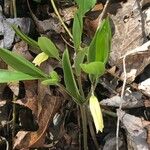
Uvularia puberula
Mountain Bellwort
Description
Source: leafsnapUvularia puberula, the mountain bellwort, is a plant species native to the eastern United States. It is common across Virginia, North and South Carolina, West Virginia, and adjacent parts of northern Georgia, eastern Tennessee, eastern Kentucky and southern Pennsylvania. Isolated populations have been found in southern Georgia, northern Alabama, southern New Jersey, and Long Island in New York State.Uvularia puberula is a perennial herb with 1-3 pale yellow flowers per stem.
Care Guide
💧 Water
Mountain bellwort thrives in areas with dappled sunlight and well-drained soil. While it prefers consistent moisture, it can tolerate brief periods of dryness. To ensure the plant stays optimally hydrated, it's important to water it weekly. Adding mulch is also beneficial, as it helps retain moisture and replicates the leaf litter found in its natural habitat.
☀️ Light Partial sun
Mountain bellwort prefers sites where sunlight is softened or filtered, which promotes healthy growth. It can also tolerate and survive in locations with substantially reduced sun exposure. However, if placed in very low light, the plant's overall development can be impaired and its growth slowed.
What are the sunlight requirements for Mountain Bellwort?
Mountain Bellwort thrives in conditions where it can receive partial sun to full shade. This translates to about 3-6 hours of sunlight for partial sun and less than 3 hours of sunlight for full shade. The plant prefers locations where the sun's rays are diluted or filtered, which supports healthy growth. However, it is capable of surviving in areas with significantly reduced sun exposure, although this may compromise its overall development, potentially resulting in slower growth. It's essential to watch how sunlight moves through your garden, selecting spots that offer an ideal balance of light and shade to ensure your plants' happiness and health.
How can artificial lighting be used for Mountain Bellwort grown indoors?
Indoor Mountain Bellwort plants require adequate lighting for optimal growth, particularly in conditions where natural sunlight is insufficient. Artificial lights, such as LED lights, are a viable solution as they can be customized to provide specific wavelengths of light needed by the plants. For plants requiring full sun, an artificial light intensity of 30-50W/sq ft is recommended. Partial sun plants need about 20-30W/sq ft, while full shade plants require 10-20W/sq ft. The light source should be placed 12-36 inches above the plant to mimic natural sunlight, ensuring the plant receives 8-12 hours of light per day to promote faster and healthier growth.
What are the symptoms of insufficient light for indoor Mountain Bellwort?
When grown indoors with insufficient light, Mountain Bellwort may exhibit several symptoms indicating light deficiency. These symptoms include smaller new leaves, leggy or sparse growth, faster leaf drop, and slower or halted new growth. Additionally, leaves may develop lighter coloration or chlorosis (turning yellow), indicating a lack of chlorophyll and essential nutrients. Sunscald, leaf curling, wilting, leaf scorching, and other symptoms can arise from excessive sunlight exposure but are also indicative of the plant's sensitivity to its light environment.
What solutions can help Mountain Bellwort with inadequate light exposure?
For indoor plants, gradually increasing sunlight exposure or supplementing with artificial light can enhance growth. Moving plants to sunnier spots each week until achieving 3-6 hours of direct sunlight or using a desk or ceiling lamp for at least 8 hours daily can be effective. For outdoor plants, it's crucial to transition them to sunnier locations progressively to avoid shock. Reducing obstructions, such as pruning trees that block sunlight, or transplanting smaller plants to more sunlit areas, can also help. However, parts of the plant that were affected by insufficient sunlight may not recover, but new growth will be healthy with improved light conditions.
🌡️ Temperature 5–32.2°C
Mountain bellwort can tolerate a wide span of temperatures, but its range may still be constrained by particular combinations of moisture and heat. It does best in warm summer climates with sufficient rainfall or watering. Extended stretches of cloudy, rainy weather or prolonged high temperatures can raise the likelihood of the plant dying. In winter, adequate protection from cold can improve its survival.
💨 Humidity
🪴 Soil 5-6
🌱 Fertilizer
For Mountain bellwort, the primary time to fertilize is in early spring while the flowers are forming. The appropriate fertilizer promotes better blooms and helps Mountain bellwort produce attractive flowers. Fertilizing in early spring ensures strong flowering during the season and supplies energy for dormant growth phases.
🪴 Pot & Repot
✂️ Pruning
Mountain bellwort has delicate, bell-shaped flowers and benefits from pruning in early spring. Begin by removing any dead or damaged stems, as well as overcrowded branches, to encourage healthy growth. Be sure to prune just above a healthy bud to stimulate new growth, which will enhance the blooms and improve the plant's overall health with proper care.
🌿 Propagating
🐛 Diseases & pets
☠️ Toxicity
Characteristics
- Plant Type
- Herb
- Life Cycle
- Perennial
- Genus
- Uvularia
- Family
- Colchicaceae
- Hardiness Zone
- 4-8
- Mature Height
- 15 cm to 30 cm
- Mature Spread
- 30 cm to 91 cm
- Leaf Color
- Green, Yellow Green
- Leaf Type
- Deciduous
- Flower Color
- Yellow
- Flower Size
- 2.54 cm to 7.62 cm
- Bloom Time
- Early spring, Mid spring
- Planting Time
- Spring, Summer
- Harvest Time
- Early summer, Mid summer