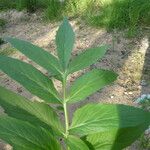
Valeriana officinalis
Garden-heliotrope · Common valerian · Valerian · Garden Valerian · Allheal
Description
Source: leafsnapValerian (Valeriana officinalis, Caprifoliaceae) is a perennial flowering plant native to Europe and Asia. In the summer when the mature plant may have a height of 1.5 metres (5 feet), it bears sweetly scented pink or white flowers that attract many fly species, especially hoverflies of the genus Eristalis. It is consumed as food by the larvae of some Lepidoptera (butterfly and moth) species, including the grey pug. Crude extract of valerian root may have sedative and anxiolytic effects, and is commonly sold in dietary supplement capsules to promote sleep, but there is insufficient clinical evidence that it is effective for this purpose. Its roots and leaves cause a catnip-like response in cats.
🌳 Valerian is a tall ornamental plant that is a perfect choice for cottage and courtyard gardens. Gardeners appreciate its delicate, fragrant flowers that bloom during the summer. Its height makes it ideal for planting at the back of borders, and it also works well as a cut flower. Additionally, valerian is resistant to most pests and diseases.
🎭 Love, Sleep, Purification
Care Guide
💧 Water
☀️ Light Full sun
🌡️ Temperature 5–35°C
💨 Humidity
🪴 Soil 6-7
🌱 Fertilizer
🪴 Pot & Repot
✂️ Pruning
🌿 Propagating
🐛 Diseases & pets
☠️ Toxicity
Characteristics
- Plant Type
- Herb
- Life Cycle
- Perennial, Annual
- Genus
- Valeriana
- Family
- Caprifoliaceae
- Hardiness Zone
- 4-9
- Mature Height
- 1.52 m
- Mature Spread
- 46 cm to 91 cm
- Leaf Color
- Green
- Leaf Type
- Deciduous
- Flower Color
- Pink, White
- Flower Size
- 0.51 cm
- Bloom Time
- Late spring, Early summer, Mid summer
- Planting Time
- Spring
- Harvest Time
- Mid summer
- Native Area
- Turkey, Sweden, Czech Republic, Slovakia, Armenia, Poland, Greece, Belarus, Ukraine, China, Russia, Lithuania, Hungary, Germany, Portugal, Italy, Spain, Switzerland, Japan, Estonia, Mongolia, Koppen, Iran, Albania, Azerbaijan, South Korea, Latvia, France