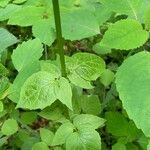
Valeriana pauciflora
Long-tube valeriana · Large-flower valeriana · Large-Flower Valerian · Largeflower valerian
Description
Source: leafsnapValeriana pauciflora, commonly called the largeflower valerian, is a plant species in the Caprifoliaceae. It is native to the Eastern United States, where it is found in the regions of the Interior Low Plateau, the Ohio River drainage, and the Potomac River Valley. In this region, it is found in very nutrient-rich, mesic forest communities, often in stream valleys or lower slopes.Valeriana pauciflora is a conservative perennial restricted to high-quality habitat. It produces white through light pink flowers in late spring and early summer. This species can set seeds without insect pollination, and also might be cross-pollinated by butterflies The specific epithet pauciflora, is Latin for 'few flowered'.
Care Guide
💧 Water
☀️ Light Partial sun
Largeflower valerian naturally occurs in habitats such as forest understories or rocky areas, where it grows under natural shade. It prefers partial sun but can tolerate both full sun and full shade, showing its adaptable and hardy nature.
What are the sunlight requirements for Largeflower Valerian (Valeriana pauciflora)?
Largeflower Valerian (Valeriana pauciflora) thrives in locations that receive full sun, which is defined as more than 6 hours of sunlight each day. It's crucial to observe how sunlight moves through your garden to identify spots that offer an ideal balance of light and shade. This careful selection ensures the plants are happy and healthy.
🌡️ Temperature 5–32.2°C
Largeflower valerian can tolerate a wide range of temperatures, but its distribution can still be restricted by particular combinations of moisture and heat. It does best in warm summer climates with sufficient rainfall or irrigation. Long stretches of cloudy, rainy weather or extended high temperatures make Largeflower valerian more likely to die. In winter, shielding the plant from cold increases its chances of survival.
💨 Humidity
🪴 Soil 6-7
🌱 Fertilizer
For Largeflower valerian, the primary time to fertilize is in early spring when the flowers are forming. The appropriate fertilizer promotes stronger blooms and helps Largeflower valerian produce attractive flowers. Fertilizing in early spring guarantees good flowering through the season and supplies energy for dormant growth phases.
🪴 Pot & Repot
✂️ Pruning
Pruning largeflower valerian in early spring promotes both its growth and appearance. Begin by removing any dead or diseased stems, and trim back excessively long growth to achieve a bushier shape. Be sure to use clean, sharp tools to prevent damage, which will improve air circulation and encourage healthy blooms.
🌿 Propagating
🐛 Diseases & pets
☠️ Toxicity
Characteristics
- Plant Type
- Herb
- Life Cycle
- Perennial
- Genus
- Valeriana
- Family
- Caprifoliaceae
- Hardiness Zone
- 4-8
- Mature Height
- 30 cm to 91 cm
- Mature Spread
- 20 cm to 40 cm
- Leaf Color
- Green, Dark Green
- Leaf Type
- Deciduous
- Flower Color
- White, Pink
- Flower Size
- 0.25 cm to 0.51 cm
- Bloom Time
- Mid spring, Late spring
- Planting Time
- Spring, Summer, Autumn
- Harvest Time
- Early summer, Mid summer