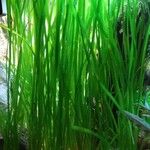
Vallisneria americana
Eelgrass · Tape-grass · Water-celery · Wild celery · Flumine-Mississippi
Description
Source: leafsnapVallisneria americana, commonly called wild celery, water-celery, tape grass, or eelgrass, is a plant in the family Hydrocharitaceae, the "tape-grasses". V. americana is a fresh water species that can tolerate salt, living in salinities varying from fresh water (0 parts per thousand) to 18 parts per thousand, although the limit to the salt tolerance is unclear, and is generally dependent on the duration and intensity of the plants’ exposure to the saline water. V. americana is a deep rooted plant with leaves, approximately one inch wide, with the ability to rise two or more meters above the clustered base of the plant. Contrary to the implications of one of its common names, wild celery bears little to no resemblance to the celery used as a vegetable. V. americana grows under water and is consumed by various animals, including the canvasback. The plants themselves are long, limp, flat, and have a green mid-ridge. Despite its name, it is not restricted to the Americas. It occurs naturally in Iraq, China, Japan, Korea, India, Papua New Guinea, the Philippines, Australia, Canada, the United States, Mexico, Guatemala, Honduras, Cuba, the Dominican Republic, Haiti and Venezuela. It is found primarily in eastern North America, occurring west from Nova Scotia to South Dakota and South to the Gulf of Mexico. It has also been reported in the western states of Washington, Nebraska, New Mexico and Arizona.V. americana is cultivated for the aquarium trade, where it is a sold as a background plant.
Care Guide
💧 Water
American eelgrass thrives in freshwater environments, where it prefers consistent moisture and stable aquatic conditions. This plant is adaptable and can grow submerged, needing weekly watering to maintain optimal health. It usually flourishes outdoors, forming dense underwater meadows in temperate climates. This highlights the benefits of planting eelgrass in groups.
☀️ Light Full sun
American eelgrass grows best when it receives a substantial amount of sunlight each day for optimal development. Coming from habitats with plentiful sun exposure, it cannot tolerate low-light environments. Low light levels negatively impact its growth and overall health. Excessive light, however, does not significantly damage it.
What are the sunlight requirements for American eelgrass?
American eelgrass requires above 6 hours of sunlight daily for optimal growth. It thrives in environments with ample sun exposure and struggles in dimly lit conditions, where its growth and health may suffer. Observing how sunlight moves through your garden to find the perfect balance of light and shade is essential for ensuring the plant's prosperity. Despite its need for significant sun exposure, excessive light does not significantly harm the American eelgrass.
How can artificial lighting benefit American eelgrass and what are the guidelines for using it?
Artificial lighting offers a solution for American eelgrass when natural sunlight is insufficient, especially during winter or in less sunny areas. It promotes faster, healthier growth by providing adequate lighting. LED lights are recommended as they can be adjusted to supply specific light wavelengths needed by the plant. Full sun plants require 30-50W/sq ft of artificial light, partial sun plants need 20-30W/sq ft, and full shade plants need 10-20W/sq ft. The light source should be placed 12-36 inches above the plant, mimicking natural sunlight, and most plants need 8-12 hours of light per day.
What are the symptoms of light deficiency in American eelgrass?
Symptoms of light deficiency in American eelgrass include smaller new leaves, leggy or sparse growth, faster leaf drop, slower or no new growth, lighter-colored new leaves, chlorosis, sunscald, leaf curling, wilting, and leaf scorching. These symptoms indicate that the plant is struggling with inadequate light conditions, affecting its ability to thrive and maintain health.
What solutions are recommended for American eelgrass not receiving enough sunlight?
For indoor American eelgrass not getting enough sunlight, gradually move the plant to a sunnier location until it receives at least 6 hours of direct sunlight daily, using a south-facing window and keeping curtains open for maximum exposure. Utilize artificial lights, such as plant grow lights, if the plant is large or not easily movable, ensuring at least 8 hours of light daily. Outdoors, gradually acclimate plants to sunnier spots to avoid sunburn. Minimize obstructions by pruning trees or other barriers that block sunlight or consider transplanting smaller plants to sunnier locations during their dormant period. Note that parts of the plant already affected by insufficient light might not recover, but new growth should be healthy with improved light conditions.
🌡️ Temperature 5–35°C
American eelgrass is native to an environment with temperature requirements ranging from 41 to 95 °F (5 to 35 ℃). It prefers a moderate temperature range and requires adjustments during extreme seasons to ensure its vitality.
What is the native temperature range for American eelgrass?
American eelgrass, botanically known as Vallisneria americana, thrives in environments where the temperature is between 41 to 95 °F (5 to 35 °C). This plant prefers a mild temperature but is capable of adjusting to more extreme seasonal variations to maintain its vitality. It's particularly notable for its strong cold resistance, meaning special frost protection measures are not typically required during winter. However, in regions where temperatures might dip below -30°C, additional cold protection should be considered, such as covering the plant with soil or straw and watering it abundantly before the first freeze in autumn to ensure the soil around it remains moist and freezes in that state. This approach helps prevent the plant from experiencing drought and water scarcity during the colder months and early spring.
How does American eelgrass react to low temperatures?
American eelgrass is well-adapted to cold environments, thriving best in temperatures above 5°C. However, during the winter season, it is crucial to ensure that the temperature does not fall below -25°C. Exposing the plant to temperatures below -30°C won't necessarily result in visible harm during the winter, but it may lead to decreased sprouting or even a complete lack of sprouting in the spring. To mitigate any potential damage from low temperatures, it's recommended to remove any parts of the plant that have failed to sprout as spring arrives.
What should be done if American eelgrass experiences high temperatures?
During the summer months, it's important to keep American eelgrass's exposure to temperatures below 35°C for optimal health. If temperatures rise above 41°C, the plant may exhibit signs of stress, such as leaves becoming lighter in color, curling, sunburn, and, in severe cases, wilting and drying out entirely. To aid a sunburned or heat-stressed plant, trim away any sunburned or dried parts. Moving the plant to a location with shade during the midday and afternoon sun or using a shade cloth can help protect it. Additionally, watering the plant in the morning and evening will help keep the soil moist and cool, further mitigating heat stress.
💨 Humidity
🪴 Soil
🌱 Fertilizer
🪴 Pot & Repot
✂️ Pruning
American eelgrass is an aquatic plant with long, ribbon-like leaves that thrives in freshwater environments. To ensure healthy growth and maintain water quality, prune the eelgrass in early to late spring using sterile scissors. This helps improve water circulation, increases light penetration, prevents overcrowding, and reduces debris. For best results, trim the leaves close to the base to encourage rejuvenation.
🌿 Propagating
🐛 Diseases & pets
☠️ Toxicity
Characteristics
- Plant Type
- Herb
- Life Cycle
- Perennial
- Genus
- Vallisneria
- Family
- Hydrocharitaceae
- Hardiness Zone
- 4-10
- Mature Height
- 1.83 m
- Mature Spread
- 61 cm to 91 cm
- Leaf Color
- Light Green, Medium Sea Green
- Leaf Type
- Evergreen
- Flower Size
- 0.10 cm to 0.15 cm
- Bloom Time
- Summer, Early fall, Mid fall
- Planting Time
- Spring, Summer
- Harvest Time
- Late summer, Fall, Early winter
- Native Area
- Cuba, Honduras, Mexico, Guatemala, Jamaica