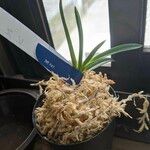
Vanda falcata
Description
Source: leafsnapVanda falcata, the wind orchid, is a species of orchid found in China, Korea, and Japan. It was formerly classified in the genus Neofinetia. 风兰 (feng lan) China (N Fujian, S Gansu, SW Hubei, W Jiangxi, Sichuan, Zhejiang) 풍란 (pungnan) Korea 風蘭 (fūran) Japan (Honshu from the Kantō region westwards; Shikoku; Kyushu; and Ryukyu Islands.)Named cultivars selected for characteristics including variegation, flower color or form, and vegetative form are often referred to as 富貴蘭 (fūkiran) in Japan. Due to these highly variable mutant forms this species has been proposed as a model organism for floral development in orchids.
Care Guide
💧 Water
The Samurai orchid, native to East Asia, thrives in environments with high humidity and ample moisture. To prevent waterlogging, water the plant weekly. Although it is primarily grown indoors, the Samurai orchid does especially well in moist conditions, with its flowering increasing during periods of active growth.
☀️ Light Full sun
The samurai orchid thrives best with plenty of sunlight, its natural environment, which supports healthy growth. However, it can also tolerate moderate amounts of sun. Too little or too much sunlight can stress the plant and reduce its vigor and flowering.
What are the sunlight requirements for Samurai Orchid?
Samurai Orchid thrives best in full sun, requiring above 6 hours of sunlight daily to ensure healthy growth. However, it can also tolerate partial sun, which constitutes about 3-6 hours of sunlight. It's essential to monitor how sunlight moves throughout your garden to find a location that offers an ideal balance of light and shade, catering to the plant's needs and ensuring its well-being.
How important is sun exposure for the growth of Samurai Orchid?
Sun exposure is crucial for the growth of Samurai Orchid, as it thrives in abundant sunlight, which mimics its natural habitat. This ensures the plant grows healthily. Although it can withstand moderate levels of sunlight, inadequate or excessive sun exposure can stress the plant, affecting its vigor and flowering potential. In conditions where natural light is not sufficient, especially during winter or in lesser sunny spaces, artificial lighting can be a beneficial alternative to support the plant's growth.
What are the symptoms of incorrect lighting for Samurai Orchid?
Incorrect lighting conditions can lead to several symptoms in Samurai Orchid, including smaller new leaves, leggy or sparse growth, faster leaf drop, slower or no new growth, lighter-colored new leaves, chlorosis (yellowing leaves), sunscald, leaf curling, wilting, and leaf scorching. These symptoms indicate the plant is not receiving the appropriate amount of light it needs to thrive, which can be due to either insufficient or excessive sunlight exposure.
What solutions can be implemented for Samurai Orchid facing light-related issues?
For Samurai Orchids facing light-related issues, gradual adaptation to increase sun exposure is recommended. For indoor plants, move them to sunnier locations gradually until they receive at least 6 hours of direct sunlight, utilizing south-facing windows for maximum light. Where moving the plant isn't feasible, consider using artificial lighting for at least 8 hours daily. For outdoor plants, similarly, gradually adjust them to sunnier spots to prevent sunburn, taking care to avoid abrupt changes in light intensity. If sunlight obstruction is an issue, consider reducing blockages by pruning or transplanting smaller plants to sunnier areas during their dormant period, ensuring they have ample sunlight and good drainage.
🌡️ Temperature 20–37.8°C
The Samurai orchid is native to regions with temperatures of 68 to 100 °F (20 to 38 ℃). It does best in those conditions, but can tolerate somewhat cooler climates in winter by reducing watering.
What is the native climate for Samurai orchid?
The Samurai orchid, or Vanda falcata, is indigenous to areas where temperatures range from 68 to 100 °F (20 to 38 °C). It thrives best within these conditions but can adapt to slightly cooler climates during the winter, provided watering is reduced. As a tropical plant, it requires indoor cultivation if winter temperatures drop below 0°C, with indoor environments kept above 20°C and near a south-facing window for ample sunlight. Humidity is crucial, so misting the plant or using a humidifier is recommended, especially when keeping the plant indoors during colder months.
How should you care for Samurai orchid in low temperatures?
In low temperatures, it is crucial to protect Samurai orchid as it thrives above 20°C and should not be exposed to temperatures below 0°C. In the event of temperatures falling below -5°C, signs of distress such as water-soaked necrosis and wilting may appear. To mitigate frost damage, trim off the affected areas and move the plant to a warm environment indoors, preferably near a south-facing window for sufficient sunlight. Avoid placing the orchid near heaters or air conditioning vents to prevent air dryness.
What are the recommended actions for Samurai orchid in high temperatures?
During high temperature periods, particularly over 38°C, Samurai orchid requires specific care to prevent halted growth, wilting leaves, susceptibility to root rot, and sunburn. It's advisable to trim sunburned or dried parts of the plant, relocate it to a shaded area avoiding direct midday and afternoon sun, and ensure adequate watering in the morning and evening to maintain moisture for both the plant and its surrounding environment.
💨 Humidity
🪴 Soil 6-7
🌱 Fertilizer
Proper fertilization is essential for the Samurai orchid's health and appearance. Fertilize the Samurai orchid in summer, repeating the treatment monthly throughout that season. Nutrients support growth and help maintain the plant's parts. Feeding the plant improves its flower display and ensures the best blooms.
🪴 Pot & Repot Every 12 months
When repotting a Samurai orchid, pick a pot that is only a bit bigger and has good drainage, ideally a clear orchid pot. Use an orchid-specific, well-draining medium that includes bark or moss. Carefully clean the roots and cut away any that are dead or rotting. Repot after the plant has finished flowering, typically in spring or fall, water well, and set it in bright, indirect light. Do not disturb the roots after repotting.
✂️ Pruning
The Samurai orchid thrives when precisely pruned from early spring to late winter. To encourage better growth, remove dead leaves and spent spikes. Be sure to use sterilized tools to reduce the risk of infection. This practice enhances air circulation, promotes healthy blooms, and keeps the plant looking tidy.
🌿 Propagating
🐛 Diseases & pets
☠️ Toxicity
The vast majority of orchids are safe for both people and animals. However, it poses a possible choking danger. It is essential to use care near children and animals.
Characteristics
- Plant Type
- Herb
- Life Cycle
- Perennial
- Genus
- Vanda
- Family
- Orchidaceae
- Hardiness Zone
- 9-12
- Mature Height
- 1.22 m
- Mature Spread
- 15 cm
- Leaf Color
- Green, Blue
- Leaf Type
- Evergreen
- Flower Color
- White
- Flower Size
- 5.08 cm to 7.62 cm
- Bloom Time
- Summer, Early fall, Mid fall
- Planting Time
- Spring, Summer, Autumn
- Harvest Time
- Fall, Early winter, Mid winter
- Native Area
- South Korea, Japan, China