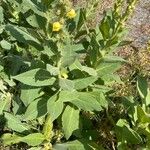
Verbascum densiflorum
Mullein · Dense-flower mullein · Denseflower mullein · Denseflowered mullein · Dense-flowered Mullein
Description
Source: leafsnapVerbascum densiflorum, commonly known as dense-flowered mullein, is a biennial or short-lived perennial plant that belongs to the Scrophulariaceae family. Native to Europe and Asia, it has also been introduced and naturalized in North America. The plant can grow between 1 to 2 meters tall and features a basal rosette of large, hairy leaves that can reach up to 30 cm in length. Its stem is erect, stout, and densely covered with hairs. The flowers of Verbascum densiflorum are arranged in dense spikes at the top of the stem. They are yellow with five petals that have purple or brown markings at their base. The flowers bloom from June through August. The plant prefers well-drained soils in full sun but can tolerate some shade and poor soils. It is commonly found growing along roadsides, fields, meadows, and disturbed areas. Verbascum densiflorum has been used for medicinal purposes for centuries due to its anti-inflammatory properties, making it useful for treating respiratory ailments such as coughs and bronchitis. Overall, Verbascum densiflorum makes an attractive addition to any garden due to its tall stature and bright yellow blooms, which attract pollinators such as bees and butterflies. It is an excellent choice for gardeners seeking a low-maintenance yet visually appealing addition to their gardens or landscapes.
Care Guide
💧 Water Every 7 days
Dense-flowered mullein thrives in a variety of European habitats, where it prefers moderate moisture levels. To ensure healthy growth, it needs to be watered weekly. This helps prevent drought conditions while also avoiding waterlogging. The plant is adaptable to different climate zones and shows resilience to temperature changes, maintaining its requirement for consistently hydrated soil.
How should I water my Dense-flowered mullein plant?
To properly water the Dense-flowered mullein, it’s best to use filtered water at room temperature because tap water may have harmful particles. This plant prefers warmer water as it originates from a warm environment, and cold water can be a shock. Instead of overhead watering, it’s recommended to apply the filtered room temperature water directly to the soil until it’s fully soaked. This method helps moisten the roots and promotes their spread and nutrient absorption.
What should I do if I give my Dense-flowered mullein too much or too little water?
Overwatering and underwatering can harm your Dense-flowered mullein, but overwatering is more common. Too much water can cause wilting and yellowing of the stems and leaves. It can also lead to diseases like root rot, mold, and mildew, which can be fatal for the plant. While underwatering is less likely due to the plant's drought tolerance, it is still possible. Signs of underwatering include brittle and brown leaves. It is important to recognize signs of overwatering early because some diseases cannot be fixed if you wait too long. Reduce your watering schedule and check the soil quality if you notice signs of overwatering. If you see signs of underwatering, simply water more regularly until the signs go away.
How often should I water my Dense-flowered mullein plant?
If your Dense-flowered mullein is in a pot, you can check if it needs water by sticking your finger in the soil. If the top two to three inches are dry, then it's time to water it. If you have your Dense-flowered mullein planted in the ground, you can use the same method to test the soil. If the top few inches are dry, it's time to water. In the spring and early fall, you'll generally need to water this plant about once a week. When it gets really hot, you may need to water it twice a week or even more. However, it's worth noting that mature and well-established Dense-flowered mullein plants have a good ability to withstand drought.
How much water does my Dense-flowered mullein require?
When watering your Dense-flowered mullein, make sure to give it a generous amount of water. Wait until the first two to three inches of soil have dried out, and then water thoroughly enough to completely soak the soil. The water should be enough to cause excess water to drain out through the holes at the bottom of the pot. If you don't see any excess water draining, it means you haven't watered enough. However, be careful not to let water accumulate in the soil, as this can harm the plant. On the other hand, if water is not draining well, it could be a sign of poorly draining soil, which is not good for the plant's health. If the plant is outside, receiving 1 inch of rain per week should be enough.
How do I water my Dense-flowered mullein as it grows?
The water needs of the Dense-flowered mullein can vary depending on its growth stages. When the plant is in its early years or has been recently transplanted, it requires more water than usual. During this time, it focuses its energy on developing new roots that will support future growth. To ensure optimal performance, these roots require slightly more moisture than during more mature stages. As the plant progresses through multiple seasons, its water requirements decrease. Another important growth stage that may demand additional water is the bloom period. The development of flowers requires a significant amount of moisture, so you may need to provide extra water during this time.
☀️ Light Full sun
The dense-flowered mullein shows a preference for abundant sunlight that supports its vigorous growth, coming from habitats with plentiful daylight. During its growth stages, both too much and too little sun can hinder development, underscoring its strict requirement for optimal light exposure to grow healthily.
What are the sunlight requirements for Dense-flowered Mullein?
Dense-flowered Mullein requires full sun, meaning it needs above 6 hours of sunlight daily to thrive. Sunlight plays a crucial role in its development, affecting its growth significantly. Insufficient or excessive sunlight can hinder its progress, emphasizing the need for an environment with an optimal balance of light and shade. Observing how sunlight moves through your garden will help you choose the best spots that cater to the needs of your plants, ensuring their health and happiness.
How can artificial lighting be used for Dense-flowered Mullein?
Artificial lighting serves as an essential substitute for natural sunlight, especially for indoor plants or during seasons with reduced daylight. For optimal growth of the Dense-flowered Mullein indoors, appropriate artificial lighting can promote healthier and faster development. LED lights are recommended due to their ability to provide specific light wavelengths needed by plants. Full sun plants benefit from 30-50W/sq ft, partial sun plants require 20-30W/sq ft, and full shade plants should have 10-20W/sq ft. The ideal placement involves situating the light source 12-36 inches above the plant, simulating the natural sunlight conditions, for about 8-12 hours per day.
What are the symptoms of inadequate light for Dense-flowered Mullein?
Inadequate light can lead to several symptoms indicating the plant's struggle to adapt. Such symptoms include smaller new leaves, indicating maturation issues; leggy or sparse growth, revealing the plant's attempt to reach more light; faster leaf drop, a sign of conservation of resources; slowed or halted new growth, indicative of survival mode; lighter-colored new leaves, suggesting insufficient chlorophyll; and several sun-related damages like chlorosis, sunscald, leaf curling, wilting, and leaf scorching—all pointing towards the plant's reaction to inappropriate light levels.
How can light exposure be optimized for Dense-flowered Mullein?
Optimizing light exposure for Dense-flowered Mullein involves gradual adaptation to appropriate sunlight conditions. For indoor plants, gradually shifting them to locations with at least 6 hours of direct sunlight usually by a south-facing window or supplementing light with artificial sources can ensure proper growth. Outdoor plants should be moved progressively each week to avoid sunburn. Addressing obstructions by pruning or transplanting can also improve sunlight access. It's crucial to note that areas affected by poor light may not fully recover, but new growth post-adjustment will be healthy.
🌡️ Temperature 5–32.2°C
Dense-flowered mullein is endemic to temperate regions where typical temperatures range from 68 to 95, which corresponds to 20 to 35 ℃. Adjust the surrounding temperature to match the plant’s native habitat, particularly during seasonal changes.
What is the native climate of Dense-flowered Mullein?
Dense-flowered mullein (Verbascum densiflorum) thrives in temperate climates with typical temperature ranges between 20 to 35°C (68 to 95°F). This makes it important to adjust ambient temperatures to mirror the plant's natural habitat, particularly during the seasonal shifts. Dense-flowered mullein possesses strong cold resistance, indicating that specific frost protection measures aren't typically necessary in winter. However, in extremely cold conditions, where winter temperatures are forecasted to fall below -30°C, it becomes crucial to provide cold protection by covering the plant with insulating materials like soil or straw. To combat drought and water scarcity during winter and early spring, it's recommended to water the plant abundantly before the first freeze arrives in autumn, ensuring the soil is moist and enters a frozen state.
How does Dense-flowered Mullein respond to low temperatures?
Dense-flowered mullein is notable for its cold tolerance, ideally thriving when temperatures remain above 20°C. While it can withstand winters where temperatures stay above 0°C, the plant faces challenges when temperatures drop below -30°C. In such cold conditions, despite its overall hardiness, there might be a noticeable decrease in sprouting activity or even no sprouting at all during the following spring. To manage these instances, the recommended solution is to remove any parts of the plant that have failed to sprout once spring arrives.
How should Dense-flowered Mullein be cared for during high temperatures?
During the summer, it's crucial to ensure that Dense-flowered mullein is kept in conditions below 35°C to prevent heat stress. When exposed to temperatures exceeding 38°C, the plant can show signs of distress such as leaves becoming lighter in color, curling, being prone to sunburn, and in extreme cases, the entire plant may wilt and dry out. To mitigate these issues, the sunburned and dried parts of the plant should be trimmed away. Relocating the plant to a shaded area or using a shade cloth to protect it from the midday and afternoon sun can also be beneficial. Ensuring the plant is watered in the morning and evening will help keep the soil moist and the plant hydrated under high temperature conditions.
💨 Humidity
🪴 Soil 6-6
🌱 Fertilizer
Dense-flowered mullein requires regular fertilizing to encourage flowering but does not tolerate excessive amounts. It needs small, frequent applications of fertilizer throughout its life, especially during the most active growth phase and while it is flowering. You should continue feeding your Dense-flowered mullein until it stops blooming.
🪴 Pot & Repot
✂️ Pruning
Dense-flowered mullein benefits greatly from pruning between early spring and late winter. To promote optimal growth and flowering, focus on removing dead stems and spent flower spikes. Regular pruning will help maintain the plant's shape, control its size, and prevent it from self-seeding. Always use clean tools to avoid spreading disease and ensure that your pruning aligns with the plant's natural growth cycle.
🌿 Propagating
🐛 Diseases & pets
☠️ Toxicity
Mullein plants contain toxic principles that are potentially harmful to people and pets. These can be found in the root, seeds, and leaves. Although some people may use mullein for medicinal purposes with minimal risk of side effects, a higher concentration can cause reactions, like irritation, itching, and rashes.
Characteristics
- Plant Type
- Herb
- Life Cycle
- Biennial, Perennial
- Genus
- Verbascum
- Family
- Scrophulariaceae
- Hardiness Zone
- 4-8
- Mature Height
- 1.52 m
- Mature Spread
- 61 cm
- Leaf Color
- Green, Silver, Gray
- Leaf Type
- Evergreen, Semi-evergreen
- Flower Color
- Yellow
- Flower Size
- 2.54 cm to 5.08 cm
- Bloom Time
- Summer
- Planting Time
- Spring, Summer, Autumn
- Harvest Time
- Late summer, Early fall, Mid fall
- Native Area
- Sweden, Austria, Czech Republic, Slovakia, Montenegro, Bulgaria, Poland, Greece, Croatia, Slovenia, Belarus, Ukraine, Serbia, Russia, Hungary, Germany, Italy, Switzerland, Denmark, France, Albania, Romania, Belgium, Netherlands