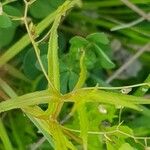
Veronica scutellata
Marsh speedwell · Skullcap speedwell · Grass-Leaf Speedwell · Grassleaf speedwell · Grass-leaved Speedwell
Description
Source: leafsnapVeronica scutellata is a species of flowering plant in the plantain family known by the common names marsh speedwell, skullcap speedwell, and grassleaf speedwell. It is native to temperate Asia, Europe, northern Africa, and northern North America, including most of Canada and the northern half of the United States. It occurs in moist and wet habitats, such as ponds, marshes and other wetlands. It is a rhizomatous herbaceous perennial producing a decumbent or upright stem 40–60 cm (16–24 in) in maximum height. It is mostly hairless in texture. The purple-green or reddish leaves are oppositely arranged in pairs about the stem, the blades lance-shaped and smooth-edged. The inflorescence is an open array of several flowers on thin, straight pedicels. The flower is up to 1 cm (0.39 in) wide with four lobes, the upper lobe being largest. It is white, blue, or purplish with purple veining. It yields a flat, notched capsule a few millimeters wide.
Care Guide
💧 Water Every 7 days
Skullcap speedwell, which originates from wet meadows, prefers consistently moist environments and should be watered weekly. Although it can endure short periods of dryness, it thrives best outdoors, where it benefits from natural rainfall and cooler temperatures. These conditions help reduce evaporation and support its moisture-loving nature.
How should I water my Skullcap speedwell plant?
To properly water the Skullcap speedwell plant, use filtered water at room temperature. Tap water may have harmful particles, so filtering is preferable. The plant is accustomed to warm environments, so avoid using cold water as it may shock the plant. Additionally, avoid overhead watering to prevent foliage problems. Instead, thoroughly soak the soil with filtered room temperature water. This will benefit the plant by moistening the roots and helping them spread and absorb nutrients.
What should I do if I give my Skullcap speedwell too much or too little water?
Overwatering is a more common issue for the health of your Skullcap speedwell. When it receives too much water, its stems and leaves may wilt and turn yellow. Overwatering for a long time can lead to diseases like root rot, mold, and mildew, which can be fatal for your plant. Underwatering is less common, but it can still happen. If it occurs, the leaves of your Skullcap speedwell will become brittle and brown. It's important to recognize the signs of overwatering early so you can take action. Some diseases caused by overwatering, like root rot, may not be fixable if you wait too long. If you see early signs of overwatering, reduce your watering immediately. Also, check the soil quality where your Skullcap speedwell is growing. If it doesn't drain well, replace it with a loose, well-draining potting mix. If you notice signs of underwatering, simply water more regularly until the signs disappear.
How often do I need to water my Skullcap speedwell plant?
When determining if your Skullcap speedwell needs water, the most accurate method is to check the soil if it is planted in a pot. Simply insert your finger into the soil and if the top two to three inches feel dry, it is time to water. For outdoor plants grown in the ground, the same method can be used. Once the first few inches of soil have dried out, it is time to water. Typically, during the spring and early fall, watering once a week is sufficient. However, during very hot weather, you may need to water twice or more per week. It is important to note that mature and well-established Skullcap speedwell plants have a remarkable ability to tolerate drought.
How much water does my Skullcap speedwell plant need?
When watering your Skullcap speedwell, be generous and make sure the first two to three inches of soil are dry before you start. It's important to thoroughly soak the soil, adding enough water to make it flow through the drainage holes at the bottom of the pot. If you don't see excess water draining, you may be underwatering, but be careful not to let water accumulate in the soil as it can harm the plant. On the other hand, if water doesn't drain properly, it may be due to poorly draining soil, which is not good for the plant's health. If the plant is outside, watering with 1 inch of rain per week should be enough.
How can I water my Skullcap speedwell as it grows?
The water requirements of the Skullcap speedwell can vary depending on its growth stages. In the first few years of its life or when it has been recently transplanted, the plant will need more water than usual. During these stages, the plant will focus on developing new roots to support future growth, and these roots require more moisture to thrive. As the plant matures, it will require less water. Additionally, during the bloom period, when the plant is producing flowers, it will also need more water as the flower development process requires a significant amount of moisture.
☀️ Light Full sun
Skullcap speedwell grows best in bright, sunlit locations that promote healthy development. The sun’s warmth and light spectrum are key parts of its habitat, closely matching its native conditions. While it can tolerate intervals without sunlight, continual exposure to plentiful light maximizes its growth potential. Both too little and too much sunlight can hinder its development.
What are the sunlight requirements for Skullcap speedwell?
Skullcap speedwell requires specific sunlight conditions to thrive, including both full and partial sun exposure. Full sun exposure is defined as receiving above 6 hours of sunlight per day, while partial sun exposure means about 3-6 hours of sunlight daily. It's crucial to observe how sunlight moves through your garden to find spots that offer an optimal balance of light and shade, ensuring the plants' well-being.
Why is sunlight essential for Skullcap speedwell, and how can artificial lighting be used?
Sunlight is a critical component of Skullcap speedwell's habitat, closely mirroring its native environment by promoting healthy growth through radiant heat and light spectrum. While it can survive periods without direct sunlight, extended exposure enhances growth potential. Artificial lighting can serve as an effective alternative to natural sunlight, especially in winter or in less sunny spaces. Adequate lighting ensures faster, healthier plant growth. LED lights are popular for indoor plants, providing necessary wavelengths of light. Depending on the plant type, appropriate wattage can range from 10-50W per square foot. The light should be placed 12-36 inches above the plant for 8-12 hours per day to mimic natural daylight conditions.
What are the symptoms of improper light exposure for Skullcap speedwell?
Skullcap speedwell exhibits several symptoms when subjected to inadequate lighting, which may include small or lighter-colored new leaves, leggy or sparse growth, faster leaf drop, and slowing or cessation of new growth. Overexposure to sunlight can also cause issues like chlorosis, sunscald, leaf curling, wilting, and leaf scorching. These symptoms indicate either a deficiency or excess of sunlight, affecting the plant's ability to perform photosynthesis efficiently and maintain healthy growth.
What are some solutions to address improper light exposure for Skullcap speedwell?
To address improper light exposure, gradually acclimate Skullcap speedwell to the appropriate light levels. For indoor plants, move them to sunnier spots incrementally until they receive at least 6 hours of direct sunlight. Use a south-facing window and consider artificial lighting for additional support. For outdoor plants, similarly adjust their exposure to sunlight gradually to prevent sunburn. Remove obstructions like tree branches if they block sunlight. If necessary, transplant smaller plants during their dormant period to better-lit locations with good drainage.
🌡️ Temperature 5–35°C
Skullcap speedwell is native to habitats with temperatures ranging from 41 °F to 95 °F (5 to 35 ℃). It does best within that range, preferring the cooler side. In cold seasons, temperatures should not drop below 41 °F (5 ℃).
What is the ideal temperature range for growing Skullcap speedwell?
Skullcap speedwell, or Veronica scutellata, thrives in environments where temperatures range from 41 to 95 °F (5 to 35 °C), favoring the cooler end of this spectrum. The plant has strong cold resistance, so it typically does not require special frost protection measures during winter. However, to ensure optimal growth and health, the temperature should not fall below 41 °F (5 °C) in colder seasons. If winter temperatures are expected to drop below -25°C, protective measures should be taken by covering the plant with soil or straw and watering it abundantly before the first freeze, to keep the soil moist.
How does Skullcap speedwell react to low temperatures?
Skullcap speedwell is highly cold-tolerant, designed to flourish when temperatures remain above 5°C. If temperatures drop below -25°C, while there may not be immediate visible damage during the winter, the plant may experience reduced sprouting or fail to sprout at all come spring. To counteract any negative impact from exceedingly low winter temperatures, remove any parts of the plant that have failed to sprout in spring.
What should I do if Skullcap speedwell is exposed to high temperatures?
During the summer, Skullcap speedwell performs best when temperatures are kept below 35°C. If the temperature rises above 38°C, the plant may show signs of stress, such as lighter colored leaves prone to curling, susceptibility to sunburn, and in extreme cases, the plant may wilt and dry out completely. In such scenarios, it is advisable to trim away the sunburned and dry parts of the plant, move it to a shaded location or create shade using a cloth, and ensure the soil remains moist by watering in the mornings and evenings.
💨 Humidity
🪴 Soil 6-7
🌱 Fertilizer
Usually one fertilizer application in spring is enough for Skullcap speedwell, though multiple feedings can increase growth. Feed every month to month and a half. Fertilization improves leaf appearance and function, encouraging even color and a healthy texture. It also promotes root development and nutrient uptake for long-term plant health.
🪴 Pot & Repot
✂️ Pruning
Skullcap speedwell is a native wetland perennial that thrives in moist environments. It is characterized by its slender stems and small blue flowers. To encourage growth and manage its spread, prune the plant in early to late spring. Ensure that your pruning tools are clean to prevent the spread of disease. For optimal results, avoid heavy pruning during the peak blooming season.
🌿 Propagating
🐛 Diseases & pets
☠️ Toxicity
Characteristics
- Plant Type
- Herb
- Life Cycle
- Perennial
- Genus
- Veronica
- Family
- Plantaginaceae
- Hardiness Zone
- 5-9
- Mature Height
- 10 cm to 49 cm
- Mature Spread
- 30 cm
- Leaf Color
- Green, Dark Green
- Leaf Type
- Semi-evergreen
- Flower Color
- White, Purple
- Flower Size
- 0.51 cm to 0.51 cm
- Bloom Time
- Late spring, Early summer, Mid summer
- Planting Time
- Spring, Summer, Autumn
- Harvest Time
- Mid summer, Late summer, Early fall
- Native Area
- Turkey, Sweden, Austria, Slovakia, Montenegro, Slovenia, Croatia, Belarus, Russia, Germany, Iceland, Estonia, Romania, Latvia, Belgium, Portugal, Netherlands, France, Czech Republic, Bulgaria, Armenia, Poland, Greece, Ukraine, Serbia, Lithuania, Norway, Italy, Kazakhstan, Spain, Switzerland, Denmark, Mongolia, Finland, Albania, Ireland, United Kingdom, Hungary, Algeria