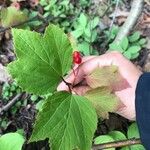
Viburnum edule
Mooseberry · Squashberry · Highbush cranberry · High Bush Cranberry · Moosewood Viburnum
Description
Source: leafsnapViburnum edule, commonly known as squashberry or mooseberry, is a deciduous shrub in the Adoxaceae family. Native to North America, it can be found in regions such as Alaska, Canada, and the northern United States. This plant typically reaches a height of 2-3 meters and has a spreading growth habit. The leaves of Viburnum edule are oval-shaped with serrated edges and are dark green in color. The plant produces small white flowers that bloom from May to June, followed by bright red berries that ripen from August through September. The berries of Viburnum edule have a tart flavor similar to cranberries and are edible. They can be used to make jams and jellies or eaten fresh off the bush. Additionally, the plant is rich in vitamin C, making it useful for treating scurvy. Viburnum edule prefers moist, well-drained soils but can tolerate various soil types, including sandy soils. It thrives in full sun but can also grow well in partial shade, making it a versatile choice for gardens and landscapes. Overall, Viburnum edule is an attractive shrub with ornamental value due to its beautiful flowers and bright red berries. It is an excellent addition to any garden or landscape design, providing both visual appeal and edible fruit for humans and wildlife alike!
Care Guide
💧 Water Every 7 days
The highbush cranberry thrives in moist, humid environments and does not tolerate drought well. For optimal health, water the plant every one to two weeks. As a deciduous plant, the highbush cranberry loses its leaves each year, which helps conserve water during dry seasons.
☀️ Light Full sun
Highbush cranberry prefers full sun, doing best when bathed in abundant sunlight that supports strong growth and development. It also shows some adaptability in light requirements, tolerating locations with moderate or lower light. Both excessive and insufficient light can potentially limit its growth and vigor.
What sun exposure requirements do plants typically have?
Plants have varying sunlight requirements to thrive. Full sun plants need more than 6 hours of sunlight daily, while those that can tolerate partial sun or full shade require about 3-6 hours of sunlight. It's essential to observe the movement of sunlight through your garden to determine the best spots that offer the ideal balance of light and shade for your plants, ensuring their optimal growth and happiness.
How does Highbush cranberry respond to different sun exposures?
Highbush cranberry thrives best in full sunlight, as it is integral for its healthy growth and development. Despite this preference, the plant exhibits a reasonable degree of flexibility regarding sun exposure, showing resilience in moderately sunny to lesser-lit areas. However, both excessive and insufficient light exposure can negatively impact its growth and vitality. It's crucial to adapt your care approach based on the plant's response to its current light conditions to ensure it continues to flourish.
What solutions exist for indoor plants with inadequate natural light?
For indoor plants struggling in low light conditions, artificial lighting serves as an excellent remedy to supplement natural sunlight. LED lights are particularly beneficial due to their ability to provide customized light wavelengths needed for plant growth. The intensity of artificial light required varies depending on the plant's natural environment needs, with full sun plants necessitating 30-50W/sq ft, partial sun plants needing 20-30W/sq ft, and full shade plants requiring 10-20W/sq ft. Proper placement and duration, mimicking natural daylight hours, are critical factors in ensuring the health and growth of your indoor plants.
What are the signs of inadequate lighting in Highbush cranberry?
Highbush cranberry exhibits several symptoms when suffering from insufficient light, including smaller new leaves, leggy growth, premature leaf drop, halted growth, pale new leaves, and chlorosis. Additionally, too much sunlight can lead to sunscald, leaf curling, wilting, and leaf scorching. These symptoms reflect the plant's struggle to adapt to its light conditions and indicate the need for immediate attention and corrective measures.
How can you improve the light conditions for Highbush cranberry both indoors and outdoors?
Improving light conditions for Highbush cranberry involves several strategies. Indoors, gradually move the plant to a sunnier location until it receives the required light, or use artificial lighting to supplement natural sunlight. Outdoors, gradually acclimate the plant to brighter areas to prevent sunburn. Reducing obstructions and considering transplantation during the plant's dormant period can also help ensure adequate sunlight exposure. It's important to note that parts of the plant already affected by incorrect lighting may not recover, but adopting these solutions will promote healthy new growth.
🌡️ Temperature 5–32.2°C
Highbush cranberry is a plant adapted to a wide range of temperatures, doing best between 41 and 89.6 °F (5 to 32 ℃). This temperature window corresponds to its native growing environment. To keep it healthy throughout the seasons, you may need to make adjustments to replicate these conditions.
What temperatures are best for growing Highbush Cranberry?
Highbush cranberry thrives in a temperature range between 41 to 89.6 °F (5 to 32 °C), which reflects its native growth conditions. It exhibits strong cold resistance, making special frost protection measures unnecessary, especially in its ideal temperature range. However, to maintain its health throughout the seasons, it's essential to mimic these natural conditions as closely as possible.
How should Highbush Cranberry be protected during winter?
To protect Highbush cranberry in winter, especially when temperatures are expected to fall below its growth limit, it is recommended to wrap the trunk and branches with non-woven fabric or cloth. Additionally, watering the plant abundantly before the first freeze in autumn ensures the soil remains moist and enters a frozen state, which helps prevent drought and water scarcity during the winter and early spring.
What are the symptoms and solutions for Highbush Cranberry in low temperatures?
In low temperatures, particularly below its growth limit, Highbush cranberry may not show noticeable changes during winter, but its branches can become brittle and dry in spring, failing to produce new shoots. The solution involves pruning away any dead branches that didn't produce new leaves in spring, promoting the growth of healthy new foliage.
How does high temperature affect Highbush Cranberry, and what are the solutions?
When the temperature exceeds the high limit for Highbush cranberry, it may result in lighter-colored leaves, tips becoming dry and withered, and an increased susceptibility to sunburn. To address this, trim away the sunburned and dried parts of the plant. Moving the plant to a shaded location or using a shade cloth to protect it from the midday and afternoon sun can prevent further damage. Ensure the soil remains moist by watering the plant in the morning and evening.
💨 Humidity
🪴 Soil 5-6
🌱 Fertilizer
The highbush cranberry plant needs adequate nutrients to achieve optimal fruit production. Apply fertilizer in early spring to promote new growth and bloom development. Regular fertilizing helps the plant remain healthy, produce more flavorful fruit, and prevents nutrient-deficiency problems like yellow leaves and poor fruit production.
🪴 Pot & Repot
✂️ Pruning
Highbush cranberry is a deciduous shrub known for its white flowers and red berries. To care for this plant, it's best to prune it in early spring. Start by removing any dead branches and thinning out crowded areas to improve air circulation. Rejuvenation pruning can also enhance the shrub's health and appearance. This encourages vigorous new growth and leads to better berry production.
🌿 Propagating
🐛 Diseases & pets
☠️ Toxicity
Characteristics
- Plant Type
- Shrub
- Life Cycle
- Perennial
- Genus
- Viburnum
- Family
- Viburnaceae
- Hardiness Zone
- 4-8
- Mature Height
- 2.44 m
- Mature Spread
- 0.61 m to 3.66 m
- Leaf Color
- Green, Dark Green
- Leaf Type
- Semi-evergreen
- Flower Color
- White
- Flower Size
- 0.51 cm to 0.76 cm
- Bloom Time
- Mid spring, Late spring
- Planting Time
- Autumn, Winter
- Harvest Time
- Late summer, Early fall, Mid fall
- Native Area
- Russia