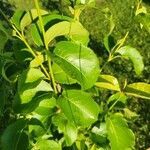
Viburnum lentago
Nannyberry · Sheepberry · Black haw · Sweet viburnum · Birnenblättriger Schneeball
Description
Source: leafsnapIn the spring, this tall and narrow shrub boasts beautiful white flowers. These abundant blossoms give way to blue-black clusters of fruit that hang down and persist through the winter, offering multi-season visual interest. It serves as a wonderful focal point and can also be seamlessly integrated into foundation plantings. Additionally, it is self-pollinating.
🌳 Nannyberry is more than just decorative; it plays a vital role in ecosystems by drawing wildlife. Its dense foliage and clusters of berries provide a habitat and food source for birds, while its fragrant flowers attract pollinators such as bees and butterflies, helping to maintain biodiversity.
🎭 Guiltlessness, purity, and serenity
Care Guide
💧 Water
Nannyberry thrives in woodlands, and it requires moderate and consistent soil moisture, with weekly watering. Once established, it is somewhat drought-tolerant. When grown outdoors, natural rainfall helps meet its moisture needs. As a deciduous plant, its water requirements decrease during dormancy, when it sheds its leaves.
How should I water Nannyberry?
Using soaker hoses is a great way to keep leaves and flowers moist without getting the entire plant wet. Simply lay the hose around the plant, leave it on for about 30 to 45 minutes, and wait until the soil is moist but not too wet. You can also hook your regular hose to the soaker hose and cover it with mulch for even more efficient watering. Alternatively, some people use drip feeders to retain moisture throughout the day. If you're planting in pots, it's best to use a watering can for the Nannyberry. Wait until you see water dripping from the bottom of the pots to ensure proper watering. The portable cans allow you to reach the soil and ensure the water penetrates deep into the roots for optimal growth.
What do I need to do if I give Nannyberry too much or too little water?
If you've overwatered your Nannyberry plant, follow these steps to prevent further damage. Nannyberries are hardy and have a good chance of survival. First, allow the plant to dry out by stopping watering. It's important to avoid waterlogged roots, so aerating the soil can be helpful. Some signs of overwatering include prematurely falling yellow leaves, fewer flowers, and misshapen buds. In more severe cases, this can lead to wilted and brown leaves. Too much water over time can even cause root rot. Similarly, underwatering can cause wilting in Nannyberry plants. To check for dehydration, stick your finger into the soil and if it feels dry, it's a sign that the plant needs water. To avoid underwatering, adding water in the evening can be helpful. Always check the soil's dryness and follow a regular watering schedule, preferably in the morning.
How frequently do I need to water Nannyberry?
To properly care for the Nannyberry plant, it is recommended to water it deeply two to three times per week. If you live in a hot climate, it may need more frequent watering. The plant requires moist but well-drained soil, so make sure the soil is not too dry. A good way to determine if watering is necessary is to feel the soil - if it is dry about 2-4 inches deep, it is probably time to water. If the plant is outdoors, watering it 1-2 times per week should be sufficient as it receives additional moisture from rainfall.
How much water does my Nannyberry plant need?
The amount of water needed can vary depending on several factors. These factors include the weather, amount of shade, and the species of plant. Newly planted Nannyberry plants require more water compared to established ones. In general, watering them with a can of water each week should be sufficient, especially during the growing season or if they are grown in pots. If the plants are being grown outdoors, it's important to monitor the amount of rain they receive using moisture meters. When the soil becomes dry, it's recommended to thoroughly water the plants with a sprinkler. To ensure that the Nannyberry receives enough moisture, it's better to water them less frequently but with sufficient amounts.
Why do I need to water my Nannyberry plant?
No matter what type of plant you're growing, it's crucial to understand its watering requirements for optimal growth. In the case of nannyberry, it requires plenty of water to thrive, otherwise it can wilt. It prefers moist soil, but it's important to ensure the ground is well-drained to avoid root rot. Overwatering should be avoided as it can result in slow flower production and stunted growth, just like underwatering can cause similar problems.
☀️ Light Full sun
Nannyberry performs best when it receives abundant sunlight for most of the day. However, it can tolerate locations that are shaded for part of the day. Too much shade can cause poor growth. Native to sun-rich habitats, this plant may display weakness and disease symptoms if it does not get enough light.
What are the sunlight requirements for Nannyberry (Viburnum lentago)?
Nannyberry requires full sun exposure, defined as more than 6 hours of sunlight daily, for optimal growth. It can also adapt to partial sun, which is about 3-6 hours of sunlight a day. However, it's crucial to observe the movement of sunlight through your garden to ensure your plants receive a balanced amount of light and shade for their health.
How does artificial lighting benefit indoor Nannyberry plants, and what are the recommendations for its use?
Indoor Nannyberry plants benefit from artificial lighting, especially when natural sunlight is insufficient, such as in winter or in less sunny spaces. Artificial lights, like LEDs, can be customized to provide the wavelengths of light that plants need, promoting faster and healthier growth. For full sun plants, 30-50W/sq ft of light is recommended; for partial sun, 20-30W/sq ft; and for full shade, 10-20W/sq ft. The light source should be placed 12-36 inches above the plant, mimicking natural sunlight for about 8-12 hours per day.
What are the signs of light deficiency or excessive sunlight exposure in Nannyberry plants?
Nannyberry shows various symptoms under suboptimal light conditions. Signs of light deficiency include smaller new leaves, leggy or sparse growth, faster leaf drop, slower or halted growth, and lighter-colored or irregularly patterned new leaves. Excessive sunlight exposure can cause chlorosis (yellowing of the leaves), sunscald, leaf curling, wilting, and leaf scorching. These symptoms indicate the plant's struggle with the light environment, affecting its health and growth.
What are some solutions for Nannyberry plants experiencing light-related growth issues?
To address light-related growth issues in Nannyberry plants, consider gradually moving indoor plants to sunnier locations to receive at least 6 hours of direct sunlight daily, potentially using a south-facing window. If moving the plant isn't feasible, consider using artificial lighting, like desk or ceiling lamps or professional grow lights, for at least 8 hours daily. For outdoor plants, gradually adapt them to sunnier spots to prevent sunburn. Pruning obstructions and transplanting smaller plants to sunnier locations with good drainage can also help. Remember, while some parts of the plant may not recover, new growth should be healthy with improved light exposure.
🌡️ Temperature 0–32.2°C
Nannyberry prefers temperatures between 32℉ and 90℉ (0℃ to 32℃). It is native to temperate areas and tolerates both cold winters and hot summers. In winter it may enter dormancy to conserve energy and protect against frost. In summer it copes with higher heat by reducing water loss through its leaves.
What temperature range is suitable for Nannyberry?
Nannyberry thrives in a temperature range of 32°F to 90°F (0°C to 32°C). It is well-adapted to temperate regions, capable of enduring both cold winters and hot summers. During winter, it enters a dormant state to conserve energy and withstand frost, while in summer, it minimizes water loss through its leaves to cope with higher temperatures. Nannyberry has a good resistance to cold, and typically, special frost protection measures are not needed. However, if temperatures are expected to fall below the plant's tolerance limit, it is advised to protect it by wrapping its trunk and branches with materials like non-woven fabric or cloth. Additionally, watering the plant abundantly before the first freeze of autumn to keep the soil moist can help prevent drought and water scarcity during the cold season.
How should Nannyberry be cared for in low temperature conditions?
Nannyberry is cold-tolerant and performs best when temperatures stay above its minimum growth threshold. Throughout the winter, it's crucial to keep it above this minimum tolerable temperature. Exposure to temperatures below its growth limit might not show immediate damage during winter, but come spring, the branches might become brittle, dry, and fail to produce new shoots. To manage this, any dead branches that haven't sprouted new leaves by spring should be pruned away to encourage healthy new growth.
What care does Nannyberry require in high temperature conditions?
During the summer, it is important to ensure that Nannyberry's temperature does not exceed its maximum suitable growth temperature. Overstepping this max threshold can lead to symptoms such as lighter leaf color, dry and withered leaf tips, and an increased risk of sunburn. To mitigate these issues, trim away any sunburned and dried-up parts, and if possible, move the plant to a shaded location or use a shade cloth to protect it from the intense midday and afternoon sun. Additionally, watering the plant during the cooler morning and evening hours can help keep the soil adequately moist, further protecting the plant from heat stress.
💨 Humidity
🪴 Soil 6-7
🌱 Fertilizer
Fertilize your Nannyberry in early spring to encourage healthy growth. Regular feeding boosts overall health, leading to vigorous growth, increased resilience to harsh conditions, and enhanced resistance to diseases and pests. Follow a set fertilization schedule for your Nannyberry to keep the foliage vibrant, deeply colored, and lush.
Why should I put fertilizer on my Nannyberry plant?
No matter what type of Nannyberry you have, regular fertilization is important for the plant's overall health. Providing the proper nutrients allows for stronger growth, better resistance to difficult growing conditions, and improved ability to fend off diseases and pests. The foliage is a notable feature of the Nannyberry, so it is crucial to maintain it. To achieve this, establish and stick to a regular fertilization schedule tailored to your specific Nannyberry. Following this routine will result in vibrant, deeply colored leaves and a lush appearance.
When should I fertilize my Nannyberry plant?
To properly fertilize your Nannyberry, start by applying fertilizer in late winter or early spring. This will provide the necessary nutrients for healthy growth once the weather warms up. In warm climate regions, it's also helpful to give your Nannyberry another fertilizer feeding in early fall. This not only adds nutrients for the following growing season but also makes the plant more resistant to winter cold and prevents foliage damage. Fertilizing earlier in the season ensures that new branches have enough time to grow and withstand the cold winter.
When should I not add fertilizer to my Nannyberry plant?
There are certain times of the year when you should avoid fertilizing your Nannyberry. Firstly, during the early and mid-winter, when the plant is dormant and doesn't require any feeding. Additionally, it's not advisable to fertilize during late spring and summer as the temperatures are higher and the weather tends to be drier. These conditions can negatively affect your Nannyberry if it's fertilized during this time. To prevent any issues, it's best to stick to a fertilization schedule that only involves feeding during early spring and early fall.
What kind of fertilizer does my Nannyberry plant need?
Nannyberries primarily require nitrogen as their main nutrient, but this does not mean that phosphorus and potassium should be disregarded. In fact, a sufficient amount of all three nutrients is important for the optimal growth of your Nannyberry. Using a balanced fertilizer like 10-10-10 is generally effective, but a more nuanced ratio of nutrients, with slightly higher nitrogen content like 10-6-4, often results in better growth. When fertilizing, you have the option of using granular or liquid-based fertilizers.
How can I give my Nannyberry plant the nutrients it needs to grow?
To fertilize your Nannyberry, you have two options: using granular fertilizer or liquid fertilizer. If you choose granular fertilizer, simply sprinkle it on the soil at the right time. The nutrients will slowly release into the soil over time. It's a good idea to lightly water your Nannyberry before applying the fertilizer. On the other hand, if you prefer liquid fertilizer, mix it with water and pour it around the base of your Nannyberry. This method is less common. Before fertilizing, consider performing a soil test to determine if any changes to the pH are necessary.
🪴 Pot & Repot 2-3 years
When repotting Nannyberry, select a pot 1-2 inches (2.5–5.1 cm) larger with ample drainage. Use a well-draining potting mix. Repot in spring or fall, making sure the root ball is slightly lower than the rim of the flower pot. Water thoroughly after repotting and place in a warm spot with indirect sunlight.
✂️ Pruning
Nannyberry showcases beautiful creamy white flowers and blue-black fruit. To promote healthy growth, prune in early spring by removing any dead or damaged wood, which helps improve air circulation and sunlight exposure. Thinning and shaping the plant not only support vigorous growth but also enhance its ornamental appeal, increase berry production, and help maintain its vitality against pests.
🌿 Propagating
🐛 Diseases & pets
☠️ Toxicity
Characteristics
- Plant Type
- Shrub
- Life Cycle
- Perennial
- Genus
- Viburnum
- Family
- Viburnaceae
- Hardiness Zone
- 3-8
- Mature Height
- 9.14 m
- Mature Spread
- 1.83 m to 3.66 m
- Leaf Color
- Green
- Leaf Type
- Deciduous
- Flower Color
- White
- Flower Size
- 0.51 cm to 0.51 cm
- Bloom Time
- Late spring, Early summer
- Planting Time
- Spring, Autumn
- Harvest Time
- Mid summer, Late summer
- Native Area
- Eastern and Midwestern United States