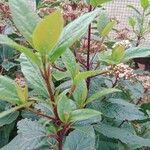
Viburnum rugosum
Care Guide
💧 Water
☀️ Light Partial sun
Laurustinus does best in parts of the garden that receive a mix of sun and shade. It can adapt to places with strong sunlight or to sites that are mostly shaded. However, extreme conditions—either too much sun or too little—can cause reduced growth or poor flowering.
🌡️ Temperature 15–35°C
Laurustinus prefers temperatures ranging from 59 to 95 ℉ (15 to 35 ℃). It can tolerate winter lows down to 14 ℉ (-10 ℃). In warmer regions, it may require some shade during the hottest part of the day.
💨 Humidity
🪴 Soil 5-7
🌱 Fertilizer
The timing of fertilizing Laurustinus is important. Apply fertilizer starting in early spring and then once a month until early summer. Fertilizer promotes lovely blooms and supplies energy both during dormant periods and active growth.
🪴 Pot & Repot 2-3 years
When repotting Laurustinus, select a pot 1-2 inches (2.5–5.1 cm) larger that has good drainage. Use a well-draining potting mix. Repot in spring or fall, making sure the root ball is slightly lower than the rim of the flower pot. Water thoroughly after repotting and place it in a warm spot with indirect sunlight.
✂️ Pruning
🌿 Propagating
🐛 Diseases & pets
☠️ Toxicity
Characteristics
- Plant Type
- Shrub
- Life Cycle
- Perennial
- Genus
- Viburnum
- Family
- Viburnaceae
- Hardiness Zone
- 8-10
- Mature Height
- 2.13 m to 7.01 m
- Mature Spread
- 2.44 m to 3.05 m
- Leaf Color
- Green
- Leaf Type
- Evergreen
- Flower Color
- White
- Flower Size
- 5.08 cm to 10.16 cm
- Bloom Time
- Spring, Early summer, Winter
- Planting Time
- Spring, Autumn
- Harvest Time
- Mid summer, Late summer, Fall
- Native Area
- Libya, Tunisia, Turkey, Montenegro, Greece, Croatia, Slovenia, Morocco, Serbia, Lebanon, Portugal, Italy, Spain, Albania, Algeria, France