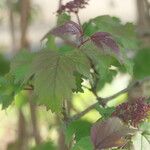
Viburnum sargentii
Sargent's Viburnum · Sargent viburnum
Description
Source: leafsnapViburnum sargentii is a species of flowering plant in the family Adoxaceae (formerly Caprifoliaceae), native to north eastern Asia. Growing to 3 m (10 ft) tall and broad, it is a substantial deciduous shrub with 3-lobed, maple-like leaves, often turning red in autumn. Flat white flower-heads (cymes) resembling those of lacecap hydrangeas are borne in early summer. The outer florets are saucer-shaped and sterile, while the central tubular flowers are fertile. The flowers are followed in autumn by globose red berries. The specific epithet sargentii commemorates the American botanist Charles Sprague Sargent.The cultivar 'Onondaga', with red central flowers, has gained the Royal Horticultural Society's Award of Garden Merit.
Care Guide
💧 Water
The Asian guelder rose thrives in moderate moisture and can tolerate short periods of dryness. Ideally, it prefers consistent moisture and benefits from being watered every 1 to 2 weeks. As an outdoor plant, it effectively regulates its water intake during the growing season to maintain optimal health and vitality.
How should I water Asian guelder rose plants?
Soaker hoses are a great way to keep leaves and flowers moist without getting the entire plant wet. To use them, lay the hose around the plant and leave it on for 30 to 45 minutes until the soil is moist but not overly wet. You can connect a regular hose to the soaker hose and cover it with mulch. Another option is to use drip feeders to keep the soil moist throughout the day. For Asian guelder rose plants in pots, it's best to water them using a watering can. Wait until you see water dripping out of the bottom of the pots. Using a portable watering can allows you to reach the soil and ensure the water penetrates deeply into the roots for better growth.
What do I do if I give Asian guelder rose too much or too little water?
If you have overwatered your Asian guelder rose, there are a few steps you can take to prevent further damage. Despite being hardy plants, they still need a chance to dry out, so stop watering them for now. Keeping their roots sitting in water for too long is not tolerable for these plants, so aerating the soil can help. Look out for symptoms like premature yellow leaf falling, fewer flowers, and misshapen buds. In more severe cases, you may notice wilted and brown leaves, which can be a result of long-term overwatering. On the other hand, underwatering can have similar symptoms, such as wilting. Check the soil for dryness by sticking your finger into it; if it feels too dry, your plant may be dehydrated. If you notice this, consider adding some water in the evening. Remember to check the soil regularly for dryness and stick to a consistent watering schedule in the morning.
How often should I water an Asian guelder rose plant?
To ensure healthy growth, the Asian guelder rose should be watered deeply two to three times a week. In hotter climates, it may need more frequent watering. The plant requires moist but well-drained soil, so check the soil moisture by feeling it with your fingers. If the soil is about 2-4 inches dry, it's a good indication that watering is needed. If the plant is planted outdoors, water it 1-2 times a week, considering the additional moisture it receives from rainfall.
How much water should I give to my Asian guelder rose?
The amount of water needed for plants can vary depending on several factors. These include the weather in the area, the amount of shade the plants receive, and the species of the plant. In the case of the Asian guelder rose, which you have recently planted, it will require more water compared to the established ones. For Asian guelder rose plants in the growing season or when in pots, a can of water each week should be sufficient. When the plants are outdoors, it is important to monitor the amount of rain they receive using moisture meters. If the soil is dry, it is best to thoroughly water the plants with a sprinkler. It is better to water the Asian guelder rose less frequently but ensure it is adequately hydrated.
Why do I need to water my Asian guelder rose?
No matter what type of plant you have, it's crucial to understand its watering requirements to ensure healthy growth. Asian guelder rose, specifically, requires ample water to avoid wilting. It prefers moist soil with good drainage to prevent root rot. Both overwatering and underwatering can result in issues like slow flower production and stunted growth.
☀️ Light Full sun
The asian guelder rose needs ample sunlight to maintain optimal health. It grows vigorously in locations that receive generous light throughout the day. While it can cope with moderately lit conditions, it truly flourishes when soaked in plentiful sunlight. However, excessive exposure can potentially damage its health.
What are the sunlight requirements for Asian Guelder Rose?
Asian Guelder Rose (Viburnum sargentii) thrives in conditions ranging from full sun, which is above 6 hours of direct sunlight, to partial sun, about 3-6 hours of sunlight. Adequate sunlight is crucial for its optimal health and robust growth. Although it can survive in moderately illuminated environments, it reaches its full potential when exposed to abundant sunlight. However, gardeners should be mindful of the plant's placement, observing the garden's light and shade dynamics to provide the best conditions for growth, as excessive exposure can be detrimental.
How does artificial lighting support the growth of indoor Asian Guelder Rose plants?
For indoor Asian Guelder Rose plants, when natural sunlight is insufficient, artificial lighting serves as a vital supplement. Effective growth under artificial lighting involves choosing the right type, such as LED lights, which can be tailored to provide specific wavelengths needed by plants. Full sun plants require 30-50W/sq ft, partial sun plants need 20-30W/sq ft, and full shade plants benefit from 10-20W/sq ft of artificial light. Positioning the light source 12-36 inches above the plant and mirroring natural daylight duration, typically 8-12 hours per day, supports healthier growth, overcoming the challenges of winter or less sunny locations.
What are the symptoms of insufficient light in Asian Guelder Rose?
When Asian Guelder Rose lacks sufficient light, several symptoms may manifest. These include small leaves compared to older ones, leggy or sparse growth due to stretched stems or leaves, faster leaf drop as a conservation measure, halted or no new growth entering survival mode, and lighter-colored new leaves indicating chlorophyll deficiency. Additionally, excessive sunlight can lead to chlorosis (leaves turning yellow), sunscald (damaged tissue), leaf curling (reduced surface area exposure), wilting (loss of turgor pressure), and leaf scorching (brown or crispy edges), adversely affecting the plant's ability to photosynthesize and maintain overall health.
How can light exposure be optimized for Asian Guelder Rose?
Optimizing light exposure for Asian Guelder Rose involves a gradual adjustment process, whether indoors or outdoors. Indoors, moving plants to sunnier locations weekly until achieving at least 6 hours of direct sunlight and considering artificial light for larger or immobile plants are recommended strategies. Outdoors, it's crucial to adapt plants gradually to sunnier spots to prevent sunburn. Furthermore, reducing obstructions such as pruning trees can enhance sunlight access. When dealing with smaller plants, transplanting during the dormant period ensures better light reception and healthier growth. Unfortunately, parts of the plant that suffered from past insufficient light may not fully recover, but new growth post-adjustment should be healthy.
🌡️ Temperature 0–32.2°C
The Asian guelder rose is very adaptable to a variety of climates, from very hot summers to fairly cold winters. Nevertheless, it has a preferred temperature range for growth. When temperatures get too high, the plant is vulnerable to heat and humidity stress, which can cause it to die. In places where temperatures approach the lower limit of its cold tolerance, it is important to provide insulation to protect the plant.
What is the Asian guelder rose?
The Asian guelder rose, known scientifically as Viburnum sargentii, is a plant species. Unfortunately, the provided information does not include details about its characteristics, such as its essentials or symptoms that might be relevant to its care or identification.
💨 Humidity
🪴 Soil 5-6
🌱 Fertilizer
Timing is important when fertilizing the Asian guelder rose. Apply fertilizer in early spring and continue monthly until early summer. Fertilizer promotes attractive blooms and supplies energy during both dormant and actively growing periods.
Why is it necessary to add fertilizer to my Asian guelder rose plant?
In order to help your Asian guelder rose thrive and produce beautiful blooms, it is important to fertilize it. One of the most obvious reasons to fertilize is to enhance flower production, especially by applying fertilizer in early spring. Fertilizer also provides the plant with ample energy that can be stored in the ground during its dormant phases. By giving your Asian guelder rose additional nutrients during fall planting or late spring, it ensures that the plant has enough energy to support active growth later on.
When should I fertilize my Asian guelder rose?
To ensure effective fertilization for Asian guelder rose, timing is crucial. Fertilizing too early when the plant is still dormant will not be effective and can be washed away by rainwater, leading to waste and pollution. It is recommended to apply the first round of fertilizer in early spring and continue once a month until early summer.
When should I not put fertilizer on my Asian guelder rose?
To ensure optimal growth and bloom development for Asian guelder rose, it is important to choose a fertilizer with a lower level of nitrogen compared to other nutrients. Excessive nitrogen can result in an abundance of leaves but few blooms. It is advisable to avoid fertilizing the plant beyond early autumn as this can lead to excessive growth right before winter. Additionally, refrain from fertilizing during hot and dry periods as the dry soil is less capable of effectively delivering nutrients to the plant. Fertilizing at this time may also stimulate growth that requires more water, which may not be readily available. It is preferable to apply fertilizer earlier in the season when temperatures are cooler. Lastly, be cautious about unintentionally providing the plant with a double dose of fertilizer, as nearby plants or lawns may contribute to its nutrient intake.
What kind of fertilizer should I use for my Asian guelder rose?
To help your Asian guelder rose thrive, consider using a fertilizer with a balanced mix of nutrients, slightly higher in phosphorus. Alternatively, you can improve the soil by adding organic materials like compost, worm castings, and manure. Some experienced gardeners choose to supplement with water-soluble fertilizers containing phosphorus when the flower buds start to appear. This encourages better flower development, resulting in larger blooms and a longer bloom time. Fertilizers can come in different forms, but liquid or powdered fertilizers work particularly well for Asian guelder rose. Regardless of the form you choose, dilute the fertilizer and apply it while watering the plant.
How do I make my Asian guelder rose grow better?
To effectively fertilize your Asian guelder rose, it's crucial to adhere to specific fertilizer instructions and conduct research on proper usage. Avoid over-fertilization by determining the correct amount to apply. A good guideline is to base the amount on the tree's age or trunk diameter, using approximately one-tenth of a pound of fertilizer per year or per inch of trunk. The maximum amount should not exceed one pound. Granular fertilizers and organic options like blood meal are commonly used. Apply them by sprinkling around the tree's base, extending to the drip line, but be sure to keep the fertilizer away from the trunk. Over time, the granules will break down and infiltrate the soil, providing nourishment to the roots. After fertilizing, apply a one-inch layer of compost around the base and thoroughly water the tree.
🪴 Pot & Repot
✂️ Pruning
To improve the health and appearance of your Asian guelder rose, prune it in late spring after it has finished flowering. Start by removing any dead or crossing branches to improve airflow and allow more sunlight to reach the plant. Additionally, thin out older stems at the base to rejuvenate the plant and encourage new growth. It is important to time your pruning carefully to avoid disrupting the flowering cycle, which in turn enhances both blooms and fruit production.
🌿 Propagating
🐛 Diseases & pets
☠️ Toxicity
Characteristics
- Plant Type
- Shrub
- Life Cycle
- Perennial
- Genus
- Viburnum
- Family
- Viburnaceae
- Hardiness Zone
- 3-7
- Mature Height
- 3.66 m to 4.57 m
- Mature Spread
- 3.66 m to 4.57 m
- Leaf Color
- Green, Purple, Bronze, Brown, Lavender
- Leaf Type
- Deciduous
- Flower Color
- White, Pink
- Flower Size
- 7.62 cm to 10.16 cm
- Bloom Time
- Mid spring, Late spring
- Planting Time
- Spring, Summer, Autumn
- Harvest Time
- Late summer, Early fall, Mid fall
- Native Area
- Russia, Japan, Mongolia, Koppen, South Korea, China