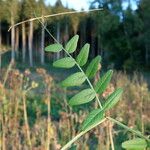
Vicia sepium
Bush Vetch · Hedge vetch · Tufted Vetch
Description
Source: leafsnapVicia sepium, commonly known as bush vetch or tufted vetch, is a perennial herbaceous plant belonging to the Fabaceae family. Native to Europe and Asia, it has been introduced and naturalized in many parts of the world. The plant can grow up to 1 meter tall and has a sprawling habit with slender stems that can climb or trail along the ground. The leaves of Vicia sepium are pinnate, featuring 8-12 pairs of oblong leaflets. Its pinkish-purple flowers are arranged in clusters at the ends of long stalks and bloom from May to August, attracting bees, butterflies, and other pollinators. The fruit of Vicia sepium is a pod containing several seeds, which can be used for food or animal feed. Due to its high protein content, the plant is also employed as a forage crop for livestock. In traditional medicine, Vicia sepium has been used as an herbal remedy for various ailments, including respiratory infections, digestive disorders, and skin conditions. Overall, Vicia sepium serves multiple purposes such as being a food source, animal feed, and having medicinal uses.
🌳 Bush vetch is a lovely addition to any garden, as it produces vibrant flowers over two seasons, from mid-spring to mid-summer. These blossoms are especially attractive to pollinators such as bees and butterflies. Bush vetch is an ideal choice for planting in woodland gardens, hedgerows, and meadows.
Care Guide
💧 Water Every 7 days
Bush vetch flourishes in moderate climates where there is consistent moisture. Weekly watering effectively mimics natural rainfall, preventing waterlogging. As an outdoor plant, it benefits from rainwater, which supports its growth during the active growing seasons.
How should I water my Bush vetch plant to make it grow best?
To properly water the Bush vetch, it is recommended to use filtered water at room temperature. Tap water may contain harmful particles, so filtered water is preferred. Additionally, the water used should be at room temperature or slightly warmer since the Bush vetch thrives in warm environments and cold water can be stressful for it. Instead of overhead watering, it is best to directly apply the filtered room temperature water to the soil until it is fully soaked. This helps to moisten the roots and support their spreading through the soil, allowing them to absorb essential nutrients.
What do I do if I give my Bush vetch plant too much or too little water?
Both overwatering and underwatering can harm your Bush vetch plant, but overwatering is a more common problem. Too much water can cause wilting, yellowing leaves, and even diseases like root rot, mold, and mildew that can kill the plant. Underwatering is less likely because the Bush vetch has good drought tolerance, but it can still happen, resulting in brittle, brown leaves. It's important to recognize the signs of overwatering early to prevent irreversible damage, and if you see them, reduce your watering immediately. Check the soil and replace it with well-draining potting mix if it doesn't drain well. If your Bush vetch shows signs of underwatering, simply water it more regularly until the signs improve.
How frequently do I need to water my Bush vetch plant?
If your plant is in a pot, the best way to determine if your Bush vetch needs water is to check the soil. Stick your finger into the soil and if the top two to three inches are dry, it's time to water. If you're growing the Bush vetch outdoors in the ground, you can use the same method. When the top few inches of soil are dry, it's time to water. During the spring and early fall, this usually means watering once a week. In extremely hot weather, you may need to water twice a week or more. However, mature and well-established Bush vetch plants are quite resilient and can withstand drought.
How much water does my Bush vetch plant need?
To water your Bush vetch effectively, don't hold back on the amount of water you give. Make sure the top two to three inches of soil are dry before watering thoroughly. The goal is to saturate the soil completely, so add enough water to the pot that excess water flows out of the bottom drainage holes. If you don't see any excess water draining, it means you haven't watered enough. However, be careful not to let the water accumulate in the soil, as this can harm the plant. On the other hand, if water doesn't drain well through the pot, it may indicate poor soil drainage, which is harmful to the plant's health and should be avoided. For outdoor plants, receiving about 1 inch of rain per week is sufficient.
How do I water my Bush vetch at different stages of growth?
The water requirements of the Bush vetch can vary depending on its growth stages. Specifically, when the plant is in its early years or has recently been transplanted, it requires more water than usual. During these stages, the Bush vetch focuses its energy on developing new roots, which are essential for future growth. These roots need slightly more moisture to function optimally compared to their mature counterparts. As the plant matures over a few seasons, its water needs decrease. Additionally, during the bloom period, the Bush vetch requires more water due to the significant amount of moisture needed for flower development.
☀️ Light Partial sun
Bush vetch performs best in conditions with moderate sun exposure, which markedly encourages its growth. Sunlight that is overly strong or too limited can be damaging to the plant's health. When situated in areas where the sun's rays are filtered, bush vetch grows most favorably.
What are the sunlight requirements for Bush Vetch?
Bush vetch requires partial sun, meaning it thrives best in environments that receive about 3-6 hours of sunlight per day. It's essential to observe how sunlight moves through your garden to find spots that offer a good balance of light and shade, ensuring the plant's well-being. Moderately sunny environments stimulate bush vetch's growth, while too much or too little sunlight can be harmful. When cultivating bush vetch indoors or in less sunny areas, using artificial lights, such as LED lamps, can provide the necessary wavelengths of light. For healthy growth, full sun plants need 30-50W/sq ft, partial sun plants 20-30W/sq ft, and full shade plants 10-20W/sq ft of artificial light.
What symptoms might Bush Vetch show due to inappropriate light conditions and how can they be mitigated?
Bush vetch can display several symptoms if the light conditions are not optimal. Inadequate light can lead to small leaves, leggy or sparse growth, faster leaf drop, slower or no new growth, and changes in leaf color such as lighter-colored new leaves, chlorosis, and sunscald. Furthermore, overexposure to sunlight might cause leaf curling, wilting, leaf scorching. To mitigate these issues, gradually adjust your plant to the correct light conditions. For indoor plants, start by moving them to sunnier spots each week or use artificial lighting for at least 8 hours daily. For outdoor plants, make adjustments gradually to avoid sunburn. If sunlight is blocked by obstacles like trees, consider pruning to improve light accessibility. For plants severely affected by light conditions, moving them during their dormant period might be necessary to ensure recovery and new healthy growth.
🌡️ Temperature 5–35°C
Bush vetch is a hardy plant native to temperate climates and does well at temperatures from 41 to 95 °F (5 to 35 ℃). Because of its broad temperature tolerance, seasonal adjustments are usually unnecessary.
What is bush vetch and where is it native to?
Bush vetch, botanically known as Vicia sepium, is a robust plant native to temperate climates. It thrives at temperatures ranging from 41 to 95 °F (5 to 35 °C), demonstrating a wide tolerance to different seasonal temperatures. This plant is well adapted to various temperate environments, making adjustments for different seasons usually unnecessary due to its adaptability.
Does bush vetch require special frost protection measures during winter?
Bush vetch has strong cold resistance and usually does not require special frost protection measures during the winter. However, if winter temperatures are expected to drop below -25°C, providing cold protection becomes important. This protection can be achieved by covering the plant with soil or straw. Additionally, it's recommended to water the plant abundantly before the first freeze in autumn to ensure the soil remains moist. This moisture helps to prevent drought and water scarcity for the plant during the winter and early spring.
How does bush vetch respond to low temperatures, and what solutions are there for any potential issues?
Bush vetch is cold-tolerant and thrives best when the temperature is kept above 5°C. During winter, it should be kept above -20°C. However, when temperatures fall below -25°C, there may not be noticeable changes during the winter, but a decrease in sprouting or even no sprouting may occur during spring. The solution to this issue is to remove any parts of the bush vetch that have failed to sprout in the spring.
What are the effects of high temperature on bush vetch, and how can these effects be mitigated?
During the summer, bush vetch should ideally be kept below 35°C. When the temperature exceeds 38°C, the leaves of the plant may become lighter in color, prone to curling, susceptible to sunburn, and, in severe cases, the entire plant may wilt and become dry. To mitigate these effects, sunburned and dried-up parts of the plant should be trimmed away. Moving the plant to a location that provides shade during the midday and afternoon sun or using a shade cloth can help, as well as watering the plant in the morning and evening to keep the soil moist.
💨 Humidity
🪴 Soil 6-7
🌱 Fertilizer
Early spring, when Bush vetch is coming out of dormancy and beginning active growth, is the best time to fertilize. Fertilizer supplies essential nutrients for healthy development. While Bush vetch has fairly low feeding requirements, an annual application can improve its survival and encourage better, longer-lasting blooms.
🪴 Pot & Repot
✂️ Pruning
Bush vetch is a climbing plant that, if left unchecked, can overtake other vegetation. To encourage compact growth and prevent it from spreading excessively, regular pruning is essential.
🌿 Propagating
🐛 Diseases & pets
☠️ Toxicity
Vicia sepium has no toxic effects reported.
Characteristics
- Plant Type
- Herb
- Life Cycle
- Perennial
- Genus
- Vicia
- Family
- Fabaceae
- Hardiness Zone
- 5-9
- Mature Height
- 30 cm to 61 cm
- Mature Spread
- 30 cm to 91 cm
- Leaf Color
- Green
- Leaf Type
- Evergreen
- Flower Color
- Purple, Lavender
- Flower Size
- 1.02 cm to 2.03 cm
- Bloom Time
- Late spring, Early summer, Mid summer
- Planting Time
- Spring
- Harvest Time
- Early summer, Mid summer
- Native Area
- India, Austria, Turkey, Sweden, Slovakia, Montenegro, Pakistan, Croatia, Slovenia, Belarus, Russia, Germany, Iceland, Estonia, Romania, Latvia, Belgium, Moldova, Portugal, Netherlands, France, Czech Republic, Bulgaria, Armenia, Poland, Greece, Ukraine, Serbia, China, Lithuania, Norway, Kyrgyzstan, Kazakhstan, Italy, Spain, Switzerland, Denmark, Finland, Ireland, United Kingdom, Hungary, Azerbaijan