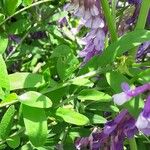
Vicia villosa
Hairy Vetch · Fodder vetch · Winter vetch · Woolly Vetch · Lesser Tufted Vetch
Description
Source: leafsnapVicia villosa, commonly known as hairy vetch, is a leguminous plant native to Europe and Asia. This annual or biennial plant can grow up to 1.5 meters tall and has a sprawling growth habit. Its leaves are pinnately compound, consisting of 10-20 leaflets, and are covered in fine hairs, giving the plant its characteristic hairy appearance. Hairy vetch is often used as a cover crop in agriculture due to its ability to fix atmospheric nitrogen into the soil, thereby improving soil fertility for subsequent crops. Additionally, its deep roots help prevent erosion and enhance soil structure. Beyond its agricultural benefits, hairy vetch has been utilized in traditional Chinese medicine to treat various ailments such as fever and inflammation. In summary, Vicia villosa, or hairy vetch, is a valuable plant species with multiple benefits ranging from agricultural applications as a cover crop to medicinal uses in traditional practices. This makes it an important resource both for farming and traditional medicine worldwide.
💡 Hairy vetch is a nitrogen-fixing legume commonly used in organic farming as a cover crop and for chop-and-drop mulching. After the winter cover crop is cut down, tomatoes can be planted in its place. The remaining hairy vetch acts as a mulch and compost for the tomatoes. However, a potential drawback of hairy vetch is its ability to reseed itself, which can lead to an unexpected fall crop that may not be desired.
🌳 Although not widely recognized, one significant trait of hairy vetch is its ability to restore soil fertility by fixing atmospheric nitrogen. As a leguminous plant, it associates with rhizobial bacteria in its root nodules to carry out this process. By converting nitrogen gas into a form plants can use, hairy vetch improves soil quality, supports sustainable farming practices, and reduces reliance on synthetic fertilizers.
🎭 I cling to you, Shyness.
Care Guide
💧 Water Every 7 days
Hairy vetch, native to temperate regions, thrives with consistent hydration and can handle short dry spells. To prevent soil from becoming waterlogged, water it once a week. It thrives outdoors, adapting well to soil moisture levels that mimic natural rainfall patterns. This makes it ideal for temperate climates with regular rain cycles.
How should I water my Hairy vetch plant?
Hairy vetch can be watered using various tools such as a garden hose with a spray nozzle or a watering can. It is not particular about the type of water it receives, whether it's rainwater, tap water, or filtered water. However, it is advisable to avoid watering the plant from above to prevent damage to leaves, flowers, and possible disease. A drip irrigation system can be the best method for watering Hairy vetch as it provides even and direct watering to the soil. For a container-grown Hairy vetch, you can use a cup, watering can, or tap to water it directly into the soil.
What can I do if I give my Hairy vetch plant too much or too little water?
To help your Hairy vetch thrive, it's important to pay attention to its water needs. Underwatering can be fixed by increasing the frequency of watering. On the other hand, overwatering is more serious and can lead to diseases and even death of the plant. To prevent this, choose a suitable growing spot that gets enough sunlight and has good drainage. If you have overwatered your Hairy vetch in a pot, consider transferring it to a new pot with proper drainage and loose soil.
How many times should I water my Hairy vetch?
To keep your Hairy vetch healthy, it requires regular watering throughout the growing season. In spring, watering once a week should suffice. However, as the weather gets warmer, you may need to increase watering to two or three times a week. Be careful not to exceed this frequency as it can harm the plant. Regardless of the watering schedule, it's important to maintain moist, but not wet, soil for your Hairy vetch. Watering potted Hairy vetch requires slightly more attention. The soil in pots tends to heat up and dry out faster, so you'll likely need to water a few times per week rather than just once.
How much water does my Hairy vetch plant need?
There are a few ways to figure out how much water your Hairy vetch needs. Some gardeners feel the soil to determine if it's moist enough, watering until the first six inches are damp. Another option is to use a specific measurement. Typically, two gallons per week should suffice, but adjust based on temperature and soil dryness. Be careful not to overwater though. When growing Hairy vetch in a container, you'll need a different approach. Ensure that all layers of dry soil are moist by testing with your finger or allowing excess water to drain from the pot.
How do I know if I'm giving enough water to my Hairy vetch?
To prevent overwatering your Hairy vetch, you need to strike a balance. These plants have deep roots that need regular moisture, but they are also prone to root rot and browning if overwatered. Underwatering is less of a concern as Hairy vetch can survive without additional watering for some time, but if they go too long without water, they will wilt and develop dry leaves.
☀️ Light Full sun
Hairy vetch prefers abundant sunlight, favoring locations with plenty of daytime light but also tolerating sites with limited daylight or low-light conditions. For healthy growth this plant requires a substantial amount of light, which changes with its growth stages. Both excessive and insufficient sunlight can negatively affect its development.
What are the sunlight requirements for hairy vetch?
Hairy vetch thrives in locations with ample sunlight, requiring more than 6 hours of sunlight for full sun conditions, and about 3-6 hours of sunlight for partial sun to full shade conditions. It’s important to observe the movement of sunlight in your garden to choose the best spots for planting, ensuring a good balance of light and shade for optimal growth.
How does the amount of sunlight affect hairy vetch's growth?
The amount of sunlight hairy vetch receives is crucial to its health and growth. It prefers plenty of light, but its light needs vary through different stages of its life. Insufficient or excessive sunlight can impact its growth negatively, emphasizing the need to provide conditions that closely mimic its natural habitat for healthy development.
What artificial lighting requirements do indoor hairy vetch plants have?
Indoor hairy vetch plants require adequate lighting, especially when natural sunlight is insufficient. Artificial lights, like LED lights, which can be adjusted to provide specific wavelengths, are ideal. For full sun plants, 30-50W/sq ft is necessary, for partial sun plants, 20-30W/sq ft, and for full shade plants, 10-20W/sq ft. The light source should be placed 12-36 inches above the plant, mimicking natural daylight hours, often requiring 8-12 hours of light per day.
What are some common symptoms of inadequate light in hairy vetch?
When hairy vetch does not receive sufficient light, it may display symptoms such as smaller leaves, leggy or sparse growth, faster leaf drop, slower or no new growth, and lighter-colored or yellowing leaves. Excessive sunlight can cause chlorosis, sunscald, leaf curling, wilting, and leaf scorching, which negatively affects photosynthesis and overall health.
What solutions are available for hairy vetch plants experiencing light-related issues?
For indoor hairy vetch struggling with light, gradually moving the plant to sunnier spots or using artificial light can help. Plants should ideally get at least 6 hours of sunlight daily, with artificial lighting serving as a supplement. Outdoors, adjusting plant placement gradually to sunnier locations helps avoid shock. Removing obstructions or transplanting to brighter spots can also improve sunlight exposure. Note that some damage from improper sunlight may be irreversible, but new growth can be healthy with correct lighting.
🌡️ Temperature 5–35°C
Hairy vetch is a temperate species native to environments where temperatures typically range from 68 to 95°F (20 to 35℃). It performs best within that range and may need extra care if temperatures fall below or rise above it. In colder seasons, it is recommended to provide a warmer microclimate to support healthy growth.
What is the optimal temperature range for growing Hairy vetch?
Hairy vetch (Vicia villosa) is a temperate plant species best suited to environments with temperatures ranging between 68 to 95°F (20 to 35°C). It requires additional care when temperatures fall below or rise above this range. To protect the plant in colder seasons, it's beneficial to provide a warmer microclimate, though it generally has strong cold resistance and special frost protection measures are not usually necessary. Nevertheless, when winter temperatures are expected to drop significantly, protecting the plant with soil or straw cover and watering it abundantly before the first freeze to keep the soil moist can help it through the cold months.
How does low temperature impact Hairy vetch, and what are the solutions?
Hairy vetch is quite cold-tolerant, but it thrives better when the temperature remains above its suitable growth minimum. During winter, maintaining temperatures above the tolerable growth minimum is essential. If temperatures fall below the limit for growth, the plant may not exhibit immediate distress but could face decreased or absent sprouting in spring. The solution for this is to wait until spring to remove any parts of the plant that failed to sprout, promoting healthier growth in the following season.
How does high temperature affect Hairy vetch, and what measures should be taken?
During summer, it's crucial to keep Hairy vetch's temperature below its maximum suitable growth level. Exceeding the maximum tolerable growth temperature can lead to the leaves becoming lighter in color, curling, and becoming susceptible to sunburn. In severe cases, the entire plant may wilt and dry out. To mitigate these effects, trim away any sunburned or dried parts of the plant, relocate the plant to a shaded area, or use a shade cloth to protect it from direct midday and afternoon sun. Additionally, watering the plant in the morning and evening will help keep the soil moist and support the plant's health.
💨 Humidity normal (40-60%)
This plant will thrive in moderate humidity, which is probably the level in your home. However, misting it a few times a week can be very beneficial. Make sure the room has good ventilation.
🪴 Soil 6-7
🌱 Fertilizer
Hairy vetch benefits from regular, light applications of fertilizer to encourage healthy leaf growth. You should fertilize Hairy vetch about once a month during the summer. Nitrogen is essential for foliage, and supplementing with nitrogen-rich sources helps Hairy vetch thrive.
🪴 Pot & Repot
Hairy vetch thrives best in pots with excellent drainage. Good drainage ensures the roots get enough airflow and prevents waterlogging.
✂️ Pruning
Hairy vetch is a climbing plant that can easily spread and overtake nearby plants if not kept in check. To maintain a compact growth and prevent it from spreading uncontrollably, regular pruning is essential.
🌿 Propagating
🐛 Diseases & pets
☠️ Toxicity
Characteristics
- Plant Type
- Herb
- Life Cycle
- Annual, Biennial, Perennial
- Genus
- Vicia
- Family
- Fabaceae
- Hardiness Zone
- 4-9
- Mature Height
- 0.3 m to 1.52 m
- Mature Spread
- 30 cm to 91 cm
- Leaf Color
- Green, Blue
- Leaf Type
- Deciduous
- Flower Color
- Purple, Violet
- Flower Size
- 2.54 cm
- Bloom Time
- Mid spring, Late spring, Early summer
- Planting Time
- Spring, Summer
- Harvest Time
- Early summer, Mid summer
- Native Area
- Libya, Egypt, Turkey, Austria, Morocco, Belarus, Russia, Iraq, Germany, Jordan, Estonia, Netherlands, Portugal, France, Tunisia, Cyprus, Bulgaria, Poland, Armenia, Greece, Ukraine, Lebanon, Lithuania, Afghanistan, Kyrgyzstan, Kazakhstan, Italy, Spain, Switzerland, Israel, Iran, Albania, Azerbaijan, Algeria, Hungary