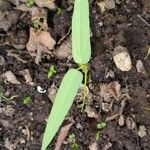
Vigna umbellata
Oriental-bean · Climbing mountain-bean · Mambi-bean · Rice bean
Description
Source: leafsnapVigna umbellata, previously Phaseolus calcaratus, is a warm-season annual vine legume with yellow flowers and small edible beans. It is commonly called ricebean or rice bean. To date, it is little known, little researched and little exploited. It is regarded as a minor food and fodder crop and is often grown as intercrop or mixed crop with maize (Zea mays), sorghum (Sorghum bicolor) or cowpea (V. unguiculata), as well as a sole crop in the uplands, on a very limited area. Like the other Asiatic Vigna species, ricebean is a fairly short-lived warm-season annual. Grown mainly as a dried pulse, it is also important as a fodder, a green manure and a vegetable. Ricebean is most widely grown as an intercrop, particularly of maize, throughout Indo-China and extending into southern China, India, Nepal and Bangladesh. In the past it was widely grown as lowland crop on residual soil water after the harvest of long-season rice, but it has been displaced to a great extent where shorter duration rice varieties are grown. Ricebean grows well on a range of soils. It establishes rapidly and has the potential to produce large amounts of nutritious animal fodder and high quality grain.
Care Guide
💧 Water
Ricebean flourishes in subtropical climates, where it prefers moderate moisture and can withstand occasional rainfall. It needs watering every three weeks and can endure brief periods of drought. Commonly grown for its edible seeds, ricebean is well-adapted to growth cycles that align with natural precipitation patterns.
☀️ Light Full sun
Ricebean comes from open habitats, such as sunny meadows and forest margins, where light is plentiful. It does best in Full Sun but can also tolerate Partial Sun, adjusting well to a range of sunlight conditions.
What are the sunlight requirements for Ricebean?
Ricebean (Vigna umbellata) thrives in various sunlight conditions, preferring full sun, which amounts to over 6 hours of direct sunlight daily, but can also grow well in partial sun, requiring about 3-6 hours of sunlight. It's vital to observe the movement of sunlight through your garden to find the ideal spots that offer the perfect balance of light and shade, ensuring the plants' health and happiness.
Can Ricebean grow under artificial lighting?
Yes, Ricebean can grow under artificial lighting, especially when natural sunlight is insufficient, such as in winter or less sunny locations. Indoor plants benefit from artificial lights like LEDs, which can be customized to provide specific wavelengths needed by the plants. Full sun plants need 30-50W/sq ft of artificial light, partial sun plants need 20-30W/sq ft, and the light source should be placed 12-36 inches above the plant for 8-12 hours per day to mimic natural daylight hours effectively.
What are the common symptoms of light deficiency in Ricebean plants?
Ricebean plants may show several symptoms when light conditions are inadequate, including smaller new leaves, leggy or sparse growth, faster leaf drop, slower or halted growth, lighter-colored new leaves, and specific issues like chlorosis (yellowing leaves due to chlorophyll breakdown), sunscald, leaf curling, wilting, and leaf scorching. These symptoms indicate the plant is not receiving enough sunlight or is exposed to excessive sunlight.
How can I address light deficiency issues in Ricebean plants?
To address light deficiency in Ricebean plants, gradually increase their exposure to sunlight. For indoor plants, move them closer to a south-facing window or use artificial lighting like desk or grow lights for at least 8 hours a day. Outdoors, relocate your plants to sunnier spots gradually to avoid sunburn. Minimize obstructions like overhanging branches to allow more sunlight to reach the plants. For profound solutions, consider pruning obstructive vegetation or transplanting smaller plants to sunnier locations with ample sunlight and proper drainage.
🌡️ Temperature 20–37.8°C
Ricebean comes from tropical areas where the climate is generally warm and humid. Consequently, it is well suited to high heat and moisture. It is sensitive to abrupt temperature shifts and prefers a consistent thermal environment, so indoor temperature fluctuations should be avoided. It typically cannot tolerate cold and needs warmer conditions to grow. If the ambient temperature falls too low, the plant may stop growing or even die.
What is Ricebean?
Ricebean, known scientifically as Vigna umbellata, is a plant species. It does not have additional information provided regarding its essentials or symptoms related to its cultivation and uses.
💨 Humidity
🪴 Soil 5-7
🌱 Fertilizer
To achieve optimal growth, Ricebean needs three fertilizer applications: one before planting, another about one month after seedling emergence, and a final application 1 to 1.5 months after the second. Some Ricebean varieties also benefit from extra fertilizer at planting to promote rapid growth.
🪴 Pot & Repot
✂️ Pruning
Ricebean is a robust Asian vine characterized by its trifoliate leaves and yellow flowers. To maintain its health, prune the vine from early to late spring. During pruning, remove any dead stems and thin out dense areas to improve air circulation. Using clean and sharp tools will help minimize damage and reduce the risk of disease, leading to healthier growth and increased yields.
🌿 Propagating
🐛 Diseases & pets
☠️ Toxicity
Characteristics
- Plant Type
- Vine
- Life Cycle
- Annual
- Genus
- Vigna
- Family
- Fabaceae
- Hardiness Zone
- 9-12
- Mature Height
- 0.3 m to 2.13 m
- Mature Spread
- 30 cm to 61 cm
- Leaf Color
- Green
- Leaf Type
- Deciduous
- Flower Color
- Yellow
- Flower Size
- 1.27 cm
- Bloom Time
- Summer, Early fall, Mid fall
- Planting Time
- Spring, Summer, Autumn
- Harvest Time
- Late summer, Fall, Early winter
- Native Area
- Nepal, Sri Lanka, India, Malaysia, Indonesia, Cambodia, Vietnam, Myanmar, Philippines, Bhutan, Laos, Thailand, China