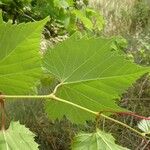
Vitis riparia
Riverbank grape · Frost grape · River-Bank Grape · Riverbank grapevine
Description
Source: leafsnapVitis riparia Michx, with common names riverbank grape or frost grape, is a vine indigenous to North America. As a climbing or trailing vine, it is widely distributed across central and eastern Canada and the central and northeastern parts of the United States, from Quebec to Texas, and eastern Montana to Nova Scotia. There are reports of isolated populations in the northwestern USA, but these are probably naturalized. It is long-lived and capable of reaching into the upper canopy of the tallest trees. It produces dark fruit that are appealing to both birds and people, and has been used extensively in commercial viticulture as grafted rootstock and in hybrid grape breeding programs. Riverbank grape is a translation of the scientific name Vitis riparia; rīpārius means "of riverbanks" in Latin, deriving from rīpa "riverbank".
🌳 The Riverbank grape's succulent grapes not only produce robust hybrid wines suited to a variety of climates, but the plant also possesses natural disease-fighting abilities. Its antifungal and antimicrobial traits make it an eco-conscious option for protecting plants from illness. Moreover, essential oils extracted from its seeds are being studied for their antioxidant and antibacterial benefits in beauty and health products.
🎭 Fecundity, Sorcery, Psychic Powers
Care Guide
💧 Water
The riverbank grape is a plant native to riverbanks and floodplains, thriving in moist environments. It prefers consistent moisture, so watering it weekly is beneficial. This plant is adaptable to different rainfall patterns, making it resilient in temperate climates with changing seasonal precipitation.
When should I water my Riverbank Grape?
Timely watering is essential for the growth and health of riverbank grape (Vitis riparia). You should water your riverbank grape when the top 1-2 inches of soil become dry to the touch. Be vigilant for signs such as wilting leaves, which typically indicate the plant needs water. However, be cautious of overwatering, as riverbank grape prefers well-drained soil, and too much water can cause root rot. Additionally, changes in leaf color or shriveled tendrils can also signal the need for watering. It's important to adjust your watering habits to avoid both overwatering and underwatering, as either can lead to problems such as leaf browning, wilting, stunted growth, and poor fruit production.
How should I water my Riverbank Grape?
Watering riverbank grape effectively involves using methods and tools that cater to its specific needs. A bottom-watering technique, where the plant pot is placed in a tray of water, allows for upward water absorption and prevents soil oversaturation. Choosing a watering can with a narrow spout helps direct water to the plant's base, minimizing foliage wetness and reducing the risk of fungal diseases. Utilizing a moisture meter can aid in accurately determining when to water by checking soil moisture levels. It's crucial to focus water at the base of the plant, keeping the leaves dry to diminish disease risks. Avoid both overwatering and underwatering by checking the soil's moisture content before each water session, ensuring that the top layer has dried out but not completely.
How much water does Riverbank Grape really need?
The amount of water riverbank grape requires varies based on several factors, including the pot size, root depth, and plant size. Generally, a mature riverbank grape planted in a large pot needs thorough soaking, with an average of 2 to 3 liters of water per session, ensuring water reaches the bottom. Proper hydration is indicated by lush, vibrant leaves and firm, robust stems. Overwatering can lead to yellow leaves and fungal growth, while underwatering might cause wilting, drooping, and stunted plant growth. Ideally, the soil should be allowed to dry somewhat between watering sessions, emulating the plant's natural habitat conditions for optimal growth.
What kind of water is best for Riverbank Grape?
Riverbank grape thrives best with rainwater due to its natural, chemical-free, and balanced pH qualities. If rainwater isn't available, filtered water or dechlorinated tap water are suitable alternatives. Riverbank grape can be moderately sensitive to chlorine, fluoride, and high mineral content in tap water, which may cause leaf burn, stress, or growth issues. Allowing tap water to sit out for 24 hours before use can help evaporate chlorine. Additionally, using water at room temperature (around 68-72°F or 20-22°C) is advisable to avoid shocking the plant with extreme temperatures.
How do Riverbank Grape's watering needs change with the seasons?
Riverbank grape's watering needs vary with the seasons. In spring, as it emerges from dormancy, ensure the soil is well-hydrated to support active growth. Summer demands ample water to counteract heat and drought, aiming for deep, less frequent watering. In autumn, reduce the frequency as growth slows and monitor for over-saturation, especially considering potential rainfall. Winter watering should be minimal, focusing on keeping the soil slightly moist but not wet, as the plant is dormant and has significantly reduced water requirements.
☀️ Light Full sun
The riverbank grape does best in locations that receive plentiful sunlight throughout the day, though it can also tolerate areas with only moderate sun. In its native habitat it prospered under unobstructed light. However, both excessive and insufficient sunlight can adversely affect its growth and health.
What are the sunlight requirements for Riverbank grape?
Riverbank grape requires areas that have abundant sunlight exposure throughout the day for optimal growth, but it can also tolerate moderate sun exposure. It thrives best under conditions where it can receive unobstructed sunlight for most of the day. There are different categories of sunlight exposure: Full sun, which is above 6 hours of sunlight daily, and partial sun, about 3-6 hours of sunlight daily. It's essential to watch how sunlight moves through your garden and choose spots that offer a good balance of light and shade to ensure the best growth conditions for your Riverbank grape.
Can artificial lighting be used for Riverbank grape?
Yes, artificial lighting can be used for Riverbank grape, especially when natural sunlight is insufficient, such as during winter or in less sunny spaces. Adequate lighting promotes faster, healthier growth. LED lights are a popular choice as they can be customized to provide specific wavelengths needed by the plant. For full sun plants, 30-50W/sq ft of artificial light is recommended, for partial sun plants, 20-30W/sq ft, and for full shade plants, 10-20W/sq ft. The light source should be placed 12-36 inches above the plant to mimic natural sunlight, and most plants require 8-12 hours of light per day.
What are the common symptoms of inadequate sunlight in Riverbank grape?
Common symptoms of inadequate sunlight in Riverbank grape include smaller new leaves, leggy or sparse growth, faster leaf drop, slower or no new growth, lighter-colored new leaves, chlorosis (leaves turning yellow), sunscald (damage from intense sunlight), leaf curling, wilting, and leaf scorching. These symptoms indicate that the plant is either not receiving enough light or is exposed to too much direct sunlight, affecting its growth and health.
What solutions are available for Riverbank grape experiencing light deficiency?
For Riverbank grapes experiencing light deficiency, several solutions can be employed. Indoors, gradually move the plants to a sunnier location each week until they receive at least 6 hours of direct sunlight daily, using a south-facing window for maximum exposure. Artificial light, such as desk or ceiling lamps or professional plant grow lights, can also supplement natural light for at least 8 hours daily. Outdoors, similarly, gradually move your plants to sunnier spots to prevent sunburn, avoiding sudden changes in light intensity. For plants on the ground, reduce obstructions by pruning trees or branches blocking sunlight and consider transplanting smaller plants during their dormant period to a location with more sunlight and good drainage. Note that parts of the plant affected by sunlight deficiency may not recover, but new growth should be healthy after increasing light exposure.
🌡️ Temperature 0–35°C
The riverbank grape is a woody plant of temperate regions with a preferred temperature range of 32 to 95 ℉ (0 to 35 ℃). It naturally occurs in riparian habitats, where temperatures commonly fall between 50 and 86 ℉ (10 to 30 ℃). In winter, the riverbank grape can survive temperatures as low as 5 ℉ (-15 ℃) provided its roots are protected.
What is the preferred temperature range for Riverbank grape?
Riverbank grape, or Vitis riparia, thrives in a temperate environment with a preferred temperature range of 32 to 95°F (0 to 35°C). This woody plant is native to riparian environments where the common temperatures vary from 50 to 86°F (10 to 30°C), indicating its preference for moderate climates. Even so, during the winter season, it can withstand temperatures as low as 5°F (-15°C) provided its roots are well protected. Given its strong cold resistance, Riverbank grape typically does not require special frost protection measures in winter, although in extreme cases where temperatures might drop below -35°C, some precautions such as wrapping the trunk and branches with protective materials might be necessary.
How can you protect Riverbank grape during extremely cold winters?
To protect Riverbank grape during extremely cold winters, especially when temperatures are expected to fall below -35°C, it's recommended to wrap the plant's trunk and branches in non-woven fabric or cloth. This provides additional insulation against the severe cold. Additionally, watering the plant abundantly before the first freeze of autumn is advisable. Keeping the soil moist allows it to enter a frozen state, which helps in preventing drought and water scarcity for the plant throughout the winter and into early spring, thereby ensuring its survival and health during these critical periods.
What are the symptoms of Riverbank grape being affected by low temperatures?
When exposed to very low temperatures, Riverbank grape remains cold-tolerant and generally thrives best when the temperature stays above 0°C. However, during winters, it's crucial to keep the temperature above -30°C. Exposure to temperatures below -35°C won't cause immediate visible damage during winter, but by spring, the plant may exhibit brittleness and dryness in its branches, leading to a lack of new shoot emergence. To remedy this, pruning away any dead branches that have failed to produce new leaves in the spring is advised.
How does Riverbank grape respond to high temperatures, and what measures should be taken?
In response to high temperatures, particularly during summer when it's best to keep the Riverbank grape below 35°C, the plant may show signs of stress if temperatures exceed 38°C. The leaves can become lighter in color, and the tips may turn dry and withered, making the plant more vulnerable to sunburn. To manage these symptoms, it's recommended to trim away the sunburned and dried up parts of the plant. Additionally, moving the plant to a shadier location or employing a shade cloth to protect it from the midday and afternoon sun can be beneficial. Proper watering practices, such as watering the plant in the morning and evening, will help keep the soil moist and support the plant's health during hot conditions.
💨 Humidity
🪴 Soil 5-6
🌱 Fertilizer
The Riverbank grape plant needs adequate nutrients to achieve optimal fruit production. Fertilize in early spring to encourage new growth and bloom development. Regular fertilization keeps the plant healthy, yields more delicious fruit, and prevents nutrient deficiency problems such as yellow leaves and poor fruit production.
Why should I put fertilizer on my Riverbank grape?
Plants need nutrients to grow, and fast-growing plants deplete the soil of nutrients quickly. So, regularly fertilizing Riverbank grape plants will provide them with the necessary nutrients to stay healthy and produce delicious fruit. If plants are not fertilized for a long time, they may face various problems. These problems include yellow leaves, leaves turning reddish, deformed leaves, withered tips, or parts of the plant dying. Nutrient deficiency can also lead to issues with bark, slow growth, poor shoot development, and a lack of fruit production.
When should I fertilize my Riverbank grape for the best results?
The best time to fertilize Riverbank grapes is in early spring, before the buds emerge. As they come out of winter dormancy, the vines use the stored reserves from winter to produce new growth. To support the development of blooms, it is important to provide enough energy. This can be achieved by fertilizing about 2 to 4 weeks before the expected blooming period. This allows the nutrients to penetrate the soil and be absorbed and distributed throughout the plant. While you can continue to fertilize during spring, it is not recommended to do so in autumn. Fertilizing in autumn can result in excessive foliage growth late in the season, which makes the leaves vulnerable to damage during winter.
When is the best time to not fertilize my Riverbank grape?
When it comes to fertilizing Riverbank grape, it's best to avoid fertilizing it in its first year of growth. If you do decide to provide fertilizer, be careful and only do so if it is truly necessary. Keep in mind that if you pruned 20% or more of the plant the previous year, you should also avoid fertilizing. Additionally, refrain from fertilizing plants that are diseased or damaged, as this could potentially cause more harm than good. Instead of solely relying on fertilizer as a solution, it's important to identify and address the root cause of any issues before considering feeding the plant again. Avoid fertilizing Riverbank grape after the peak of summer, as excessive growth right before winter may lead to problems. Moreover, refrain from fertilizing during hot and dry periods, as dry soil is less effective at delivering fertilizer and the plant may require more water that might not be available. It's generally best to apply fertilizer earlier in the season when temperatures are cooler. Lastly, be mindful that Riverbank grape can absorb fertilizer that has been applied to nearby plants or lawns. This means you should be cautious about inadvertently over-fertilizing both the grapevine and surrounding plants.
What kind of fertilizer does my Riverbank grape plant need?
Using fertilizer that contains a balance of nitrogen, phosphorus, and potassium can bring many benefits to plants. Nitrogen is important for leaf growth and chlorophyll production. Phosphorus helps support the root system and promotes the development of blossoms, fruits, and seeds. Potassium plays a role in photosynthesis and the movement of water and nutrients throughout the plant. When choosing a fertilizer, you can opt for a commercial one that is specifically designed for a particular type of tree. Alternatively, you can use organic sources of nitrogen such as manure, feather meal, or blood meal. To ensure you apply fertilizer accurately, conducting a soil test can give you a better understanding of the condition of your soil. For commercial fertilizers, if your soil lacks sufficient phosphorus and potassium according to the soil test, you can use a balanced granular fertilizer with a ratio of 10-10-10 or similar. In most cases, nitrogen in the soil is continuously depleted with rainfall. If your soil already has enough phosphorus and potassium, it would be more appropriate to use a high-nitrogen fertilizer with a ratio of 6-2-1 or 10-2-2.
How can I add fertilizer to my Riverbank grape?
To properly fertilize your Riverbank grape, it is essential to follow specific instructions for the type of fertilizer you are using. Avoid over-fertilization by determining the correct amount to apply, which is particularly important for fruit trees. As a general guideline, you can calculate the amount based on the age of the tree or the trunk's diameter. Use approximately one-tenth of a pound of fertilizer per year or per inch of trunk, with a limit of one pound. It's important to note that Riverbank grapes should not be fertilized during the first few years. When applying granular or organic fertilizers like blood meal, sprinkle the substance around the tree's base, extending up to the drip line (the outermost branches' reach). Be careful not to let the fertilizer come into contact with the trunk. These granules will gradually break down and mix with the soil, allowing the roots to absorb them. After fertilizing, apply a one-inch layer of compost around the base of the tree and thoroughly water it.
🪴 Pot & Repot 2-3 years
Repot the Riverbank grape in early spring, selecting a pot only slightly larger than the current one that provides good drainage. Use a well-draining potting mix and ensure the root ball is placed at the same level as before. Gently loosen any root-bound roots. After repotting, water thoroughly and set it in a warm, shady location. Prune regularly to keep size in check and encourage new growth.
✂️ Pruning
Pruning riverbank grape vines is essential for promoting growth and preventing disease. Key practices include selectively removing buds, thinning flower spikes before they bloom, and conducting winter pruning to strengthen the trunk. Careful maintenance encourages fruiting and maintains branch health, and protective agents should be applied to larger wounds. Any cuttings that are removed should be burned.
🌿 Propagating
🐛 Diseases & pets
☠️ Toxicity
Characteristics
- Plant Type
- Vine
- Life Cycle
- Perennial
- Genus
- Vitis
- Family
- Vitaceae
- Hardiness Zone
- 3-9
- Mature Height
- 14.94 m
- Mature Spread
- 91 cm
- Leaf Color
- Green, Yellow, Gold
- Leaf Type
- Deciduous
- Flower Color
- Green, White, Yellow, Gold
- Flower Size
- 0.25 cm to 0.51 cm
- Bloom Time
- Late spring, Early summer
- Planting Time
- Spring
- Harvest Time
- Mid summer