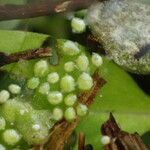
Wolffia arrhiza
Rootless duckweed · Spotless Watermeal · Spotless water flaxseed · Least duckweed
Description
Source: leafsnapWolffia arrhiza is a species of flowering plant known by the common names spotless watermeal and rootless duckweed, belonging to the Araceae, a family rich in water-loving species, such as Arum and Pistia. It is the smallest vascular plant on Earth. It is native to Europe, Africa, and parts of Asia, and it is present in other parts of the world as a naturalized species. It is an aquatic plant which grows in quiet water bodies such as ponds. The green part of the plant, the frond, is a sphere measuring about 1 mm wide, but with a flat top that floats at the water's surface. It has a few parallel rows of stomata. There is no root. The plant produces a minute flower fully equipped with one stamen and one pistil. It often multiplies by vegetative reproduction, however, with the rounded part budding off into a new individual. In cooler conditions the plant becomes dormant and sinks to the bed of the water body to overwinter as a turion. The plant is a mixotroph which can produce its own energy by photosynthesis or absorb it from the environment in the form of dissolved carbon.This tiny plant is a nutritious food. Its green part is about 40% protein by dry weight and its turion is about 40% starch. It contains many amino acids important to the human diet, relatively large amounts of dietary minerals and trace elements such as calcium, magnesium, and zinc, and vitamin B12. It has long been used as a cheap food source in Myanmar, Laos, and Thailand, where it is known as khai-nam ("eggs of the water"). The plant is prolific in its reproduction, growing in floating mats that can be harvested every 3 to 4 days; it has been shown to double its population in less than four days in vitro.It is also useful as a form of agricultural and municipal water treatment. It is placed in effluent from black tiger shrimp farms to absorb and metabolize pollutants. The plants grow quickly and take up large amounts of nitrogen and phosphorus from the water. The plants that grow in the wastewater can then be used as feed for animals, such as carp, Nile tilapia, and chickens.
Care Guide
💧 Water Every 7 days
Spotless watermeal flourishes in humid, consistently moist environments, making it perfect for aquatic settings. For optimal growth, water it weekly. This plant is ideal for indoor cultivation in containers, where you can carefully manage water levels to mimic its natural wetland habitat.
☀️ Light Full sun
Spotless watermeal is native to habitats that receive abundant sunlight, such as the shallow margins of ponds and lakes. It favors full sun exposure, although it can also tolerate partial sun.
What are the sunlight requirements for Spotless watermeal?
Spotless watermeal, a perennial herbaceous plant known scientifically as Wolffia arrhiza, thrives in full sun conditions, requiring more than 6 hours of sunlight per day. It can also tolerate partial sun, with about 3-6 hours of sunlight. To ensure your plant's happiness, observe the movement of sunlight through your garden and choose locations that offer a balance of light and shade, catering to the plant's needs.
Can Spotless watermeal grow under artificial lighting?
Yes, Spotless watermeal can grow under artificial lighting, especially in conditions where natural sunlight is insufficient, like during winter or in less sunny indoor spaces. Artificial lights such as LED are recommended because they can be tailored to provide the specific wavelengths needed by plants. Full sun plants require 30-50W/sq ft, partial sun plants need 20-30W/sq ft, and shade plants need 10-20W/sq ft of artificial light. The light source should be placed 12-36 inches above the plant to mimic natural sunlight and should be kept on for 8-12 hours per day.
What are the symptoms of insufficient light for Spotless watermeal?
When Spotless watermeal is grown in inadequate lighting, it may demonstrate several symptoms, such as smaller new leaves, leggy or sparse growth, faster leaf drop, slower or no new growth, lighter-colored new leaves, chlorosis, sunscald, leaf curling, wilting, and leaf scorching. These symptoms indicate that the plant is not receiving enough sunlight, affecting its growth and health negatively.
How can you care for Spotless watermeal to ensure adequate light exposure?
To care for Spotless watermeal and ensure it receives adequate light, gradually move the plant to sunnier locations, allowing it to adapt to changes in light intensity over several weeks until it gets at least 6 hours of direct sunlight daily. For indoor plants, consider using artificial lighting to supplement sunlight, keeping lights on for 8 hours daily. If outdoor plants are exposed to sudden changes in light, they may experience sunburn, so it's crucial to move them gradually. Additionally, reducing obstructions like pruning trees and transplanting smaller plants during their dormant period can help increase sunlight exposure.
🌡️ Temperature 20–37.8°C
Spotless watermeal comes from tropical areas, where the climate is normally warm and humid. Consequently, it is well suited to high temperatures and humidity. It does not tolerate sudden temperature shifts and prefers a consistent temperature, so avoiding indoor temperature fluctuations is important. It generally cannot withstand cold conditions and needs warmer temperatures to grow; if the surrounding temperature falls too low, growth may stop or the plant may die.
What is Spotless Watermeal?
Spotless watermeal, scientifically known as Wolffia arrhiza, is a unique plant species. Unfortunately, there aren't details provided about its essentials or symptoms related to its growth or care in the provided data.
💨 Humidity
🪴 Soil
🌱 Fertilizer
For optimal growth, spotless watermeal should be fertilized occasionally with a diluted, balanced liquid fertilizer. This should be applied monthly during the warmer months and every other month during cooler seasons. Be cautious not to over-fertilize, as this can lead to algae problems. With the right amount of fertilization, nutrient uptake is enhanced, which supports the plant's robust health and is a good indicator of water quality.
🪴 Pot & Repot
✂️ Pruning
Spotless watermeal is a small, fast-growing aquatic plant that benefits from pruning between early and late spring to manage its growth and maintain its health. Effective pruning techniques include thinning the plant and removing any decayed parts. This process not only improves water quality but also helps maintain ecosystem balance. It's important to handle spotless watermeal gently because of its delicate structure.
🌿 Propagating
🐛 Diseases & pets
☠️ Toxicity
Characteristics
- Plant Type
- Herb
- Life Cycle
- Perennial
- Genus
- Wolffia
- Family
- Araceae
- Hardiness Zone
- 10-11
- Mature Height
- 0 cm to 0 cm
- Mature Spread
- 0 cm to 0 cm
- Leaf Color
- Lime Green
- Leaf Type
- Evergreen
- Bloom Time
- Summer, Early fall, Mid fall
- Planting Time
- Spring, Summer, Autumn
- Harvest Time
- Mid summer, Late summer, Fall
- Native Area
- India, Austria, Angola, Slovakia, Madagascar, Rwanda, Pakistan, Nigeria, Slovenia, Morocco, Croatia, Kenya, Uganda, Tanzania, Guinea-Bissau, Russia, Belarus, Benin, Germany, Burundi, Mozambique, Ghana, Romania, South Korea, Belgium, Botswana, Portugal, Netherlands, France, Czech Republic, South Africa, Bulgaria, Poland, Greece, Ukraine, Serbia, China, Lithuania, Italy, Spain, Japan, Togo, Senegal, Iran, Côte d'Ivoire, United Kingdom, Hungary, Algeria, Congo (DRC)