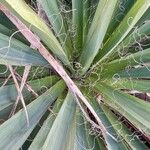
Yucca filamentosa
یوکا زنگوله ای · Yucca · Adam's-needle · Common yucca · Bear-grass
Description
Source: leafsnapYucca filamentosa, commonly known as Adam's needle or Spanish bayonet, is a perennial plant native to the southeastern United States. As a member of the Asparagaceae family, it is distinguished by its sword-shaped leaves, which can grow up to three feet long and one inch wide. These leaves are stiff and pointed, with white threads along their edges, giving the plant a unique appearance. In the summer, Yucca filamentosa produces tall spikes of creamy white flowers that can reach up to eight feet in height. These bell-shaped flowers, composed of six petals, emit a sweet fragrance that attracts pollinators such as bees. Yucca filamentosa thrives in well-drained soil and full sun but can tolerate partial shade. Once established, it is drought-tolerant, though it benefits from occasional watering during extended dry periods. The plant is popular for ornamental use in gardens and landscapes due to its distinctive appearance and low maintenance requirements. Historically, Native Americans utilized various parts of Yucca filamentosa for medicinal purposes, such as treating skin conditions, and they made soap from its roots. Overall, Yucca filamentosa is an intriguing plant with striking features, making it an excellent addition to any garden or landscape design. It also holds cultural significance for Native American communities.
💡 Adam's needle is one of many plants that can be used to stun and kill fish for hunting and collection purposes. The Cherokee people traditionally used this plant for such tasks. To utilize adam's needle, an extract is made from its roots and leaves and then poured into a stream or pond. This extract contains a fish toxin that causes the fish to float to the surface, making them easy to collect.
🌳 Adam's needle, though mainly prized for its striking flower spikes in garden settings, also serves as an unexpected component in everyday hygiene products and other goods because its leaves are rich in saponins. These natural, soap-like compounds are used in items ranging from shampoos to fire-extinguishing foams. Historically, Native Americans made use of its fibers for textiles and additional purposes. Even in cooking, parts of the plant's flowers are eaten, often used to brighten salads.
🎭 Transformation, Safeguarding, Cleansing, Power, Fidelity, Fresh opportunities
Care Guide
💧 Water Every 7 days
Adam's needle is well-suited for dry environments, as it has a high tolerance for drought. It should be watered only after the soil has completely dried out, usually every 2 to 3 weeks. As a xeric landscape plant, Adam's needle is excellent at conserving water during hot weather and extended sun exposure.
When should I water my Adam's Needle?
Watering your Adam's Needle (Yucca filamentosa) correctly is essential for its growth and health. The key is to water when the top 2-3 inches of soil feel dry. Drought-tolerant by nature, this plant can survive low water conditions, yet proper hydration helps maintain healthy leaves and supports root development. Signs your Adam's Needle needs water include dry soil, wilting, or drooping leaves, leaves changing color to brown or yellow, and slow or stunted growth. Overwatering and underwatering both pose risks, including root rot or dehydration, which can lead to leaf discoloration and dropping.
How should I water my Adam's Needle?
To water your Adam's Needle effectively, consider bottom-watering by placing the plant pot in a tray of water to let the soil absorb moisture upwards, which prevents soil over-saturation and reduces waterlogging risk. Use a watering can with a narrow spout to target water directly to the soil base, avoiding the leaves to prevent potential rot. Employing a moisture meter can help in measuring the soil's moisture content. Ensure the plant has well-draining soil and adequate drainage holes in the pot. The watering frequency should be adjusted based on climate, seasonality, and soil dryness, aiming for slightly dry conditions favorable to Yucca filamentosa. Applying mulch can help retain soil moisture, and using rainwater when available can be beneficial due to its lower mineral content.
How much water does Adam's Needle really need?
Adam's Needle requires thorough watering that penetrates deep to reach its extensive root system. The exact amount of water depends on the pot size and the plant's size, ensuring all water drains out to avoid waterlogging. A well-hydrated plant shows firm, upright leaves, while signs of under-watering include wilted or brown leaves, and overwatering may cause soft, mushy stems from root rot. Despite its drought tolerance, consistent neglect can lead to growth issues or plant death. Use lukewarm water to avoid shocking the plant, which can lead to stressed or stunted growth.
What kind of water is best for Adam's Needle?
Rainfall is ideal for Adam's Needle, but tap or well water is also suitable. If you have hard tap water, consider using purified or filtered water to prevent potential damage from high mineral content. This plant is not particularly sensitive to chlorine or fluoride in tap water, but letting tap water sit before use can help evaporate some of the chlorine. Ensure the water is at room temperature to avoid root shock. Adam's Needle can tolerate dry conditions well, so it is crucial to avoid overwatering and ensure good drainage to prevent root rot.
How do Adam's Needle's watering needs change with the seasons?
Seasonal changes affect Adam's Needle's watering needs. In spring, as temperatures warm, it's important to water deeply at the season's start to promote root growth, following rainfall patterns for occasional watering. During the hot and dry summer, the plant prefers minimal water, only requiring occasional deep watering in extreme drought. In autumn, reduce watering as the plant prepares for dormancy and the evaporation rate decreases. During winter, minimize watering significantly to prevent root freezing, especially ensuring no water collects in the leaf rosettes.
☀️ Light Full sun
Adam's needle performs best with plenty of light, though it can tolerate locations with a little less brightness. Hailing from places exposed to strong sunlight, it favors healthy growth and endures high light levels. Conversely, a lack of sufficient sunlight can impede its growth.
What are the sunlight requirements for Adam's needle?
Adam's needle requires full sun, meaning it thrives in conditions where it receives more than 6 hours of sunlight daily. It can also grow in partial sun, which involves about 3 to 6 hours of sunlight. The key to successfully growing Adam's needle in your garden is to carefully observe how sunlight moves throughout the area, ensuring that you choose locations that offer an ideal balance of light and shade. This consideration ensures the plant's well-being by providing it with the environment it needs to flourish.
What are the essential care tips for Adam's needle regarding sunlight?
Adam's needle, originating from environments with intense sun exposure, thrives best under abundant light but can also manage in slightly less illuminated areas. It is resilient to high light conditions, promoting healthy growth. However, a lack of sufficient sunlight may negatively affect its growth. For indoor plants, artificial lighting becomes crucial when natural sunlight is insufficient, especially during winter or in less sunny locations. LED lights are recommended because they can be customized to provide specific wavelengths needed by the plant. The brightness requirement varies depending on the plant's natural preference for sunlight, with full sun plants demanding 30-50W/sq ft, partial sun 20-30W/sq ft, and full shade 10-20W/sq ft of artificial light. Proper distance (12-36 inches above the plant) and duration (mimicking natural daylight hours, typically 8-12 hours daily) of artificial light exposure are vital for mimicking the natural conditions the plant would receive outdoors.
What symptoms indicate Adam's needle is getting too much or too little sunlight?
When Adam's needle receives too little sunlight, it may exhibit symptoms such as leggy or sparse growth, lighter-colored new leaves, slower or no new growth, indicative of insufficient light exposure. Conversely, symptoms of too much sunlight include chlorosis, where leaves lose their green color and turn yellow; sunscald, showing as pale, bleached, or dead areas on the plant; leaf curling as a defense against excessive light; wilting due to increased water loss; and leaf scorching, seen as brown, dry edges or patches on leaves. These signs indicate the plant's struggle with the current lighting conditions, whether it be an excess or shortage, affecting its health and growth.
What solutions can help Adam's needle thrive in indoor and outdoor environments?
To help Adam's needle thrive, a gradual adjustment to more suitable lighting conditions is advised, aiming for at least 6 hours of direct sunlight if possible. For indoor care, if the plant is too large or not easily moved, supplemental artificial light, such as a desk or ceiling lamp lit for a minimum of 8 hours a day, can be beneficial. For outdoor care, it’s crucial to adjust the plant gradually to brighter spots to prevent sunburn. If the plant is suffering from lack of sunlight, transitioning it to a location with better sun exposure is recommended, albeit carefully to avoid shock. Additionally, removing obstructions that block sunlight or transplanting smaller plants to sunnier locales can greatly improve their access to sunlight. Note that while adjusting the light environment can promote healthy new growth, parts of the plant that were previously affected might not recover.
🌡️ Temperature 15–37.8°C
Adam's needle is a temperate woody plant native to regions that have warm summers and cold winters. It prefers an average temperature range of 59 to 100 ℉ (15 to 38 ℃) and can withstand short episodes of extreme temperatures in both summer and winter. In hot summer months it copes with higher temperatures by reducing evapotranspiration, and in winter it endures cold by lowering water loss. As a result, it is highly adaptable to a variety of seasonal temperature conditions.
What is Adam's needle and where is it native to?
Adam's needle, botanically known as Yucca filamentosa, is a temperate woody plant native to regions with warm summers and cold winters. It exhibits a high degree of adaptability to various temperature conditions across different seasons, making it a versatile plant for various climates.
How does Adam's needle adapt to temperature changes?
Adam's needle adapts to temperature changes by adjusting its evapotranspiration during hot summer months to tolerate elevated temperatures, and by reducing water loss in winter to withstand cold conditions. Its strong cold resistance means that special frost protection measures are not typically necessary, but in extremely cold winters, providing some protection might be beneficial.
What special care does Adam's needle require in winter?
In winter, Adam's needle can generally withstand the cold without special frost protection measures. However, if temperatures are expected to drop significantly, it's important to provide some protection by wrapping the trunk and branches with non-woven fabric or cloth. Additionally, watering the plant abundantly before the first freeze of autumn to ensure the soil is moist can help prevent drought and water scarcity during the colder months.
How does Adam's needle react to low and high temperatures and what are the solutions?
Adam's needle thrives best in temperatures above a certain minimum and should be kept above this minimum during winter to avoid damage. When temperatures fall below this limit, the branches may become brittle and dry by spring, with no new shoots. The solution includes pruning away any dead branches. In high temperatures, exceeding a certain maximum, the leaves can become lighter, and tips may dry out, making the plant susceptible to sunburn. Solutions include trimming sunburned parts, moving the plant to a shaded area, or using a shade cloth, and ensuring to water the plant in the morning and evening.
💨 Humidity
🪴 Soil 5-7
🌱 Fertilizer
Fertilize your Adam's needle in early spring to encourage healthy growth. Regular feeding improves overall health, leading to vigorous growth, increased tolerance of harsh conditions, and better resistance to diseases and pests. Keep a specific fertilization schedule for your Adam's needle to maintain vibrant, deeply colored, lush foliage.
Why is it necessary to put fertilizer on my Adam's needle plant?
To ensure optimal health for your Adam's needle plant, it is important to fertilize it regularly, regardless of the variety you own. By providing the proper nutrients, you can promote strong growth and enhance its resilience against challenging conditions, as well as improve its ability to ward off diseases and pests. The foliage of the Adam's needle is especially attractive, so it is crucial to maintain its integrity. Thus, develop and stick to a personalized fertilization schedule for your specific Adam's needle variety to encourage the growth of vibrant and lush leaves with deep colors.
When should I fertilize my Adam's needle plant?
To ensure healthy growth, it is recommended to fertilize your Adam's needle in late winter or early spring. This gives the plant the necessary nutrients to thrive once it becomes warmer. In warm climates, it is also beneficial to provide an additional fertilizer feeding in early fall. This not only adds nutrients for the following growing season but also helps the plant withstand winter without foliage damage. Fertilizing earlier in fall ensures that new branches have enough time to grow and be sturdy enough for the cold winter.
When is it not a good time to put fertilizer on my Adam's needle plant?
There are specific times in the year when you should avoid fertilizing your Adam's needle plant. The first is during the early and mid-winter months when the plant is dormant and doesn't require any nutrients. Another time to avoid fertilization is during late spring and throughout the summer. This is because the weather tends to be hotter and dryer, which can have a negative impact on the plant if it's fertilized. To prevent any issues, it's best to follow a fertilization schedule that focuses on feeding only during early spring and early fall.
What kind of fertilizer does my Adam's needle plant need?
Adam's needle is most in need of nitrogen, but phosphorus and potassium are still important. A balanced fertilizer like 10-10-10 can work, but a more specific nutrient ratio like 10-6-4 often leads to better growth. Granular or liquid fertilizers can both be used.
How can I make my Adam's needle plant grow better?
To fertilize your Adam's needle, you have two options: using granular fertilizer or liquid fertilizer. For granular fertilizer, simply sprinkle it on the soil at the right time. The slow-release properties of granular fertilizer will gradually release nutrients into the soil. It's generally recommended to lightly water your Adam's needle before applying the fertilizer. Alternatively, you can use liquid fertilizer, although it is less common. To do this, mix the fertilizer with water and pour the mixture onto the soil around the base of your Adam's needle. If you want to be extra thorough, consider conducting a soil test before fertilizing. This will help you determine if any adjustments to the soil pH are necessary.
🪴 Pot & Repot 2-3 years
When repotting Adam's needle, select a pot 1–2 inches (2.5–5.1 cm) larger with good drainage. Use a well-draining potting mix. Repot in spring or fall, making sure the root ball sits slightly below the rim of the flower pot. Water thoroughly after repotting and place it in a warm spot with indirect sunlight.
✂️ Pruning
Adam's needle is characterized by its sword-like leaves and tall flower spikes. To maintain its health and appearance, prune it in early spring by removing dead leaves and spent stalks. This encourages healthy growth and helps deter pests. Be sure to use clean, sharp tools for precise cuts, which will enhance the plant's appearance and promote vigorous development.
🌿 Propagating
🐛 Diseases & pets
☠️ Toxicity
Characteristics
- Plant Type
- Shrub
- Life Cycle
- Perennial
- Genus
- Yucca
- Family
- Asparagaceae
- Hardiness Zone
- 7-11
- Mature Height
- 0.2 m to 3.05 m
- Mature Spread
- 61 cm to 91 cm
- Leaf Color
- Green, Yellow, Blue, Gray, Variegated
- Leaf Type
- Evergreen
- Flower Color
- White
- Flower Size
- 4.06 cm to 7.62 cm
- Bloom Time
- Early summer, Mid summer
- Planting Time
- Spring, Autumn
- Harvest Time
- Mid summer
- Native Area
- Sandy beaches and fields of Southeastern U.S.