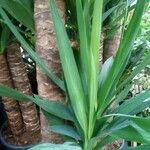
Yucca gigantea
Bluestem yucca · Izote · Spineless Yucca · Giant yucca · Elephant yucca
Description
Source: leafsnapYucca gigantea, commonly known as the giant yucca or spineless yucca, is a large succulent plant native to Mexico and Central America. It belongs to the Agavaceae family and can grow up to 30 feet tall with a spread of 15 feet. The plant features thick, sword-shaped leaves that are green and can reach up to 4 feet in length. These leaves are arranged in a rosette pattern at the base of the stem. In late spring or early summer, the giant yucca produces large clusters of white, bell-shaped flowers that can grow up to 4 inches long. These flowers emit a pleasant fragrance that attracts pollinators such as moths. The plant thrives in well-drained soil with full sun exposure but can also tolerate partial shade. Although it is drought-tolerant once established, it requires regular watering during its initial growth period. Yucca gigantea has multiple uses. It serves ornamental purposes due to its unique appearance, medicinal purposes because of its anti-inflammatory properties, and culinary purposes, such as being used to make soap or shampoo. Overall, Yucca gigantea is an impressive succulent known for its towering height and distinctive look, making it an excellent choice for any garden enthusiast seeking something both different and beautiful.
💡 Yuca has a sturdy and robust stem, complemented by its vibrant green leaves that exude strength and character. Placing it indoors can lend a solemn and serious atmosphere to the space. It's an excellent choice for both indoor and outdoor green decorations.
🌳 Beyond its ornamental value, spineless yucca has long been employed for a variety of uses. Its tough, fibrous leaves provide excellent material for making ropes and weaving baskets. In local cultures, the plant’s sap was commonly used as a natural shampoo, cleansing hair while giving it shine and strength. This tradition highlights spineless yucca’s untapped potential in personal care industries, especially as consumers seek more natural products.
🎭 Eliminates bad luck
Care Guide
💧 Water Every 14 days
Spineless yucca, which originates from arid regions, is adept at efficiently storing water and can thrive with minimal watering. It is recommended to water the plant every 2 to 3 weeks, making sure that the soil is completely dry between waterings. This evergreen plant is often grown indoors and benefits from occasional misting to add some humidity to the typically dry indoor air.
When Should I Water My Spineless Yucca?
Watering your spineless yucca at the right time is crucial for its health. It prefers dry soil between waterings, so the dryness of the potting mix is a key indicator; water the plant when the soil feels dry about an inch below the surface. The physical condition of the leaves can also signal the need for water. Firm and flexible leaves are ideal, while wilted or dry leaves with brown tips suggest dehydration. Pay attention to the plant's growth rate as well; a slowdown might indicate a need for water. However, be mindful of the risks of both over-watering, which can lead to root rot and fungal growth, and under-watering, which can cause dehydration and stunted growth.
How Should I Water My Spineless Yucca?
Watering your spineless yucca requires a specific approach to ensure it thrives. Use well-draining soil and let the top inch of soil dry out before watering again. A bottom-watering method, where the pot is placed in a tray of water, allows the soil to absorb moisture from the bottom up, which is effective for this plant. If using a watering can, choose one with a narrow spout to target the base of the plant and prevent excess moisture on the foliage, which could cause fungal diseases. Utilizing a moisture meter can help determine the ideal time for watering. It's important to avoid overwatering by ensuring the pot has adequate drainage, and adjust watering frequency according to temperature changes, watering less in colder months. Observing the plant's response to watering and adjusting your methods accordingly will help maintain its health.
How Much Water Does Spineless Yucca Really Need?
Spineless yucca, adapted to arid conditions, has relatively low water requirements. It prefers deep and infrequent watering, ensuring that the water reaches deep into the roots without waterlogging. Typically, the plant needs watering when the top 1-2 inches of soil are dry. Proper hydration is indicated by firm and upright leaves, and both overwatering and underwatering can lead to various health issues for the plant. An average mature spineless yucca may require about 1-1.5 liters of water per session, but this can vary based on the size of the plant and the environmental conditions. Using well-draining soil and monitoring the plant for signs of over or under-watering will help manage its water needs effectively.
What Kind of Water is Best for Spineless Yucca?
Spineless yucca thrives best with fresh, clean water, preferably filtered, distilled, or rainwater since chlorinated or fluoridated tap water can pose risks. While it is somewhat tolerant to chlorine, letting tap water sit out for 24 hours before use can allow chlorine to evaporate, which is beneficial. Fluoride in tap water, however, can cause yellowing or browning of the leaf tips, so it's best avoided. Similarly, high mineral content in water can lead to leaf burn and stunted growth. Room temperature water is ideal to avoid shocking the plant's roots. Using water that closely mimics natural rainwater conditions can contribute to the healthy growth of spineless yucca.
How Do Spineless Yucca's Watering Needs Change with the Seasons?
The watering needs of spineless yucca vary throughout the year, adapting to the plant's growth cycle and external temperatures. In spring, as temperatures rise and the plant exits dormancy, it requires more water to support new growth; ensure the top inch of soil dries out before watering. Summer brings peak temperatures and active growth, necessitating regular watering while still allowing the soil to dry out partially between sessions. As growth slows in autumn, reduce watering, waiting for the top inch of soil to dry out. Watering needs drop significantly in winter during the plant's dormancy; water sparingly, only after the soil has completely dried out, to avoid root rot.
☀️ Light Partial sun
Spineless yucca originates from environments with varying sun exposure and prefers moderate light, though it can tolerate both high and low light levels. Its light requirements change little as it grows. Extended periods of low light can lead to sparse foliage, while excessive light may cause leaf burn.
What are the sunlight requirements for plants?
Plants have varying sunlight requirements to thrive. For example, some plants need about 3-6 hours of sunlight and are considered to require partial sun. Others may need above 6 hours, falling into full sun or full shade categories. It's essential to observe the movement of sunlight through your garden to find spots that offer the right balance of light and shade, ensuring your plants grow happily.
What are the essentials for growing Spineless Yucca?
Spineless Yucca (Yucca gigantea) thrives in conditions where sun exposure varies, making it adaptable to both abundant light and minimal light. This plant's need for light remains fairly consistent throughout different growth stages. However, a prolonged lack of light can lead to sparse foliage, while too much exposure might cause leaf burn. Adequate artificial lighting, such as LED lights customized to provide specific wavelengths, can support optimal growth, especially in conditions where natural sunlight is insufficient.
How do you use artificial lighting for indoor plants?
When natural sunlight is not enough for indoor plants, especially during winter or in less sunny spaces, artificial lighting becomes crucial. The right type of artificial light, like LED lights, can provide essential wavelengths. Full sun plants require 30-50W/sq ft of artificial light, partial sun plants need 20-30W/sq ft, and full shade plants should have 10-20W/sq ft. The light source should be placed 12-36 inches above the plant, mimicking natural sunlight, and kept on for about 8-12 hours per day depending on the plant species needs.
What are the symptoms of light deficiency in Spineless Yucca?
Spineless Yucca may develop symptoms of light deficiency when placed in insufficiently lit corners for extended periods. These symptoms include leggy or sparse growth, faster leaf drop, lighter-colored new leaves, chlorosis (yellowing of leaves due to lack of chlorophyll), sunscald, leaf curling, wilting, and leaf scorching. Each symptom indicates a need for better light exposure or protection from excessive sunlight.
What solutions can help Spineless Yucca with light deficiency?
For Spineless Yuccas suffering from light deficiency, gradually increasing sunlight exposure is key. Start by moving them to sunnier spots each week to receive 3-6 hours of direct sunlight daily. If the plant is too large or immobile, consider using artificial light, such as a desk lamp or professional grow lights, for at least 8 hours daily. For outdoor Spineless Yuccas, gradually move them to better-lit areas while avoiding sudden changes in light to prevent sunburn. Improving sunlight accessibility, like pruning trees or transplanting smaller plants to sunnier locations, can also benefit the plant's health. It's important to note that while increased light can promote new healthy growth, parts of the plant that have already been affected by insufficient sunlight may not fully recover.
🌡️ Temperature 20–37.8°C
Spineless yucca comes from warm regions and can tolerate temperatures of 20 to 38℃ (68 to 100℉). In winter it prefers cooler conditions of 10 to 15℃ (50 to 59℉) and should be kept safe from frost. In summer it may benefit from being put outdoors in partial shade to prevent scorching during very high temperatures.
What is the native climate for Spineless yucca?
Spineless yucca, botanically known as Yucca gigantea, is native to warm climates. It thrives in temperatures ranging from 20 to 38°C (68 to 100°F). During warmer months, it can handle being placed outdoors in partial shade to prevent scorching from high temperatures. However, it is extremely sensitive to cold and requires protection from frost. In winter, cooler temperatures between 10 to 15°C (50 to 59°F) are preferable. It's advised to bring outdoor-grown Spineless yucca inside near a bright window during autumn, keeping it at a safe distance from heaters to maintain ideal growth conditions.
How does low temperature affect Spineless yucca and what are the solutions?
Spineless yucca prefers warm temperatures and does not tolerate low temperatures well. It thrives best when kept above a certain minimum suitable growth temperature. During winter, it's crucial to keep it above a tolerable minimum temperature to avoid stress. If the temperature falls below its growth limit, the leaves may begin to lighten in color, and frost damage can turn them brown or black, leading to wilting and drooping. To remedy this, trim off the frost-damaged parts and move the plant to a warm environment indoors, preferably near a south-facing window for ample sunlight. It's also important to avoid placing the plant too close to heaters or air conditioners, as this can cause excessive dryness.
What should be done if Spineless yucca is exposed to high temperatures?
During summer, it's important to ensure that Spineless yucca is kept below a maximum suitable growth temperature to prevent stress from high heat. Exceeding a tolerable maximum temperature can lighten the color of the leaves and make the plant more susceptible to sunburn. If sunburn occurs, the damaged, sunburned, and dried-up parts should be trimmed away. Moving the plant to a shaded location, especially from the midday and afternoon sun, helps prevent further damage. To maintain soil moisture and support the plant's needs, watering in the morning and evening is recommended.
💨 Humidity dry (<40%)
This plant prefers dry conditions, so don't mist it. However, watering it less often can also thrive in higher humidity.
🪴 Soil 6-7
🌱 Fertilizer
Fertilization is essential for Spineless yucca care. Regular feeding during the growing season preserves the energy required for its showy leaves and supports overall growth. Failing to fertilize can lead to unhealthy leaves, reduced ornamental appeal, and stunted or weak growth that is prone to breaking.
Why should I put fertilizer on my Spineless yucca plant?
Spineless yucca needs regular fertilization because it has showy leaves that need a lot of energy to grow and stay healthy. This is a challenge because the plant also needs energy to support the growth of its stems, branches, roots, and other important structures. If you don't fertilize the plant, two things are likely to happen. First, the leaves will lose their natural color and texture, making the plant look unhealthy and less attractive. Second, the plant's overall growth will slow down or produce weak growth that could easily break.
When should I fertilize my Spineless yucca plant?
To ensure the proper growth of your Spineless yucca, it is recommended to occasionally feed it rather than sticking to a specific schedule. An easy way to fertilize this plant is to apply fertilizer when watering it from time to time. Additionally, during the growing season, the Spineless yucca requires a decent amount of water. Feeding the plant once every two to three weeks should be maintained throughout the period of new growth.
When is it not a good idea to fertilize my Spineless yucca plant?
For most of the year, you can fertilize your Spineless yucca regularly. This is especially important during the active growing season in spring, summer, and early fall. However, it's important to avoid fertilizing during winter. During this time, the Spineless yucca enters a dormant phase with little to no new growth. Because the plant is using less energy during this time, fertilization is unnecessary.
What kind of plant food does my Spineless yucca plant need?
For a Spineless yucca, the fertilizer requires a specific blend of nutrients, each in small amounts. The ideal fertilizer should have a 3-1-2 ratio of nitrogen, phosphorus, and potassium (N-P-K). However, a general-purpose fertilizer with a balanced blend could also be effective. Regardless, the ratio number for each nutrient should be 3 or lower when using a balanced fertilizer. You can choose between granular or liquid-based fertilizer. If you go with liquid fertilizer, it is recommended to dilute its strength by half. Granular fertilizer has few drawbacks, but using liquid fertilizer, especially when watering your Spineless yucca, is often the better choice.
How can I help my Spineless yucca plant grow better?
Fertilizing a Spineless yucca is easy. One way is to feed it whenever you water it. To do this, gather fertilizer and a watering can. Mix the fertilizer with water to dilute it, then pour it onto the soil and let it soak down to the roots. Another option is to use granular fertilizer. Simply sprinkle it on the soil where your Spineless yucca is. Granular fertilizers are slow-release, so you don't have to fertilize as often as with liquid fertilizer. Remember to water while feeding your Spineless yucca to maximize benefits.
🪴 Pot & Repot 2-3 years
When repotting Spineless yucca, choose a pot 1–2 inches (2.5–5.1 cm) larger with ample drainage. Use a well-draining potting mix. Repot in spring or fall, ensuring the root ball is slightly lower than the rim of the flower pot. Water thoroughly after repotting and place in a warm spot with indirect sunlight.
✂️ Pruning
To ensure a spineless yucca plant thrives, proper pruning is essential. Ideally, this should be done in late spring to encourage growth and prevent disease. Begin by removing any damaged leaves and trimming the base to maintain its shape. Using clean tools is crucial for promoting the plant's health and ensuring it remains robust and attractive.
🌿 Propagating
🐛 Diseases & pets
☠️ Toxicity
Characteristics
- Plant Type
- Shrub, Tree
- Life Cycle
- Perennial
- Genus
- Yucca
- Family
- Asparagaceae
- Hardiness Zone
- 9-12
- Mature Height
- 6.1 m
- Mature Spread
- 4.57 m to 7.62 m
- Leaf Color
- Green, Blue
- Leaf Type
- Evergreen
- Flower Color
- White
- Flower Size
- 2.54 cm to 5.08 cm
- Bloom Time
- Mid summer
- Planting Time
- Spring, Summer, Autumn, Winter
- Harvest Time
- Mid summer, Late summer, Fall
- Native Area
- Mexico