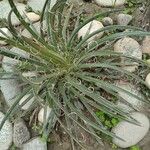
Yucca harrimaniae
Harriman's yucca · Spanish bayonet · Salt Lake Desert Yucca
Description
Source: leafsnapYucca harrimaniae Trel., the Spanish bayonet, is a species in the family Asparagaceae, native to Utah, Nevada, Colorado, northeastern Arizona and northern New Mexico, at elevations from 1000 m to 2700 m.Yucca harrimaniae is a small, acaulescent (stemless) species forming clumps of rosettes. Flowers are nodding (hanging downward), partly greenish-white, partly purplish. The species is closely related to Y. sterilis (Neese & S.L.Welsh) S.L.Welsh & L.C.Higgins..The overall species is relatively common and widespread. Two varieties, var. nana and var. sterilis, have very small and restricted ranges.
Care Guide
💧 Water
The Spanish bayonet flourishes in arid conditions due to its remarkable drought tolerance. Native to desert environments, it needs to be watered only once every 1 to 2 weeks. As an evergreen plant, the Spanish bayonet keeps its leaves throughout the year, helping it conserve water during dry seasons.
☀️ Light Full sun
Spanish bayonet is a sun-loving, herbaceous perennial that originates from open habitats and is often found thriving in meadows and grasslands. It prefers full sun but can also tolerate partial sun conditions.
What are the sunlight requirements for Spanish bayonet (Yucca harrimaniae)?
The Spanish bayonet (Yucca harrimaniae) thrives in conditions where it can receive ample sunlight. Specifically, it requires 'full sun' conditions, which means it should get above 6 hours of sunlight daily. Alternatively, it can also grow under 'partial sun' with about 3-6 hours of sunlight. It's important to observe the movement of sunlight through your garden carefully, choosing spots that provide an ideal balance of light and shade. This ensures the plant's health and happiness, making the most out of its environment.
🌡️ Temperature 5–35°C
Spanish bayonet can tolerate a wide range of temperatures, but its distribution may still be constrained by various combinations of water and heat. It does best in warm summer climates with sufficient rainfall or watering. Extended stretches of cloudy, rainy weather, as well as prolonged high temperatures, can raise the chance of Spanish bayonet dying. In winter, adequate protection from cold can increase the plant's survival rate.
💨 Humidity
🪴 Soil 6-7
🌱 Fertilizer
The best time to fertilize a Spanish bayonet is in early spring, as it comes out of dormancy and begins active growth. Fertilizing supplies essential nutrients for healthy growth. Although Spanish bayonet has fairly low fertilizer requirements, applying fertilizer yearly can improve its survival and encourage better, longer-lasting flowers.
🪴 Pot & Repot
✂️ Pruning
The Spanish bayonet plant showcases a cluster of rigid, sword-shaped leaves. To promote healthy and vibrant growth, prune the plant from early to late spring by removing any dead or damaged leaves along with spent flower stalks. Be sure to use sterilized tools and handle the sharp leaves carefully to maintain a neat appearance.
🌿 Propagating
🐛 Diseases & pets
☠️ Toxicity
Characteristics
- Plant Type
- Herb, Shrub
- Life Cycle
- Perennial
- Genus
- Yucca
- Family
- Asparagaceae
- Hardiness Zone
- 4-9
- Mature Height
- 15 cm to 40 cm
- Mature Spread
- 15 cm to 30 cm
- Leaf Color
- Green Yellow, Olive Drab
- Leaf Type
- Evergreen
- Flower Color
- White
- Flower Size
- 2.54 cm to 7.62 cm
- Bloom Time
- Late spring, Early summer
- Planting Time
- Summer, Autumn
- Harvest Time
- Mid summer, Late summer, Early fall