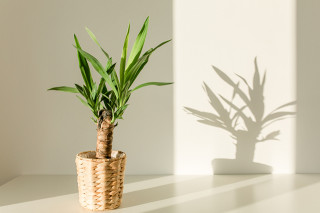
Yucca spp.
Description
Source: leafsnapMore than 40 perennial plants, shrubs, and trees belong to the genus Yucca, although only a few of them—most frequently the Yucca gigantea (also known as Y. guatemalensis and Y. elephantipes) and the Yuca aloifolia—are planted as houseplants under the name yucca plant. Yuccas are slow-growing, visually appealing plants that are native to Mexico and the Caribbean. They also have the added advantage of being incredibly drought tolerant. The majority of yucca species will eventually turn into room-devouring monsters, but this takes so much time that you can use it as a houseplant for many years before it takes over your space.
Care Guide
💧 Water Once a week
Overwatering greatly affects yuccas. During the spring and summer growing season, water your plant once a week, but make sure it has great drainage and dries out in between. Reduce your watering frequency to once every few weeks in the winter (or even less). Never allow a yucca plant to stand in a water tray.
☀️ Light
🌡️ Temperature
They are adapted to the desert, where daytime highs can exceed 90 degrees Fahrenheit and nighttime lows can reach 30 degrees. Consequently, yuccas can tolerate the majority of interior temperature variations and circumstances. Although they thrive in arid climates and are desert plants, they will grow best with moderate humidity.
💨 Humidity
🪴 Soil
🌱 Fertilizer
Because they grow slowly, yuccas may only require fertilizer a few times a year. Ideal fertilizer should be balanced and low in nitrogen. Fertilizers should contain micro/trace nutrients including iron (Fe), manganese (Mn), and zinc(Zn), as well as necessary secondary nutrients like calcium (Ca), magnesium (Mg), and sulfur (S). Due to its modest and balanced nutrient concentrations, cacti fertilizer can be utilized.
🪴 Pot & Repot
✂️ Pruning
You need sterile cutting equipment to prune the yucca palm properly in order to prevent infection. You can either cut off a section of the stem or remove individual leaves, depending on your requirements. Yucca palms can also withstand harsh trimming and swiftly resprout. It is generally advisable to wear gloves when removing any individual sharp leaves.
🌿 Propagating
🐛 Diseases & pets
☠️ Toxicity
Yucca species contain steroidal saponins in their leaves, chemicals that can cause intestinal irritation and even central nervous system problems if consumed in large enough quantities.
Characteristics
- Plant Type
- Herbaceous perennials, shrubs, trees
- Genus
- Yucca
- Family
- Asparagaceae
- Hardiness Zone
- 4-11
- Bloom Time
- Mid-summer to early fall (flowers are not significant)
- Native Area
- Hot, arid parts of the Americas and the Caribbean