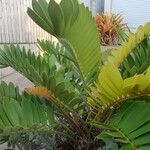
Zamia furfuracea
Cardboard cycad · Cardboard Palm
Description
Source: leafsnapZamia furfuracea, commonly known as the cardboard palm, is a cycad plant native to Mexico. It is a slow-growing plant that can reach 3-4 feet in height and width. The leaves of the cardboard palm are stiff and leathery, with a glossy green color that can turn bronze in direct sunlight. The plant produces cones containing seeds for reproduction. The cardboard palm is an excellent choice for indoor or outdoor landscaping due to its low maintenance requirements and unique appearance. It prefers well-draining soil and partial shade but can tolerate full sun exposure with proper watering. Although Zamia furfuracea resembles a palm tree, it is not related to palms. Instead, it belongs to an ancient group of plants known as cycads, which have existed since prehistoric times and are often referred to as "living fossils." Overall, Zamia furfuracea is an attractive ornamental plant that adds a tropical flair wherever it's planted. Its ease of care makes it perfect for both novice gardeners and experienced horticulturists alike!
🌳 Even with ancient origins, the cardboard palm has modern roles beyond mere ornamentation. Besides its decorative appeal, it is valued for its resilience as a xerophytic plant in landscaping to reduce watering needs. Its tough, durable leaves are occasionally used in floral arrangements, displaying both sturdiness and beauty. Although it has not traditionally served as a source of human food or for widespread industrial use, the cardboard palm’s distinctive appearance has inspired furniture and art designs, reflecting a blend of historic legacy and contemporary aesthetic.
Care Guide
💧 Water Every 14 days
The Cardboard Palm, native to Eastern Mexico, thrives in arid conditions. It should be watered once every 1-2 weeks, allowing the soil to dry out between waterings. This plant is ideal for rock gardens or xeriscapes, as it retains its foliage year-round. During cooler months, it requires even less water.
If I give my Cardboard palm too much water or too little water, what should I do?
Outdoor plants, especially newly planted ones or plant seedlings, are prone to lack of watering. It is important to remember to keep watering them sufficiently for a few months when they are small or newly planted. Once the roots are established, the Cardboard palm can rely on rain most of the time. When the Cardboard palm is planted in pots, overwatering is often more likely. If you accidentally overwater your plant, there are steps you can take to remedy the situation. First, stop watering your plant immediately to minimize the effect of overwatering. Then, remove the Cardboard palm from its pot to inspect its roots. If there is no root rot, you can safely return the plant to its container. However, if you see signs of root rot, trim away the affected roots and apply a fungicide to prevent further damage. Lastly, repot the Cardboard palm in well-draining soil. On the other hand, underwatering is easily fixed. If you notice that the plant's leaves are drooping, drying out, and falling off, simply water it more frequently. Make sure to correct your watering frequency as soon as you observe underwatering occurring.
How frequently do I need to water my Cardboard palm?
If your area doesn't get much rain, you'll need to water your plants every 2 weeks in the spring and fall, and more often in the summer. In the winter, when plants don't grow as much, you can water them less frequently or not at all. If you have a young or newly planted Cardboard palm, you'll need to water it more often to help it grow and adapt to drought. For potted plants, you can either set a regular watering schedule of once a week or every other week, but this may not always work depending on the specific conditions of your Cardboard palm's environment. Alternatively, you can check the moisture level of the soil before watering. Wait until the top 2 to 4 inches of soil have dried out before giving it more water.
How much water does my Cardboard palm plant need?
When watering your Cardboard palm, you might be surprised to learn that it doesn't always require a large amount of water. Instead, if only a few inches of soil have dried since the last watering, giving it about five to ten ounces of water will support healthy growth. You can also determine the amount of water based on the moisture level of the soil. Take note of how many inches of soil have dried out between waterings. To ensure your Cardboard palm receives adequate moisture, provide enough water to moisten all the dry soil layers since the last watering. If more than half of the soil has dried out, consider giving it more water. In these cases, continue watering until you see excess water draining from the pot's drainage holes. If your Cardboard palm is planted in an area with sufficient outdoor rain, additional watering may not be necessary. However, when the Cardboard palm is young or establishing, make sure it receives 1-2 inches of rain per week. As it grows and establishes further, it can rely solely on rainwater. Only in hot weather with no rainfall for 2-3 weeks should you consider giving it a full watering to prevent stress.
How can I know if I'm watering my Cardboard palm plant enough?
The Cardboard palm is more commonly affected by overwatering, and there are a few signs to watch out for. Generally, when a Cardboard palm is overwatered, its leaves turn yellow and it may even lose some leaves. Overwatering can also cause the overall structure of the plant to shrink and can lead to root rot. On the other hand, when a Cardboard palm is underwatered, it starts to droop and its leaves may become brown and brittle. Whether you notice signs of overwatering or underwatering, it's important to take action and restore the plant's health.
How should I water my Cardboard palm when it is growing at different stages?
When the Cardboard palm is young, especially as a seedling, it requires more water compared to when it is fully grown. It is important to keep the soil consistently moist during the early stages to promote root development. This applies to any Cardboard palm that has been transplanted to a new location. Additionally, if your Cardboard palm is producing flowers or fruits, it may need a bit more water than usual to support these structures.
☀️ Light Partial sun
Cardboard palm does best with plenty of, but not intense, sunlight. It is adaptable and can tolerate darker spots as well as locations with strong sun. Yet too much or too little light can produce unhealthy growth or dull, drooping leaves. It originates from a native environment where shade and sun commonly alternate.
What are the sunlight requirements for a Cardboard palm?
Cardboard palm requires partial sun to thrive, about 3-6 hours of sunlight per day, but can also handle full sun or full shade conditions with more than 6 hours of sunlight. It's essential to watch how sunlight moves through your garden, choosing spots that provide a perfect balance of light and shade to ensure the plants' happiness. Cardboard palm adapts well to different lighting conditions due to its native habitat's intermittent shade and sun.
How does artificial lighting benefit indoor plants like the Cardboard palm?
Artificial lighting is crucial for indoor plants, especially when natural sunlight is limited, such as in winter or less sunny spaces. It promotes faster and healthier growth by providing adequate lighting. LED lights are recommended for indoor plant lighting as they can be adjusted to provide specific wavelengths needed by the plants. Full sun plants require 30-50W/sq ft, partial sun plants need 20-30W/sq ft, and full shade plants 10-20W/sq ft of artificial light. The light should be placed 12-36 inches above the plant and turned on for 8-12 hours per day to mimic natural sunlight.
What are some common symptoms of poor lighting conditions in a Cardboard palm?
Poor lighting conditions can cause several symptoms in a Cardboard palm, including leggy or sparse growth, lighter-colored new leaves indicating a lack of chlorophyll, slower or halted growth, faster leaf dropping, chlorosis or yellowing of leaves due to excessive sunlight, sunscald from intense sunlight exposure, leaf curling as a defense against excess sunlight, wilting from increased water loss, and leaf scorching. These symptoms highlight the importance of providing adequate lighting to maintain the plant's health.
What are some solutions for addressing poor lighting conditions for a Cardboard palm?
To optimize growth under poor lighting conditions for a Cardboard palm, gradually shift indoor plants to sunnier spots each week until they receive 3-6 hours of direct sunlight daily. If moving the plant is not feasible, consider using artificial light, keeping a desk or ceiling lamp on for at least 8 hours daily, or invest in professional plant grow lights. For outdoor plants, gradually move them to sunnier locations to adjust to changing light conditions, avoiding sudden changes to prevent sunburn. Minimizing obstructions or transplanting (for smaller plants) during their dormant period into areas with more sunlight can also improve their exposure. Note that parts of the plant affected by insufficient sunlight may not recover, but new growth should be healthy with proper light adjustments.
🌡️ Temperature 20–37.8°C
The cardboard palm grows best in its native habitat at temperatures of 68 to 100 ℉ (20 to 38 ℃). As a temperate woody species, it needs warm conditions for optimal development. In summer, the temperature should be set to roughly 82 to 100 ℉ (28 to 38 ℃) for ideal growth. In winter, a cooler range of 50 to 68 ℉ (10 to 20 ℃) is preferred so the plant can enter dormancy.
What are the ideal growth conditions for a Cardboard Palm?
The Cardboard Palm (Zamia furfuracea) thrives in warm temperatures, with an ideal range of 68 to 100 °F (20 to 38 °C). During the summer months, temperatures of 82 to 100 °F (28 to 38 °C) are optimal for its growth. In contrast, winter temperatures should be cooler, between 50 to 68 °F (10 to 20 °C), to facilitate dormancy. As a heat-loving plant, it suffers in cold conditions. When autumn arrives, plants grown outdoors should be brought inside and placed near a bright window, far enough from heaters to avoid damage. It's crucial to keep the temperature above the minimum growth-friendly threshold during winter, as temperatures nearing the lower tolerance limit can harm the plant.
How does low temperature affect the Cardboard Palm and what are the solutions?
Cardboard Palms prefer warm climates and struggle in lower temperatures. It's essential for their health to maintain temperatures above their minimal growth-tolerable range during winter. Exposure to temperatures below their growth limit causes the leaves to lighten in color. Frost damage can further lead to the leaves turning brown or black, accompanied by wilting and drooping. To mitigate frost damage, trim the frost-damaged parts and move the plant indoors to a warm spot, preferably near a south-facing window for ample sunlight while avoiding placement near heaters or air conditioning vents to prevent excessive dryness.
What impact does high temperature have on Cardboard Palm, and how can it be managed?
During the summer, it's important to ensure that the Cardboard Palm is kept below its maximum temperature tolerance. Exceeding this can lighten the color of the leaves and increase susceptibility to sunburn. Managing high-temperature stress involves trimming away sunburned and dried parts of the plant, relocating it to a shaded area during intense midday and afternoon sun, and maintaining soil moisture by watering the plant in the morning and evening.
💨 Humidity normal (40-60%)
This plant will thrive in moderate humidity, which is probably the level in your home. However, misting it a few times a week can be very beneficial. Make sure the room has good ventilation.
🪴 Soil 6-7
🌱 Fertilizer
Cardboard palm has specific nutrient needs and does not require heavy fertilization. Spring is the best time to fertilize for optimal growth. Supplying nutrients improves its health, increases resistance to pests and diseases, and supports a long lifespan.
Why should I put fertilizer on my Cardboard palm?
In order to support the long lifespan of the Cardboard palm, it is important to fertilize in the spring for healthy growth. By adding nutrients to the soil, you can improve the plant's health, making it more resistant to pests and diseases that can hinder growth or reduce its lifespan.
When should I fertilize my Cardboard palm plant?
Cardboard palm is a unique plant that doesn't need excess nutrients like other garden plants. The growing medium might not provide enough nutrients for healthy growth, but Cardboard palm doesn't require much. The ideal time to fertilize it is in the spring, right before new growth starts.
When is the best time to not fertilize my Cardboard palm?
Unlike other plants that benefit from regular fertilization, such as monthly or weekly, the Cardboard palm is different. It actually doesn't need excessive nutrients and can suffer from fertilizer overdose, leading to its decline. To properly care for it, only apply fertilizer during the spring season, completely avoiding the other seasons like summer, fall, and winter. Additionally, refrain from adding any fertilizer or organic matter to the soil during those three seasons.
What kind of plant food does my Cardboard palm plant need?
When choosing fertilizer for your Cardboard palm, consider the age of your plant. Keep in mind that this plant doesn't need a lot of extra nutrients. Look for a balanced plant food that promotes healthy root development and growth. Avoid fertilizers that have high nitrogen levels.
How can I give nutrients to my Cardboard palm?
To properly fertilize your Cardboard palm, timing and application technique are key. It is best to fertilize once in the spring, at the base of the plant. Be cautious not to get any fertilizer on the trunk. If you are using granulated fertilizer, make sure to cover the pellets with a thin layer of soil. This will aid in the absorption of the fertilizer into the soil.
🪴 Pot & Repot 2-3 years
When repotting the Cardboard palm, pick a pot 1-2 inches (2.5–5.1 cm) larger with ample drainage. Use a well-draining potting mix. Repot in spring or fall, making sure the root ball sits slightly lower than the rim of the flower pot. Water thoroughly after repotting and place the plant in a warm spot with indirect sunlight.
✂️ Pruning
The cardboard palm has stiff, waxy fronds that resemble cardboard. For best results, prune it from early to late winter using sanitized shears. This helps enhance air circulation and improve the plant's appearance. Regular pruning can reduce the risk of disease, and keeping a careful eye out for pests will ensure the plant's health and longevity.
🌿 Propagating
🐛 Diseases & pets
☠️ Toxicity
Characteristics
- Plant Type
- Shrub
- Life Cycle
- Perennial
- Genus
- Zamia
- Family
- Zamiaceae
- Hardiness Zone
- 9-11
- Mature Height
- 1.22 m
- Mature Spread
- 2.13 m
- Leaf Color
- Green
- Leaf Type
- Evergreen
- Flower Color
- Brown, Red
- Bloom Time
- Late spring, Early summer, Mid summer
- Planting Time
- Spring, Autumn
- Harvest Time
- Late summer, Early fall, Mid fall
- Native Area
- Mexico