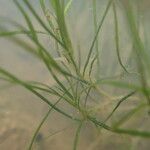
Zannichellia palustris
Horned-pondweed · Horned Poolmat
Description
Source: leafsnapZannichellia palustris, the horned pondweed, is a plant found in fresh to brackish waters in the United States (especially in the Chesapeake Bay), Europe, Asia, Australasia, and South America. It is recognizable by its long, thread like leaves, and "stringy" appearance. Its roots are also long and tendril-like, and its seeds bear a distinctive horned shape, hence the common name. The species epithet palustris is Latin for "of the marsh" and indicates its common habitat. Its diploid Chromosome number was confirmed as 2n = 24 in Japan.
Care Guide
💧 Water Every 7 days
Horned pondweed flourishes in aquatic environments, as it needs a constant supply of water and can withstand very wet conditions. It thrives with regular weekly watering and grows best outdoors, where it can receive plenty of moisture. It is also adaptable to varying temperatures, which helps simulate its natural habitat.
☀️ Light Full sun
Horned pondweed grows in habitats with plentiful sunlight, such as the shallow margins of ponds and lakes. It prefers full sun but can also tolerate partial sun.
What are the sunlight requirements for Horned Pondweed?
Horned Pondweed, or Zannichellia Palustris, is a sun-loving perennial herb that thrives best in full sun conditions, requiring above 6 hours of sunlight daily. It can also adapt to partial sun, which means about 3-6 hours of sunlight daily. To ensure your plants grow healthy, it's important to monitor and choose garden spots that provide a balance of light and shade according to these needs.
Can Horned Pondweed be grown indoors, and what are the artificial lighting requirements?
Yes, Horned Pondweed can be grown indoors, especially when natural sunlight is insufficient, like during winter or in less sunny spaces. Artificial lighting is a vital solution for optimal growth under such conditions. It's recommended to use LED lights, which can be modified to provide specific wavelengths needed by the plant. For full sun plants like Horned Pondweed, 30-50W/sq ft of artificial light is needed. The light source should be placed 12-36 inches above the plant to mimic natural sunlight, with the duration varying to match the natural daylight hours, usually between 8-12 hours per day.
What are some common symptoms of light deficiency in Horned Pondweed?
Horned Pondweed may exhibit several symptoms when exposed to inadequate lighting, including: new leaves growing smaller than those matured, leggy or sparse growth, faster leaf drop, halted growth or no new growth, and lighter-colored or yellow new leaves. These signs indicate that the plant is in survival mode due to poor light conditions, which affects its ability to photosynthesize and grow healthily.
How to address sunlight deficiency for indoor and outdoor Horned Pondweed plants?
To combat sunlight deficiency in Horned Pondweed, gradually move the plants to locations with more sunlight. For indoor plants, relocate them closer to a south-facing window or use artificial lighting for at least 8 hours a day. Outdoor plants should be moved incrementally to sunnier spots to avoid shock. Additionally, for plants in the ground, identify and mitigate any obstructions to sunlight, such as by pruning trees. Remember, while parts of the plant that have suffered might not recover, new growth will be healthy with improved sunlight exposure.
🌡️ Temperature 0–21.1°C
Horned pondweed naturally inhabits moderate climates and prefers temperatures between 32 to 70 °F (0 to 21 ℃). To replicate these natural conditions for optimal growth, water temperatures may need to vary across the seasons.
What are the optimal growing conditions for horned pondweed?
Horned pondweed thrives in moderate climatic conditions, flourishing best when temperatures range between 32 to 70°F (0 to 21°C). To ensure optimal growth, it's crucial to simulate these natural temperature conditions throughout the seasons. Despite its high tolerance to cold, it doesn't require extra frost protection during winter. However, it's advisable to water the plant abundantly before the first freeze of autumn to keep the soil moist. This preparation helps prevent the plant from experiencing drought and water scarcity throughout winter and early spring.
What should be done if the temperature drops below -40°C?
Horned pondweed shows exceptional cold tolerance but does struggle when temperatures plummet below -40°C. While there might not be any visible changes during winter at these extreme lows, you might notice a decline in sprouting or a complete lack of sprouting come spring. The recommended solution to this issue is to remove any parts of the plant that haven't sprouted in the spring.
How does horned pondweed react to high temperatures, and what can be done?
Horned pondweed is not well-suited to high temperatures. Growth may halt, and the plant becomes prone to rot if temperatures rise above 21°C. If exposed to such conditions, it's advised to trim any parts of the plant that are sunburned or have dried up. Relocating the plant to an area with ample shade during the intense midday and afternoon sun or employing a shade cloth can offer protection. Additionally, watering the plant in the morning and evening helps maintain soil moisture, providing some relief from the heat.
What is the botanical name of horned pondweed?
The botanical name of horned pondweed is Zannichellia palustris.
💨 Humidity
🪴 Soil
🌱 Fertilizer
To ensure the optimal growth of horned pondweed, apply balanced fertilizers sparingly and always follow the manufacturer's guidelines to prevent over-fertilization. Adjust the frequency of application according to the season, applying more fertilizer in spring and reducing the amount in winter. After fertilization, monitor water parameters to maintain the health of the plants, using reliable sources to guide proper application.
🪴 Pot & Repot
✂️ Pruning
Horned pondweed is an aquatic plant characterized by its slender stems and horned fruits. For optimal growth, prune the plant between early and late spring to remove dead material, which encourages healthier development. Trim above the nodes to promote bushier growth, improve water circulation, and reduce algae. Be careful not to over-prune, as this can stress the plant.
🌿 Propagating
🐛 Diseases & pets
☠️ Toxicity
Characteristics
- Plant Type
- Herb
- Life Cycle
- Perennial
- Genus
- Zannichellia
- Family
- Potamogetonaceae
- Hardiness Zone
- 2
- Mature Height
- 49 cm
- Mature Spread
- 30 cm to 61 cm
- Leaf Color
- Green, Olive Drab
- Leaf Type
- Semi-evergreen
- Flower Color
- Brown, Bronze
- Bloom Time
- Late spring, Summer
- Planting Time
- Spring, Summer
- Harvest Time
- Mid summer, Late summer, Early fall, Mid fall
- Native Area
- Libya, Turkey, Sweden, India, Mexico, Madagascar, Pakistan, Morocco, Belarus, Tanzania, Germany, Romania, Belgium, Portugal, Netherlands, Saudi Arabia, Tunisia, Peru, Cyprus, Bulgaria, Bangladesh, Ukraine, New Zealand, Chad, China, Colombia, Afghanistan, Italy, Kazakhstan, Japan, Mongolia, Finland, Iran, Egypt, Austria, Namibia, Yemen, Uzbekistan, Russia, Iraq, Argentina, Iceland, Oman, Botswana, France, Nepal, Chile, South Africa, Sudan, Poland, Greece, Norway, Spain, Switzerland, Bolivia, Denmark, Myanmar, Israel, Albania, Ireland, United Kingdom, Hungary, Algeria, Turkmenistan