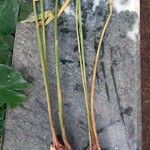
Zingiber officinale
Ginger · Garden ginger · Common ginger · Canton Ginger · Halia
Description
Source: leafsnapGinger (Zingiber officinale) is a flowering plant whose rhizome, ginger root or ginger, is widely used as a spice and a folk medicine. It is a herbaceous perennial which grows annual pseudostems (false stems made of the rolled bases of leaves) about one meter tall bearing narrow leaf blades. The inflorescences bear flowers having pale yellow petals with purple edges, and arise directly from the rhizome on separate shoots.Ginger is in the family Zingiberaceae, which also includes turmeric (Curcuma longa), cardamom (Elettaria cardamomum), and galangal. Ginger originated in Maritime Southeast Asia and was likely domesticated first by the Austronesian peoples. It was transported with them throughout the Indo-Pacific during the Austronesian expansion (c. 5,000 BP), reaching as far as Hawaii. Ginger is one of the first spices to have been exported from Asia, arriving in Europe with the spice trade, and was used by ancient Greeks and Romans. The distantly related dicots in the genus Asarum are commonly called wild ginger because of their similar taste. Although used in traditional medicine and as a dietary supplement, there is no good evidence that consuming ginger or its extracts has any effect on human health or as a treatment for diseases. In 2019, world production of ginger was 4.1 million tonnes, led by India with 44% of the world total.
🎭 Affection, Wealth, Achievement
Care Guide
💧 Water Every week
Ginger flourishes in tropical conditions and prefers consistent moisture, thriving with weekly watering. Although it becomes drought-tolerant once established, ginger still benefits from regular soil moisture during its growing season. This regular watering enhances its lush foliage and vibrant blooms, making ginger an excellent choice for outdoor growth as a herbaceous perennial.
How should I water my Ginger plant?
To properly water Ginger, it is recommended to use filtered water at room temperature. Tap water may contain harmful particles, so using filtered water is preferable. Since Ginger originates from warm environments, it is important to avoid using cold water as it can shock the plant. Additionally, overhead watering should be avoided to prevent issues with the foliage. Instead, gently soak the soil with the filtered room temperature water until it is fully saturated. This method benefits the plant by nourishing the roots and facilitating their growth and nutrient absorption.
What should I do if I give my Ginger plant too much or too little water?
Overwatering is a more common problem for Ginger plants than underwatering. Overwatering can cause the stems and leaves to wilt and turn yellow, and it can lead to diseases like root rot, mold, and mildew which can be fatal to the plant. Underwatering is less common for Ginger plants because they are relatively drought-tolerant. However, if underwatering does occur, the leaves may become brittle and brown. It's important to recognize the signs of overwatering early on because some of the resulting diseases, like root rot, may not be fixable if addressed too late. If you notice signs of overwatering, reduce your watering schedule and check the soil drainage. If the soil doesn't drain well, replace it with a loose, well-draining potting mix. If you notice signs of underwatering, simply water more regularly until the signs improve.
How frequently should I give water to my Ginger?
If your Ginger plant is in a pot, the most precise way to check if it needs water is to stick your finger into the soil. If the top two to three inches of soil feel dry, it's time to water it. If you have your Ginger plant outdoors in the ground, you can also use this method to test the soil. Again, if the top few inches of soil have dried out, it's time to water. In the spring and early fall, you will typically need to water about once a week using this method. During extremely hot weather, you may need to water twice or more per week. However, mature and well-established Ginger plants have a remarkable ability to tolerate drought.
How much water does my Ginger plant require?
When watering your Ginger plant, don't be afraid to give it a generous amount of water. Make sure the top two to three inches of soil are dry before watering, and then water thoroughly until the soil is completely soaked. You'll know you've added enough water if it starts to flow out of the drainage holes at the bottom of the pot. If you don't see any excess water coming out, it means you haven't watered enough. However, be careful not to let the water accumulate in the soil, as this can harm the plant. On the other hand, if water is not draining properly, it could mean that the soil is not draining well, which is not good for the plant's health. If your Ginger plant is outside, it should receive about 1 inch of rain per week, which is sufficient.
What is the best way to water my Ginger plant during different growth stages?
The water needs of Ginger can vary depending on its growth stages. In the early years or after transplanting, more water is required as the plant focuses on growing new roots to support future growth. These new roots need extra moisture compared to mature roots. However, after a few seasons, Ginger will require less water. Another stage in which it may need more water is during blooming when the development of flowers requires a significant amount of moisture.
☀️ Light Partial sun
Ginger requires a substantial amount of gentle light. In its native habitat it experienced abundant filtered sunshine. During the early growth phase it benefits from a gradual amount of sun exposure that can be increased as it matures. Excessive light can scorch the foliage, while too little light can restrict its growth and vigor.
What are the sunlight requirements for growing ginger?
Ginger plants require different amounts of sunlight depending on their growth stage. Initially, they benefit from partial sunlight, about 3-6 hours daily, and as they mature, they can handle full sunlight, which means more than 6 hours of sunlight each day. It's important to observe how sunlight moves through your garden to ensure your plants receive a balance of light and shade, promoting optimal growth and happiness.
How important is light exposure for ginger, and can artificial lighting be used?
Light exposure is crucial for ginger, as it originates from habitats with plenty of filtered sunshine. During its initial growth stages, ginger needs soft and gradual light exposure, which should increase as the plant matures. Excessive exposure to light can cause foliage burn, while insufficient light can stunt growth and vigor. In indoor settings or when natural light is insufficient, artificial lighting becomes essential for optimal growth. It’s advisable to use LED lights, which can be customized to provide specific wavelengths needed by the plant. For full sun plants, 30-50W/sq ft of artificial light is recommended, 20-30W/sq ft for partial sun plants, and 10-20W/sq ft for full shade plants. The light source should be placed 12-36 inches above the plant, and the duration should mimic natural daylight hours, generally 8-12 hours per day.
What are some symptoms of improper light exposure in ginger, and how can they be addressed?
Ginger can exhibit several symptoms when light conditions are not optimal. Inadequate light can lead to smaller leaves, leggy or sparse growth, faster leaf drop, slower or halted growth, and lighter-colored or yellowing leaves due to chlorosis. Excessive light exposure can cause sunscald, leaf curling, wilting, and leaf scorching. To address these issues, for indoor plants, gradually shift them to sunnier spots or use artificial lighting to provide at least 3-6 hours of direct sunlight daily. For outdoor plants, move them gradually to sunnier locations each week to avoid sunburn. Reducing obstructions like pruning trees can help increase sunlight exposure, and for smaller plants, transplanting during their dormant period to a location with ample sunlight and good drainage is beneficial. It's important to note that parts of the plant affected by insufficient sunlight may not recover, but new growth should be healthy after adjusting light exposure.
🌡️ Temperature 15–37.8°C
Ginger naturally grows in warm, humid conditions. It prefers temperatures of 59 to 100 °F (15 to 38 °C) and can endure short periods down to 50 °F (10 °C). In cooler months, it's advisable to place the plant in a warm, well-lit spot to preserve its growth.
What is the ideal growing environment for ginger?
Ginger thrives in a warm and humid environment, ideally with temperatures ranging from 59°F to 100°F (15°C to 38°C). It can tolerate temperatures as low as 50°F (10°C) for brief periods. To ensure continued growth during cooler months, it's recommended to keep ginger in a warm and well-lit area. While ginger has some degree of cold tolerance and generally does not require special measures for temperatures above -5°C, it's important to protect it with plastic film, fabric, or other materials if temperatures are expected to drop below this point.
How does ginger react to low temperatures?
Ginger has a moderate tolerance to low temperatures, thriving best above 15°C. In winter, it's crucial to keep it above -5°C to prevent damage. If temperatures fall below -10°C, the plant's leaves may begin to droop and, in severe cases, wilt and fall off. For recovery from mild frost damage, trim off the affected parts. To preemptively protect against cold, wrap the plant with non-woven fabric or cloths and establish a wind barrier.
What should I do if my ginger is exposed to high temperatures?
During the summer, it's essential to keep ginger's environment below 38°C to prevent stress on the plant. Exposure to temperatures over 43°C can cause the leaves to lighten in color, wither at the tips, curl, and increase susceptibility to sunburn. To mitigate damage from high temperatures, trim away sunburned or dried parts of the plant. Relocating the plant to a shaded area or using a shade cloth can protect it from intense sun. Additionally, watering the plant in the morning and evening helps keep the soil adequately moist.
💨 Humidity
🪴 Soil 6-6
🌱 Fertilizer
A single application of fertilizer in spring is generally enough for ginger, though repeated feedings can maximize growth. Fertilize once every month to a month and a half. Feeding improves the leaves’ appearance and function, helping maintain even color and a healthy texture. It also encourages root development and nutrient uptake for long-term plant health.
Why should I put fertilizer on my Ginger plant?
Fertilization benefits the leaves of Ginger by enhancing their appearance and functionality. It not only improves the consistent color and healthy texture of the leaves but also promotes the growth of new roots and maintenance of existing ones. This ensures the plant's overall health and enhances its ability to absorb nutrients from the soil over time.
What is the ideal time to fertilize my Ginger?
Growing Ginger outdoors each year results in new growth in early spring, indicated by the emergence of leaves. This is the cue to begin fertilization for the year. Typically, one application of fertilizer is sufficient for the Ginger to thrive. However, if you want to optimize growth, you can fertilize multiple times during spring and early summer, ideally once every month to a month and a half.
When is it not a good idea to put fertilizer on my Ginger plant?
During the late fall and winter, your Ginger will go into a dormant phase and stop producing new growth. It's important to avoid fertilizing your Ginger during this time. In the spring and summer, if you choose to fertilize multiple times, start reducing the amount of fertilizer as summer approaches because the growth rate of your Ginger will also decrease. In general, it's not advisable to fertilize your Ginger when the weather is unusually hot or the soil is extremely dry. Fertilizing in such conditions can stress your Ginger and cause it to die earlier.
What kind of fertilizer does my Ginger plant need?
Choosing the best fertilizer for Ginger plants is straightforward. A general-purpose garden fertilizer with equal amounts of nitrogen, phosphorus, and potassium works well. Look for a fertilizer with a ratio of 10-10-10 or something similar. Avoid using fertilizers with high nitrogen levels if unsure. Granular fertilizers are the most effective for Gingers. Look for slow-release options that are easy to apply to the soil. Additionally, consider feeding the Ginger with organic soil amendments like compost for extra nourishment.
How should I fertilize my Ginger?
In early spring, when you notice the first leaves of your Ginger poking through the soil, it's time to apply a granular slow-release fertilizer. Make sure to apply the fertilizer to the soil surrounding the base of the Ginger, rather than directly on the plant. If needed, gently move the leaves aside to access the soil above the roots. You can repeat this process later in the season if you prefer. Additionally, it is a good idea to water your Ginger before and after fertilizing.
🪴 Pot & Repot 2-3 years
When repotting Ginger, select a pot 1-2 inches (2.5–5.1 cm) larger with ample drainage. Use a well-draining potting mix. Repot in spring or fall, making sure the root ball sits slightly lower than the rim of the flower pot. Water thoroughly after repotting and place in a warm spot with indirect sunlight.
✂️ Pruning
Ginger is a rhizomatous perennial known for its aromatic roots. To encourage growth and improve air circulation, prune the plant from early to late spring, removing any dead foliage. Regular pruning not only promotes healthy rhizome development but also optimizes the plant's vitality and yield. Be sure to use clean, sharp tools to prevent infection.
🌿 Propagating
🐛 Diseases & pets
☠️ Toxicity
Characteristics
- Plant Type
- Herb
- Life Cycle
- Perennial
- Genus
- Zingiber
- Family
- Zingiberaceae
- Hardiness Zone
- 8-11
- Mature Height
- 49 cm to 91 cm
- Mature Spread
- 0.61 m to 1.22 m
- Leaf Color
- Green
- Leaf Type
- Deciduous
- Flower Color
- Yellow
- Flower Size
- 4.06 cm to 5.08 cm
- Bloom Time
- Mid summer, Late summer, Early fall
- Planting Time
- Spring
- Harvest Time
- Late summer, Fall, Winter
- Native Area
- India, Thailand