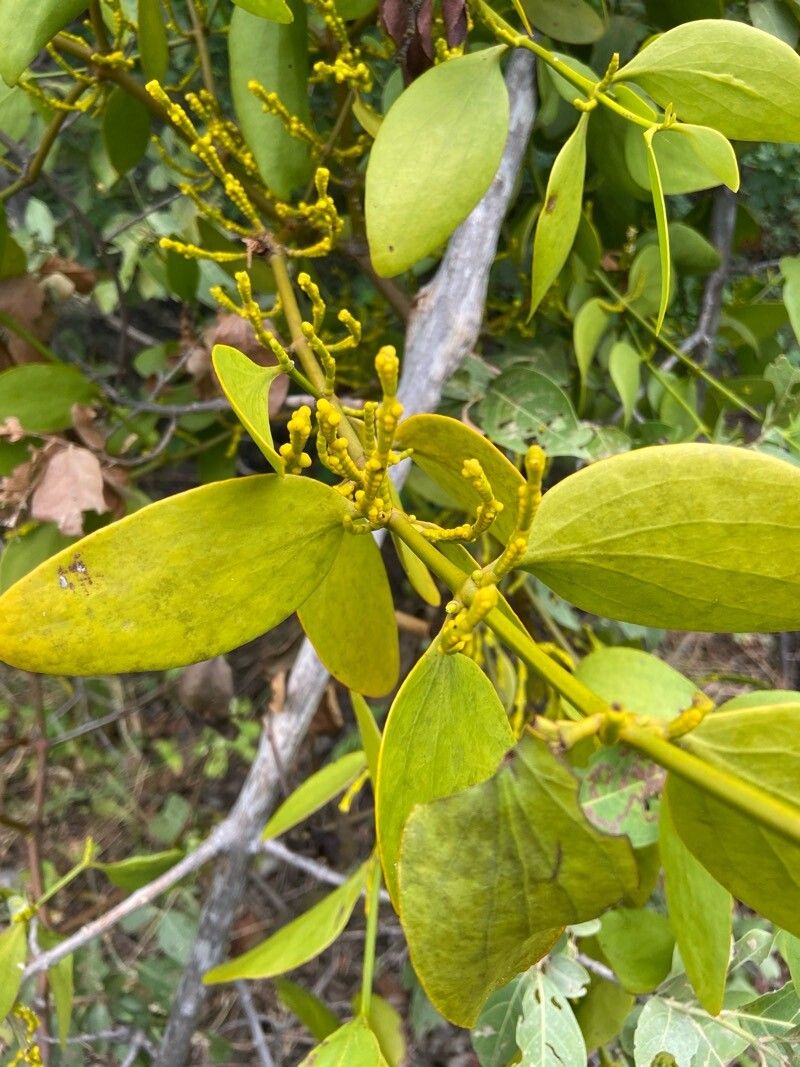
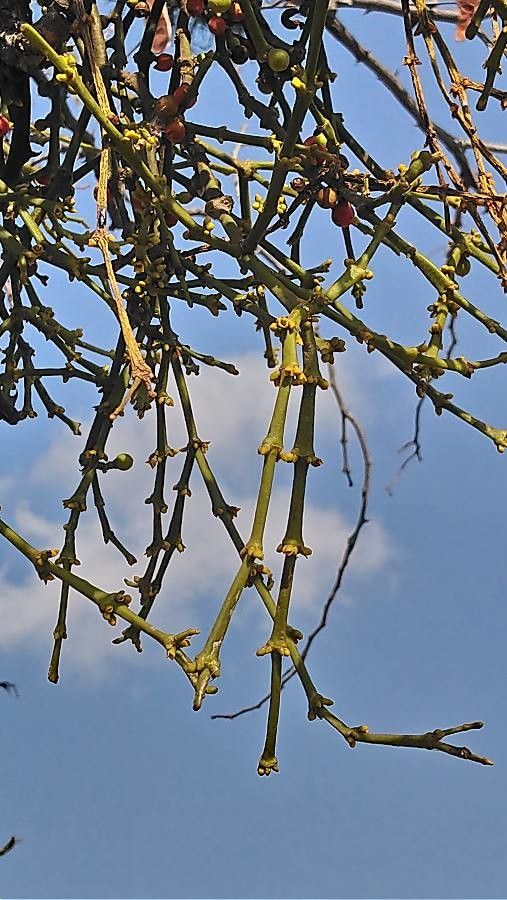
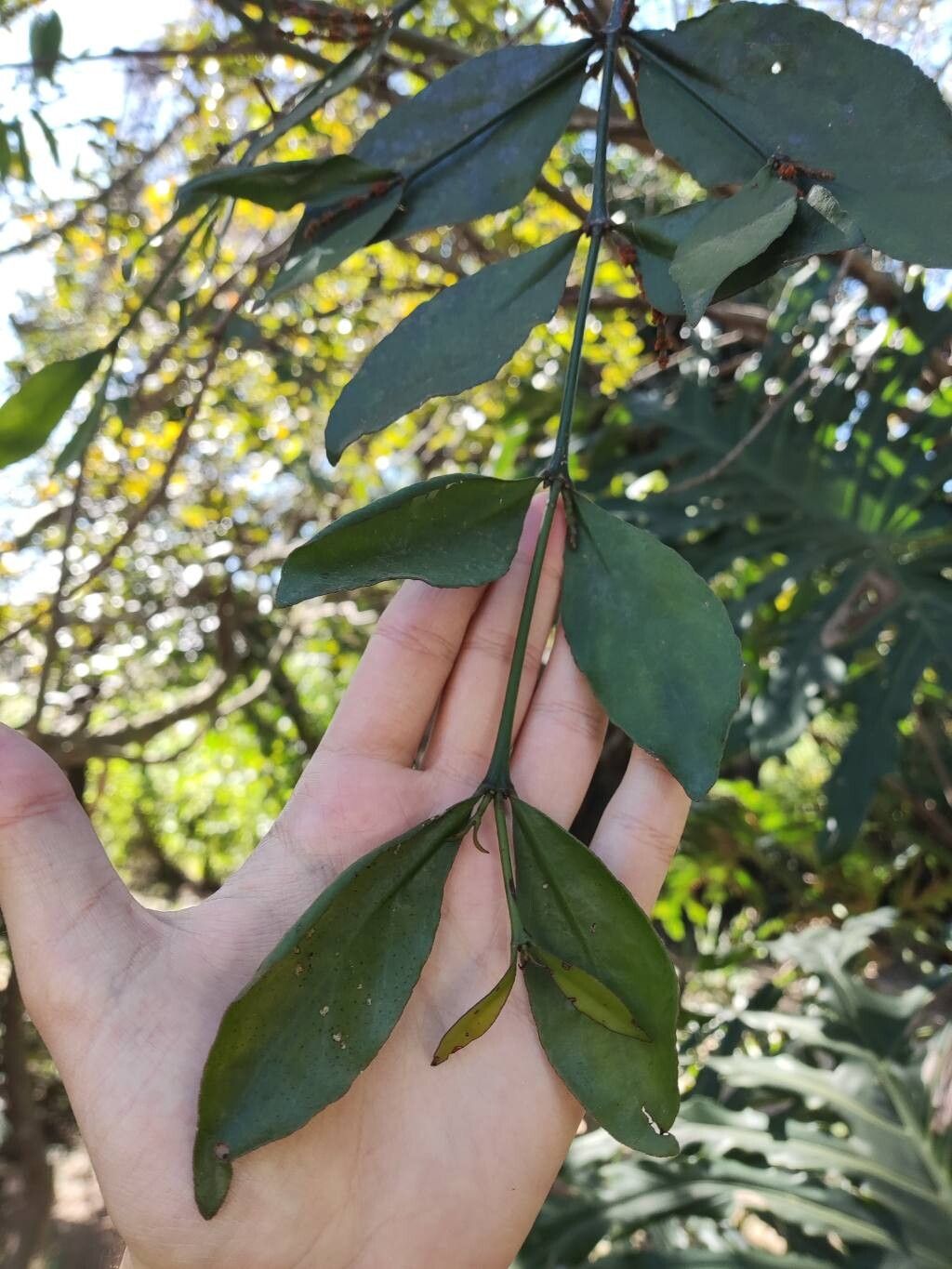
Phoradendron juniperinum is a species of flowering plant in the sandalwood family known by the common name juniper mistletoe. It is native to the southwestern United States and northern Mexico, where it grows in various types of woodland habitat. It has been reported from California, Nevada, Arizona, New Mexico, Oregon, Utah, Texas, Chihuahua and Sonora.This mistletoe parasitizes species of juniper, including Utah (Juniperus osteosperma), Rocky Mountain (J. scopulorum), and western juniper (J. occidentalis).It is a shrub producing many erect and spreading yellow-green branches 20 to 40 centimeters long from a woody base where it attaches to its host tree, tapping the xylem for water and nutrients. It is hemiparasitic, meaning it contains some chlorophyll and can photosynthesize some energy for itself as well. The smooth, noded branches have flattened, scale-like leaves. The plant is dioecious, with male and female individuals producing different forms of inflorescence with knobby flower clusters. Female flowers yield shiny light pink spherical berries each about 4 millimeters wide. Birds eat the fruits and excrete the undigested seeds on tree branches, where they root.
Juniper mistletoe shows strong disease resistance and is usually not susceptible to illnesses. In terms of care, the plant is fairly low-maintenance. When grown outdoors it needs minimal watering, and larger specimens generally do not require pruning. Smaller plants, however, should be trimmed after they have finished blooming. Juniper mistletoe is suitable for anyone with an outdoor area, such as a garden or deck, and does not demand a lot of care experience.
How to keep Phoradendron Juniperinum.
Light
Juniper mistletoe is native to open habitats, like sunny meadows and forest edges, that offer abundant light. It does best in Full Sun but will also tolerate Partial Sun, making it adaptable to a range of light conditions.
Water
Juniper mistletoe thrives in dry conditions and is highly drought-resistant. It needs minimal watering, just once every two to three weeks, making it perfect for xeriscaping. As an evergreen plant, juniper mistletoe helps conserve water by reducing the need for frequent irrigation.
Temperature
Juniper mistletoe naturally occurs in climates with temperatures between 41 and 100.4 °F (5 to 38 ℃). It favors milder temperate conditions. Care should be taken to keep seasonal temperature variations within this range to support healthy growth.
Fertilizer
Fertilize your Juniper mistletoe in early spring to encourage healthy growth. Regular feeding boosts overall health, resulting in vigorous development, greater tolerance of harsh conditions, and improved resistance to pests and diseases. Stick to a specific fertilization schedule for your Juniper mistletoe to maintain foliage that is vibrant, deeply colored, and lush.
Pruning
Juniper mistletoe is an evergreen parasite that grows on juniper trees. To prevent its spread and to allow for proper healing, it’s best to prune in early spring. Regular pruning not only helps maintain the health of the host tree but also enhances its appearance. Be sure to disinfect your tools before and after pruning to prevent the transfer of diseases.
Botanical profile.
- Plant Type
- Shrub
- Life Cycle
- Perennial
- Genus
- Phoradendron
- Family
- Santalaceae
- Hardiness Zone
- 5-11
- Mature Height
- 61 cm to 91 cm
- Mature Spread
- 0.61 m to 1.22 m
- Leaf Color
- Olive Drab
- Leaf Type
- Semi-evergreen
- Flower Color
- Yellow, Green
- Flower Size
- 0.25 cm to 0.51 cm
- Bloom Time
- Early spring, Mid spring
- Planting Time
- Spring, Summer
- Harvest Time
- Late summer, Early fall, Mid fall
- Native Area
- Mexico
Other names.
Reader questions.
What are the sunlight requirements for Juniper mistletoe?
Juniper mistletoe requires full sun, defined as above 6 hours of sunlight, to thrive but can also tolerate partial sun, which is about 3-6 hours of sunlight. It originates from open environments, such as sunny meadows and forest edges, making it adaptable to various sunlight conditions. However, when planning your garden, it's crucial to observe how sunlight moves through the area to ensure that your plants get the right balance of light and shade.
What is the indigenous climate for Juniper mistletoe?
Juniper mistletoe is indigenous to climates with temperatures ranging from 41 to 100.4 °F (5 to 38 °C). It prefers milder temperate environments and requires careful management to ensure seasonal temperature shifts remain within this range for healthy growth. Despite its strong cold resistance, in situations where winter temperatures are expected to fall below -25°C, measures should be taken to protect the plant from frost. This includes wrapping the trunk and branches with non-woven fabric or cloth and watering the plant abundantly before the first freeze in autumn to keep the soil moist, which helps prevent drought and water scarcity during the winter and early spring.
Can I use artificial lighting for Juniper mistletoe?
Yes, artificial lighting can be a vital solution for growing Juniper mistletoe indoors, especially when natural sunlight is insufficient. LED lights are popular for indoor plants as they can be customized to provide specific wavelengths needed for growth. For full sun plants, 30-50W/sq ft of artificial light is recommended, while partial sun plants require 20-30W/sq ft, and full shade plants need 10-20W/sq ft. The artificial light source should be placed 12-36 inches above the plant to mimic natural sunlight and left on for 8-12 hours per day, depending on the plant species.
How does Juniper mistletoe react to low temperatures?
Juniper mistletoe is cold-tolerant, thriving best above 5°C and managing well through winters kept above -20°C. However, should temperatures drop below -25°C, while there may not be noticeable impact during winter, come spring, the plant's branches can become brittle and dry, and it may fail to produce new shoots. The recommended solution for these symptoms is to prune away any dead branches that have not sprouted new leaves in the spring.
What are some symptoms of insufficient light for Juniper mistletoe?
Juniper mistletoe displays several symptoms when it does not receive enough light. New leaves may grow smaller, and the plant might exhibit leggy or sparse growth due to longer spaces between leaves or stems. There can also be faster leaf drop, slower or no new growth, and lighter-colored new leaves, indicating a lack of chlorophyll and essential nutrients. Excessive sunlight, however, can lead to chlorosis, sunscald, leaf curling, wilting, and leaf scorching, which are harmful to the plant.
What are the effects of high temperatures on Juniper mistletoe and how can it be protected?
During the summer, it is important to keep Juniper mistletoe temperatures below 38°C. Exceeding 43°C can cause the leaves to lighten in color, tips to become dry and withered, and increase susceptibility to sunburn. To protect the plant under such conditions, trim away the sunburned and dried parts. Moving the plant to a shadier location or using a shade cloth can protect it from the midday and afternoon sun. Ensure to water the plant in the morning and evening to maintain soil moisture.
How can I address the symptoms of insufficient light for my Juniper mistletoe?
To address insufficient light, gradually move your Juniper mistletoe to a sunnier location each week, aiming for at least 6 hours of direct sunlight daily if indoors, using a south-facing window to maximize sunlight exposure. For outdoor plants, move them carefully to avoid sunburn. Additionally, consider reducing obstructions like overhanging branches for ground-planted specimens or using artificial lighting for indoor plants, ensuring it's on for at least 8 hours daily. Note that parts of the plant already affected may not recover, but new growth should be healthy.