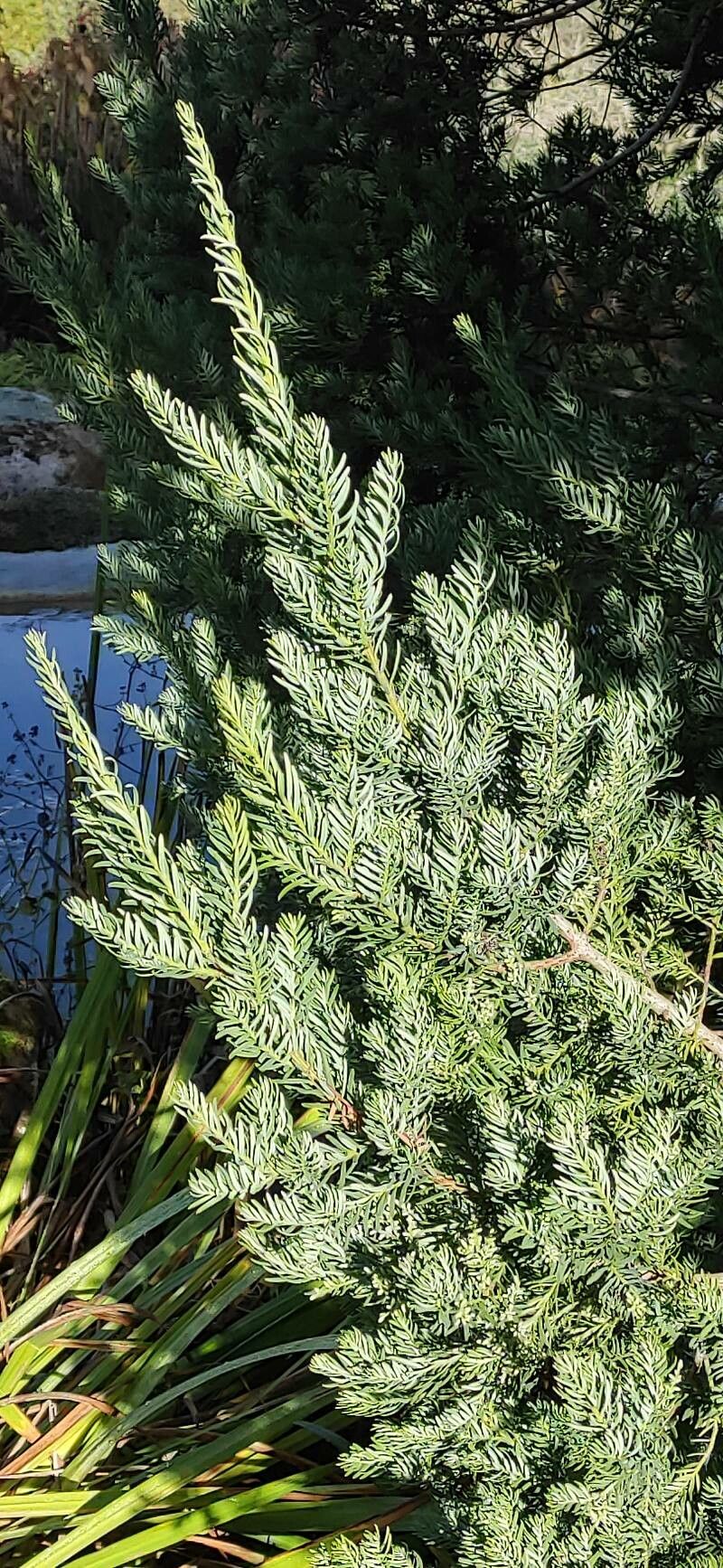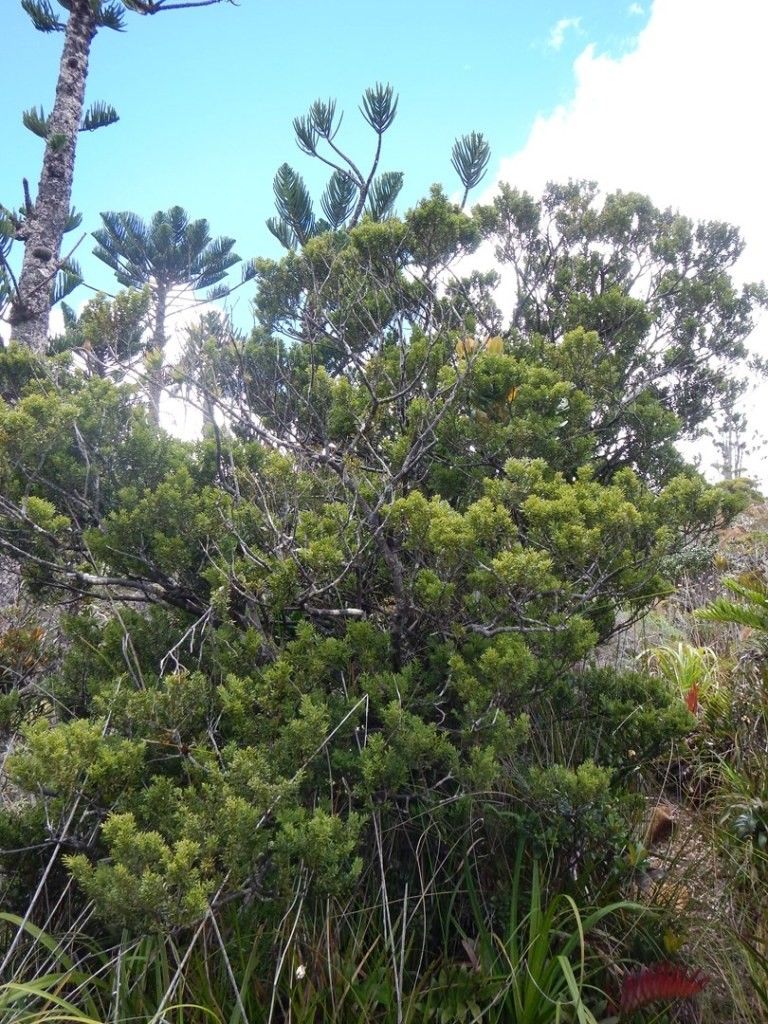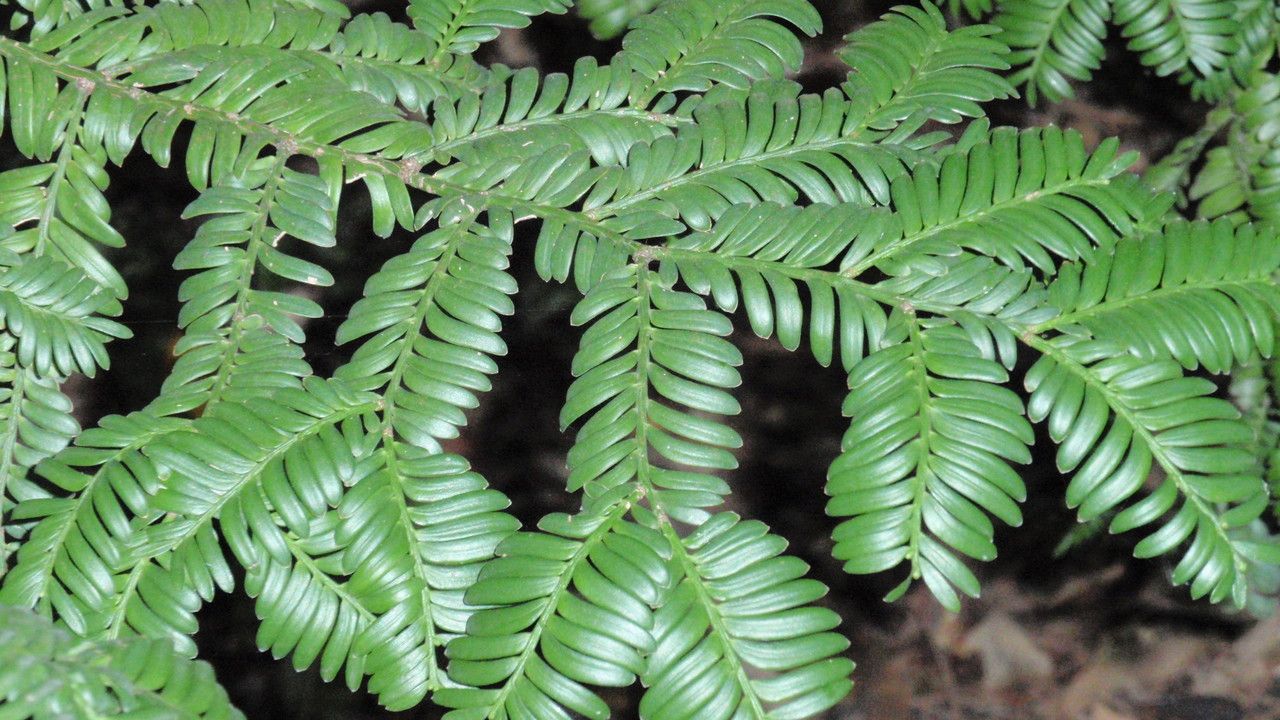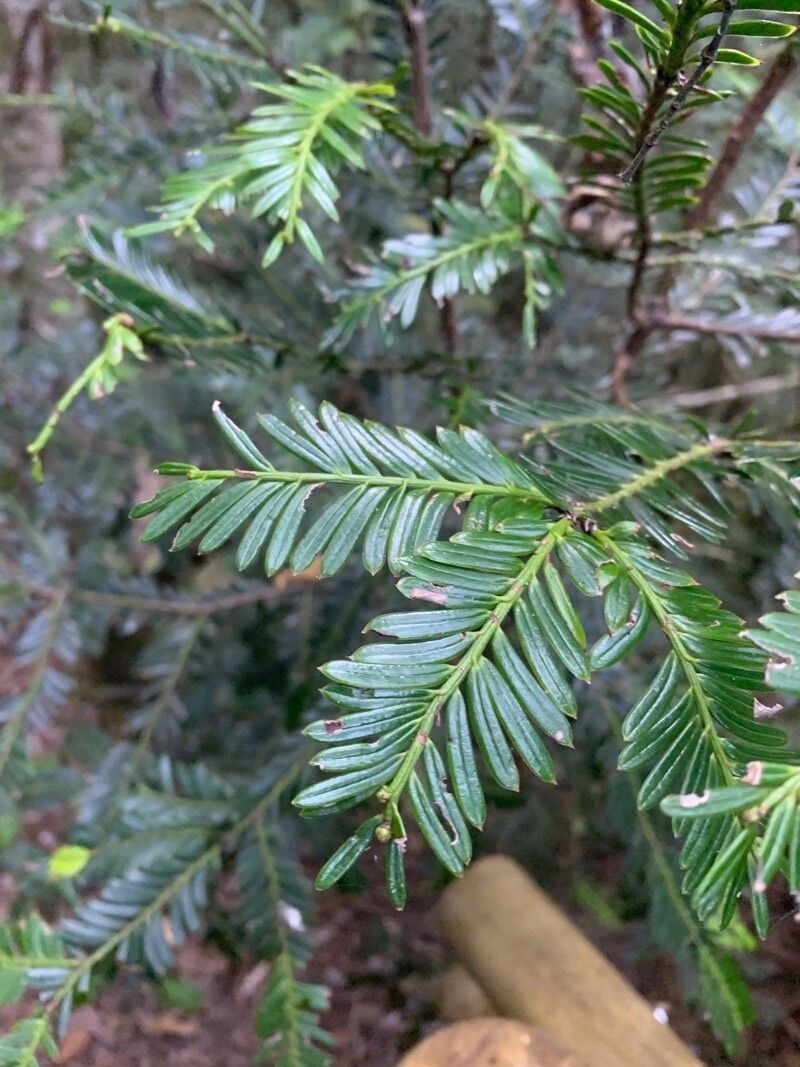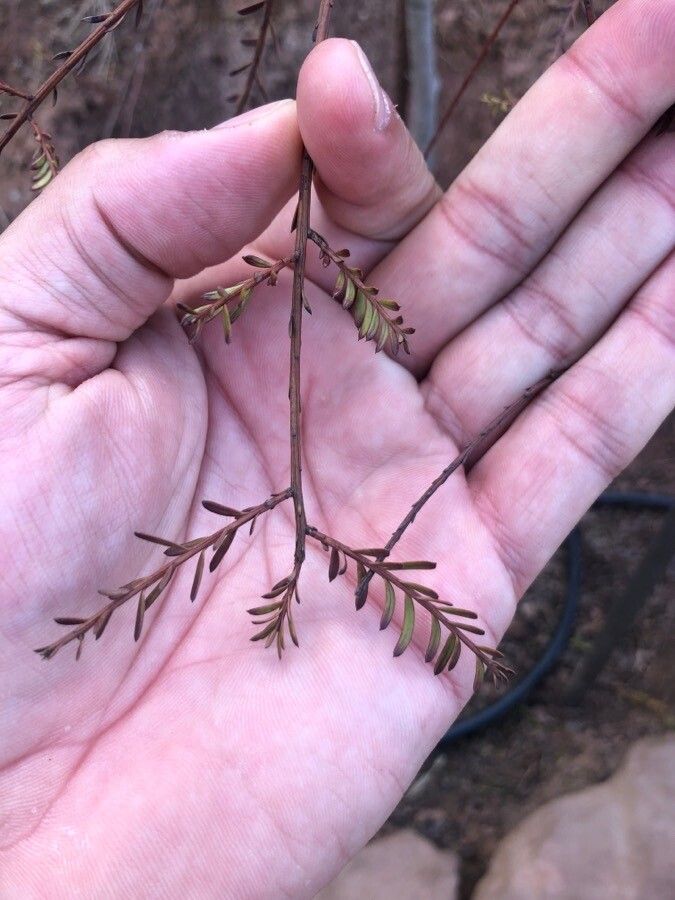
Prumnopitys ferruginea, commonly called miro, is an evergreen coniferous tree which is endemic to New Zealand. Before the genus Prumnopitys was distinguished, it was treated in the related genus Podocarpus as Podocarpus ferrugineus. It grows up to 25 m high, with a trunk up to 1.3 m diameter. The leaves are linear to sickle-shaped, 15–25 mm long and 2–3 mm broad, with downcurved margins. The plants are dioecious with pollen cones being solitary while those of female plants hang from a curved, scaly stalk. The seed cones are highly modified, reduced to a central stem 2–3 cm long bearing 1-3 scales, each scale maturing berry-like, oval, about 20 mm long and 10–15 mm broad, red to purple-red with a soft edible pulp covering the single seed. The seeds are dispersed by the New Zealand pigeon, which eats the very conspicuous 'berries' and passes the seeds in its droppings. It is found growing on both lowland terrain and on hill slopes throughout the two main islands as well as on Stewart Island/Rakiura (47° S). The Tree can live for at least 600 years.The scientific name ferruginea derives from the rusty colour of dried herbarium specimens of the leaves.
Miro is resistant to disease and generally not susceptible to illnesses. In terms of care, the plant is fairly low-maintenance. When grown outdoors it needs only minimal watering, and larger specimens typically do not require pruning. Smaller plants, however, should be pruned after they finish blooming. Mirot is suitable for anyone with an outdoor area, such as a garden or deck, and does not call for extensive care experience.
How to keep Prumnopitys Ferruginea.
Light
Miro performs best when it receives a substantial amount of light during the day, though it can tolerate conditions with less sun. Having originated in an environment with abundant sunlight, inadequate light can impede its growth and result in reduced vigor and poor health. Conversely, excessively intense exposure can stress the plant.
Water
Miro thrives in environments with moderate humidity and has some tolerance for drought. Although it naturally grows in regions with regular rainfall, it prefers moist soil. To achieve this, water the plant every 2-3 weeks, keeping the soil damp but not waterlogged. As an evergreen, miro needs consistent hydration all year round.
Temperature
Miro naturally occurs in habitats where temperatures range from 59 to 100.4 °F (15 to 38 ℃). It does best within that range. Seasonal adjustments may be necessary to maintain its preferred temperature.
Fertilizer
Miro has particular nutrient needs and does not require heavy fertilization. Spring is the best time to apply fertilizer for optimal growth. Providing nutrients improves its health, increases its resistance to pests and diseases, and helps maintain its long lifespan.
Pruning
Miro is a slow-growing, evergreen conifer that benefits from winter pruning to shape the tree and remove any dead branches. Light thinning helps to increase airflow and sunlight, which improves the plant's overall health. It is important to prune conservatively to avoid stressing the miro and to preserve its natural form.
Botanical profile.
- Plant Type
- Tree
- Life Cycle
- Perennial
- Genus
- Prumnopitys
- Family
- Podocarpaceae
- Hardiness Zone
- 8-11
- Mature Height
- 24.99 m
- Mature Spread
- 6.1 m
- Leaf Color
- Dark Green
- Leaf Type
- Evergreen
- Bloom Time
- Mid fall, Late fall
- Planting Time
- Spring, Summer, Autumn, Winter
- Harvest Time
- Spring
Other names.
Reader questions.
What are the sunlight requirements for Miro plants?
Miro plants, botanically known as Prumnopitys ferruginea, thrive best when exposed to a considerable amount of sunlight throughout the day. They are versatile in their sunlight needs, flourishing in both full sun (above 6 hours of sunlight) and partial sun (about 3-6 hours of sunlight) conditions. Originating from environments with abundant sunlight, Miro plants can suffer from poor vigor and health if they receive inadequate light. Similarly, too intense sunlight exposure can also stress the plant. It is important to observe the movement of sunlight in your garden to ensure that your Miro plants are placed in locations that provide an ideal balance of light and shade, promoting their wellbeing.
What is the ideal temperature range for Miro?
Miro, botanically known as Prumnopitys ferruginea, thrives best in temperatures ranging from 59 to 100.4 °F (15 to 38 °C). This temperature range is ideal for its growth, and maintaining this temperature preference might require seasonal adjustments. Miro has some cold tolerance, generally not requiring additional cold protection measures if the temperature stays above -5°C. However, if temperatures are expected to fall below -5°C, temporary measures like wrapping the plant with plastic film, fabric, or other materials are recommended to protect it from cold weather. These protective measures should be removed once temperatures rise again.
How does artificial lighting benefit indoor Miro plants?
Indoor Miro plants require sufficient lighting for optimal growth, especially in conditions where natural sunlight is lacking, such as during winter or in less sunny spaces. Artificial lighting can be a vital solution, promoting faster and healthier growth. LED lights are recommended for their ability to provide specific wavelengths needed by plants. Full sun plants need 30-50W/sq ft of artificial light, partial sun plants require 20-30W/sq ft, and full shade plants need 10-20W/sq ft. It is essential to place the light source 12-36 inches above the plant, mimicking natural sunlight as closely as possible, and ensure the plant receives 8-12 hours of light daily.
How does Miro respond to low temperatures and what are the solutions?
Miro has a moderate tolerance to low temperatures, thriving best above 15°C and needing protection when winter temperatures drop below -5°C. Exposure to temperatures below -10°C may cause leaves to droop, and while mild cases may recover, severe exposure results in wilting and leaf loss. To protect Miro from low temperatures, frost-damaged parts should be trimmed off. Additionally, wrapping the plant with non-woven fabric or cloth and constructing a wind barrier can help safeguard it against cold winds.
What symptoms indicate light deficiency in Miro plants?
Miro plants exhibit several symptoms when they suffer from light deficiency, including smaller new leaves compared to older ones, leggy or sparse growth, faster leaf drop, slower or halted new growth, paler new leaves, and symptoms of chlorosis, sunscald, leaf curling, wilting, and leaf scorching. These symptoms result from insufficient sunlight, leading to a reduction in chlorophyll and essential nutrients, structural weakness, and decreased overall health. Ensuring adequate sunlight is crucial to avoiding these issues and promoting healthy growth.
What should be done if Miro is exposed to high temperatures?
During summer, it's important to keep Miro's temperature below 38°C to prevent stress from high heat. Exposure to temperatures above 43°C can alter leaf coloration, cause the tips to dry and wither, as well as lead to leaf curling and increased susceptibility to sunburn. To manage heat stress, sunburned and dried parts of the plant should be trimmed away. Moving Miro to a shaded location or using a shade cloth can protect it from the midday and afternoon sun. Additionally, watering the plant in the morning and evening helps to keep the soil adequately moist, mitigating the adverse effects of high temperatures.
How can I manage light exposure to improve the health of my Miro plant?
To improve your Miro plant's health through better light management, gradually move the plant to a location where it receives at least 6 hours of direct sunlight daily. This can be achieved by using a south-facing window and keeping curtains open during the day. For large or immovable plants, consider using artificial light for at least 8 hours daily or professional grow lights for ample exposure. For outdoor plants, move them gradually to prevent shock. Reduce obstructions to sunlight by pruning obstructing trees and consider transplanting smaller plants to sunnier locations. Remember, parts of the plant damaged by insufficient light may not recover, but new growth will be healthy with improved light exposure.