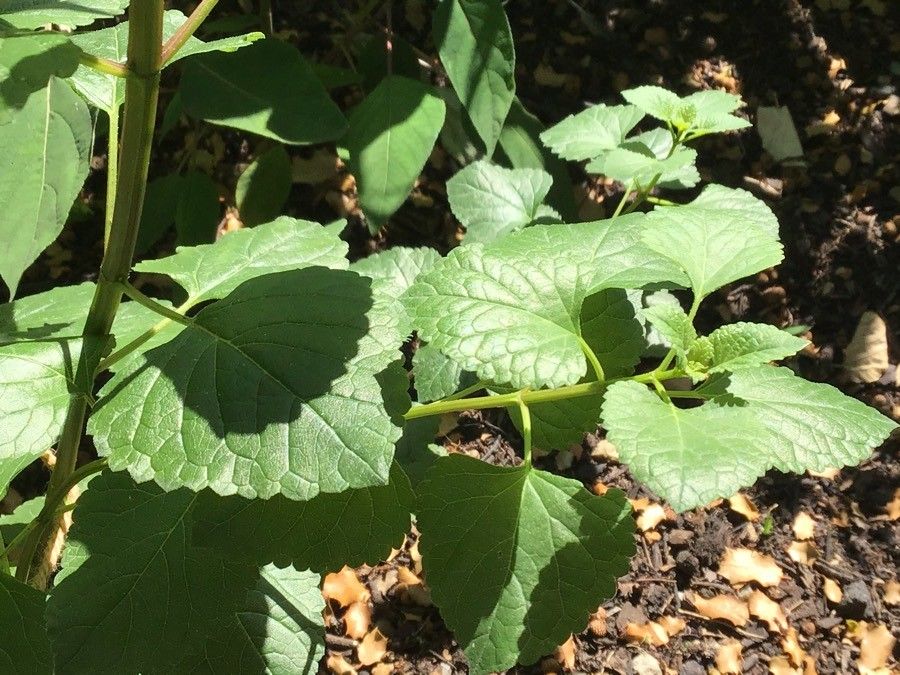
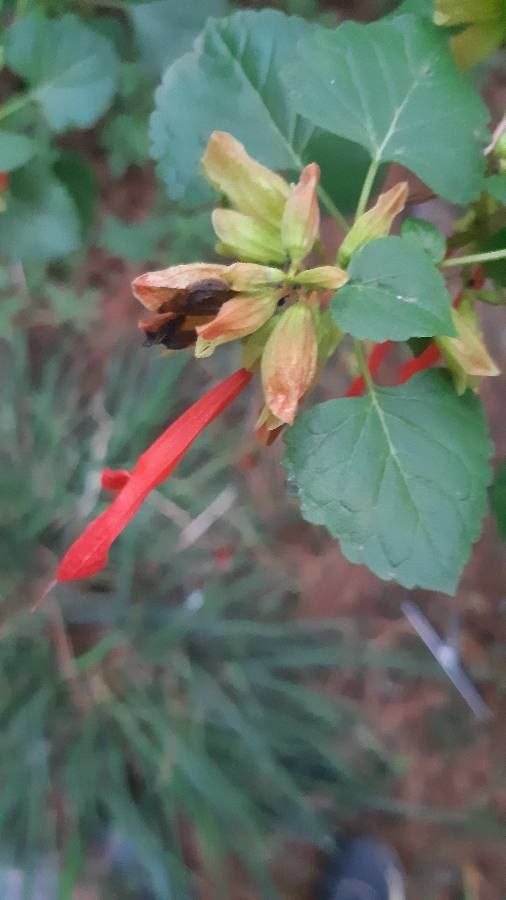
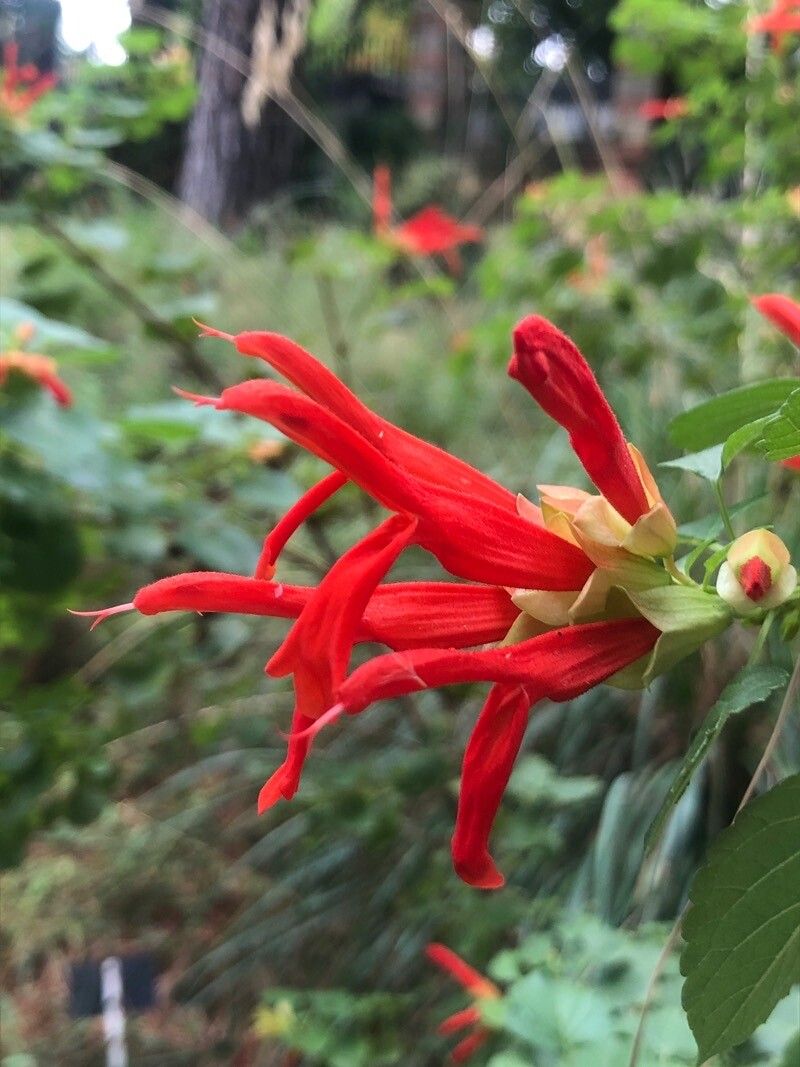
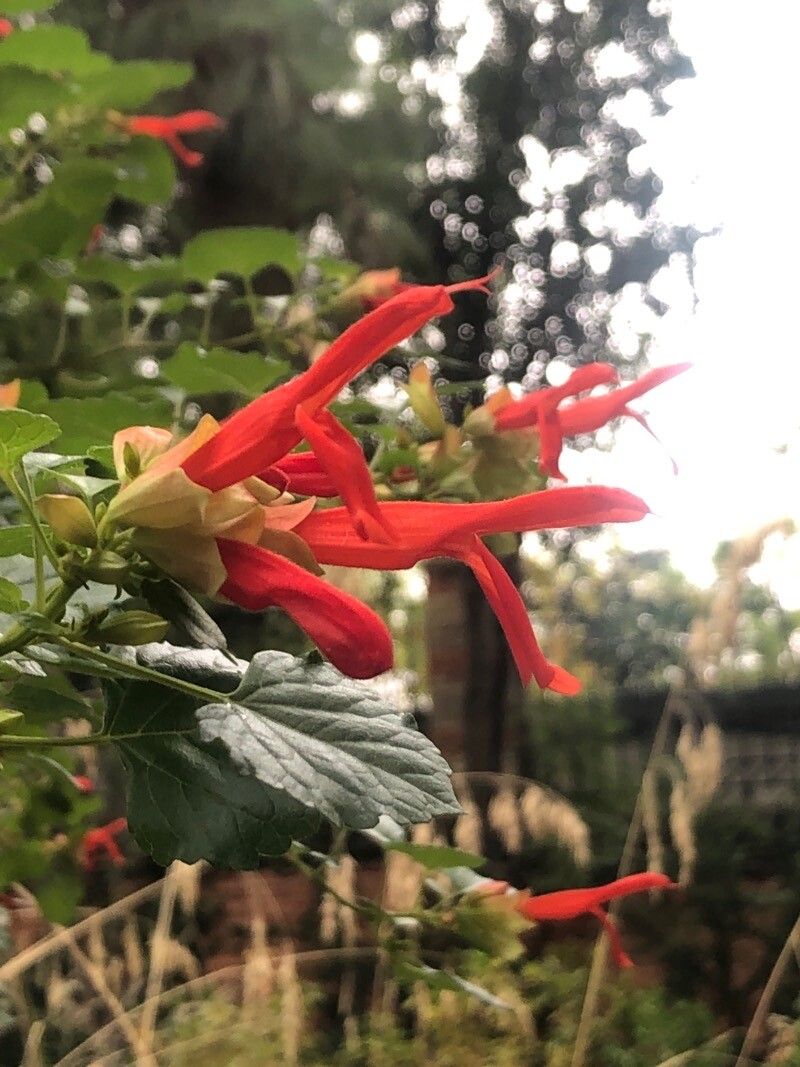
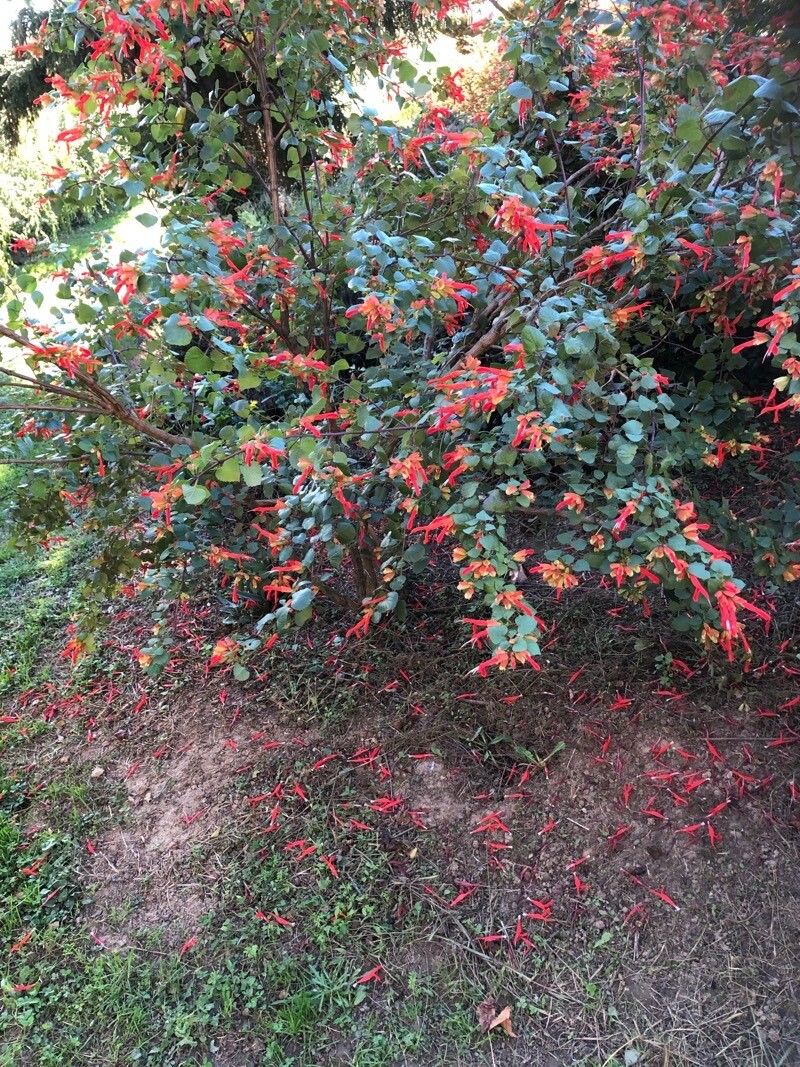
Salvia regla (Mountain sage) is a deciduous perennial that is native to a small area of the Chisos Mountains in west Texas and a large area of Mexico, in the states of Coahuila, Durango, and Oaxaca. The specific epithet is probably from the town of Regla in the state of Hidalgo. It is also referred to as the "queen of the Chisos Mountains". It has been widely planted along the Texas flyway for migrating birds, and is an important food source for hummingbirds returning to the tropics in September and October.Salvia regla is a deciduous shrub which reaches up to 6 feet tall and 4–5 feet wide. It grows on upright stems which give it a stately appearance. The mistletoe-green deltoid leaves are deeply veined and about 1 inch wide and long. The flower tube is 1 inch long, with a signal-red 1 inch calyx that is turned to the light, and is chartreuse on the underside. Though it was introduced into horticulture in 1839, it was very uncommon until the 1980s. Nurseries sell several cultivars, including 'Royal', 'Mount Emory', and 'Warnock's Choice'.
Mountain sage has strong resistance to disease and is generally not vulnerable to illnesses. As for care, this plant is fairly low-maintenance. Planted outdoors, it needs little watering, and larger specimens typically do not require pruning. Smaller plants, however, should be trimmed after they have finished blooming. Mountain sage is suitable for anyone with outdoor space, such as a garden or deck, and does not demand extensive care experience.
How to keep Salvia Regla.
Light
Mountain sage is native to exposed habitats like sunlit meadows and the edges of woodlands, where plenty of light is present. It does best in full sun but can also tolerate partial sun, adapting well to a range of light conditions.
Water
Mountain sage flourishes in rocky canyons and is drought-tolerant, though it benefits from occasional rainfall. To simulate natural precipitation, it should be watered weekly. Adapted to different weather conditions, mountain sage is resilient in diverse climates, making it suitable for regions with intermittent rain.
Temperature
Mountain sage is fairly adaptable to temperature, capable of withstanding higher heat and considerable temperature swings. In hot weather, it’s important to maintain watering and provide adequate shade to avoid sunburn. On the other hand, mountain sage is not very tolerant of low temperatures. It can handle some cold, but extreme cold can result in frost damage.
Fertilizer
The timing of fertilizing Mountain sage is critical. Apply fertilizer in early spring and continue once a month until early summer. Fertilizer encourages attractive blooms and provides energy during both dormant and active growth periods.
Pruning
Mountain sage is known for its vibrant red flowers and bushy growth habit. To enhance blooming, it is best to prune the plant in early spring. Begin by removing any dead wood, and then shape the plant as desired. Make sure to use clean tools to prevent damage. Regular pruning helps improve air circulation and sunlight exposure, contributing to the overall health of the plant.
Botanical profile.
- Plant Type
- Shrub
- Life Cycle
- Perennial
- Genus
- Salvia
- Family
- Lamiaceae
- Hardiness Zone
- 7-11
- Mature Height
- 0.91 m to 1.83 m
- Mature Spread
- 61 cm to 91 cm
- Leaf Color
- Green, Dark Green
- Leaf Type
- Deciduous
- Flower Size
- 3.05 cm to 4.06 cm
- Bloom Time
- Late summer, Fall
- Planting Time
- Spring, Summer, Autumn
- Harvest Time
- Mid fall, Late fall, Early winter
Other names.