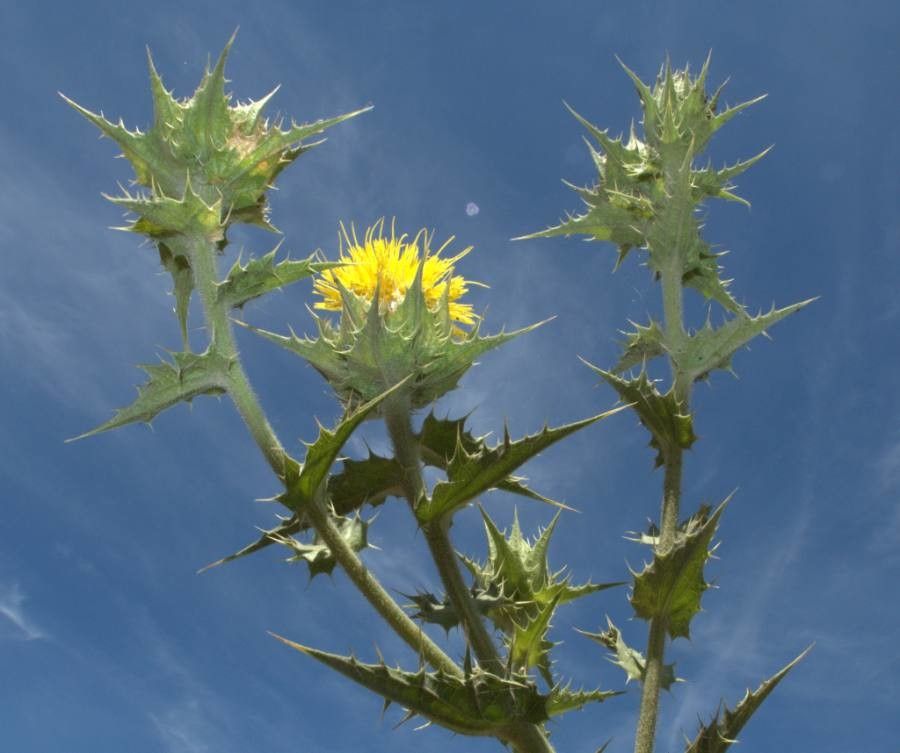
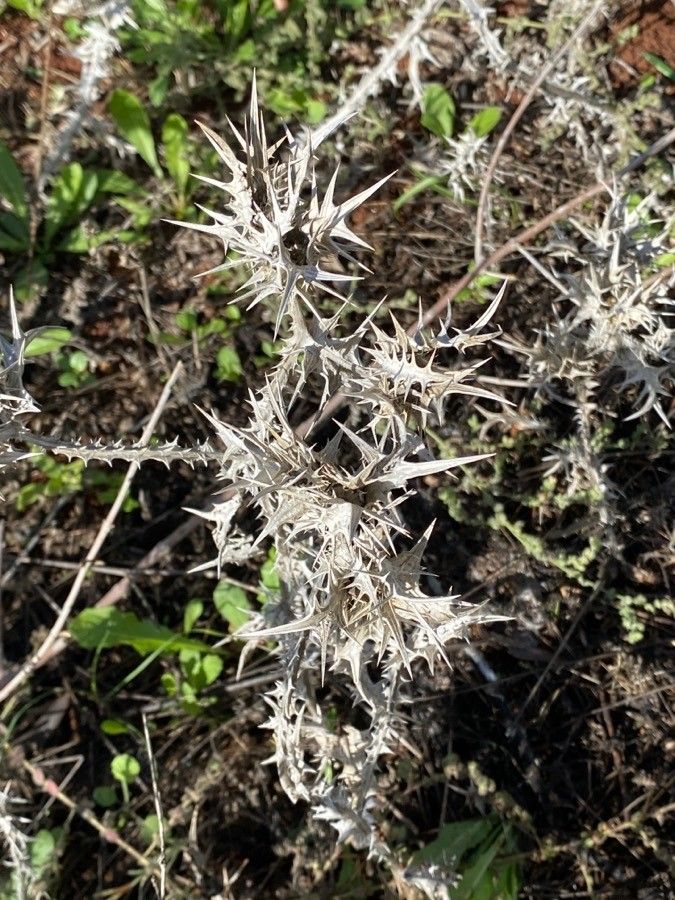
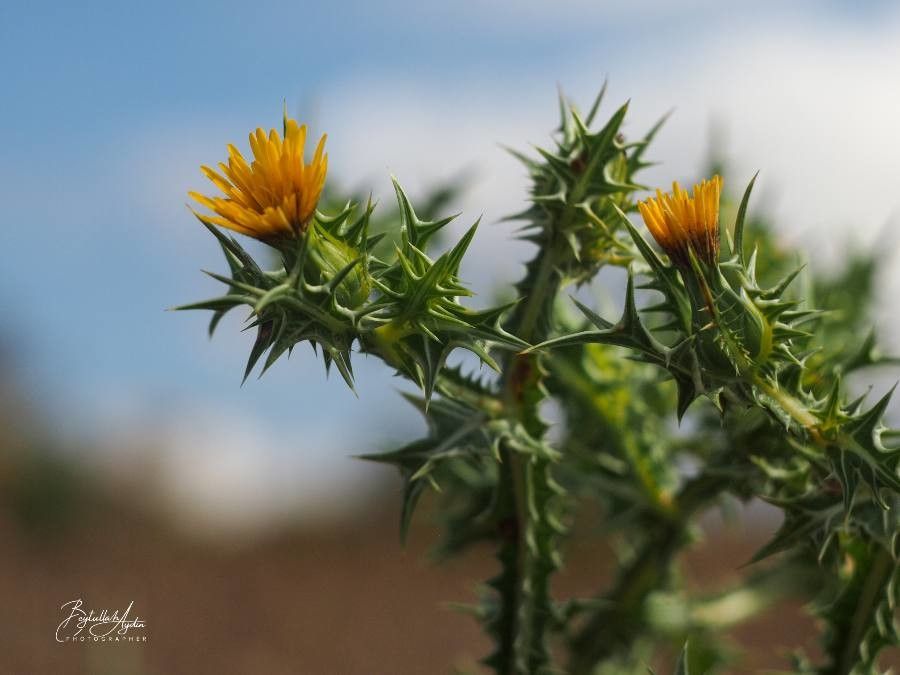
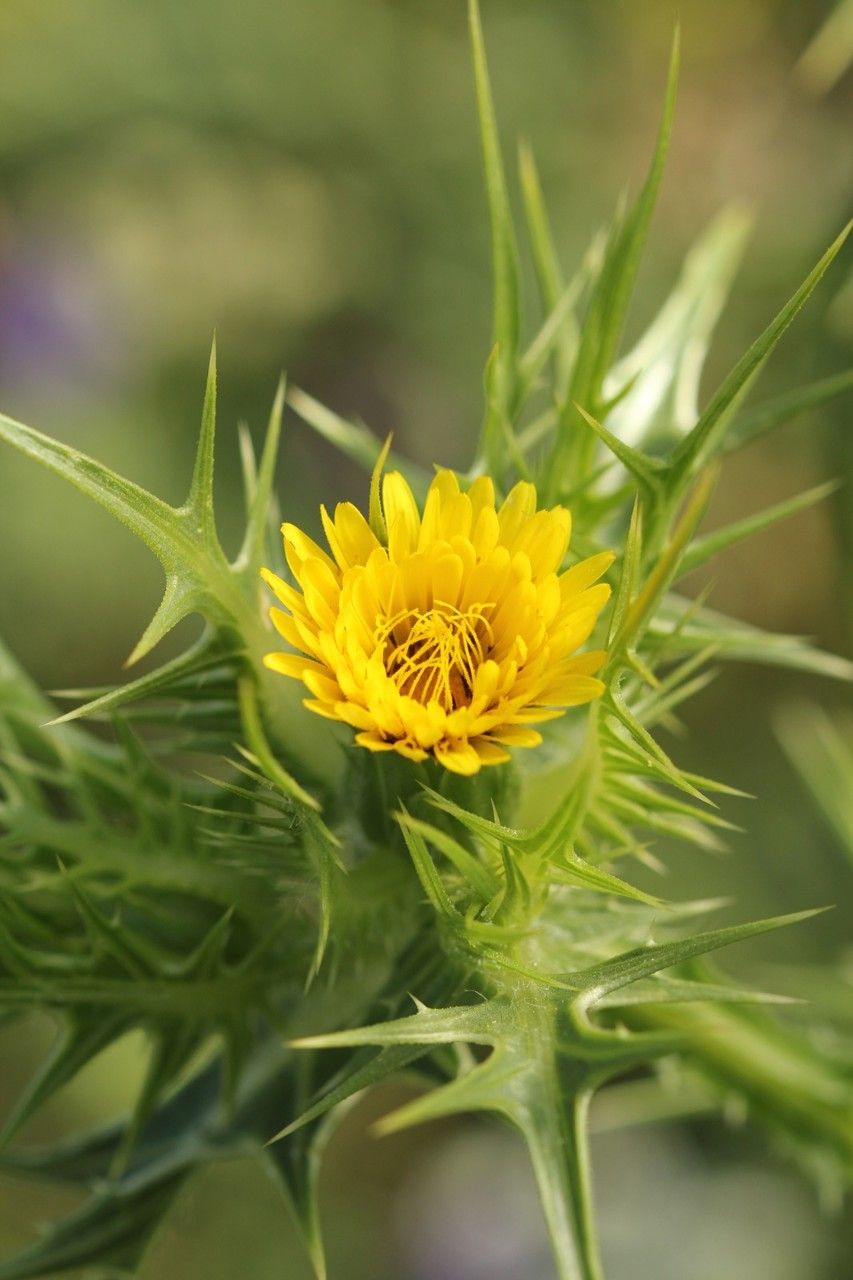
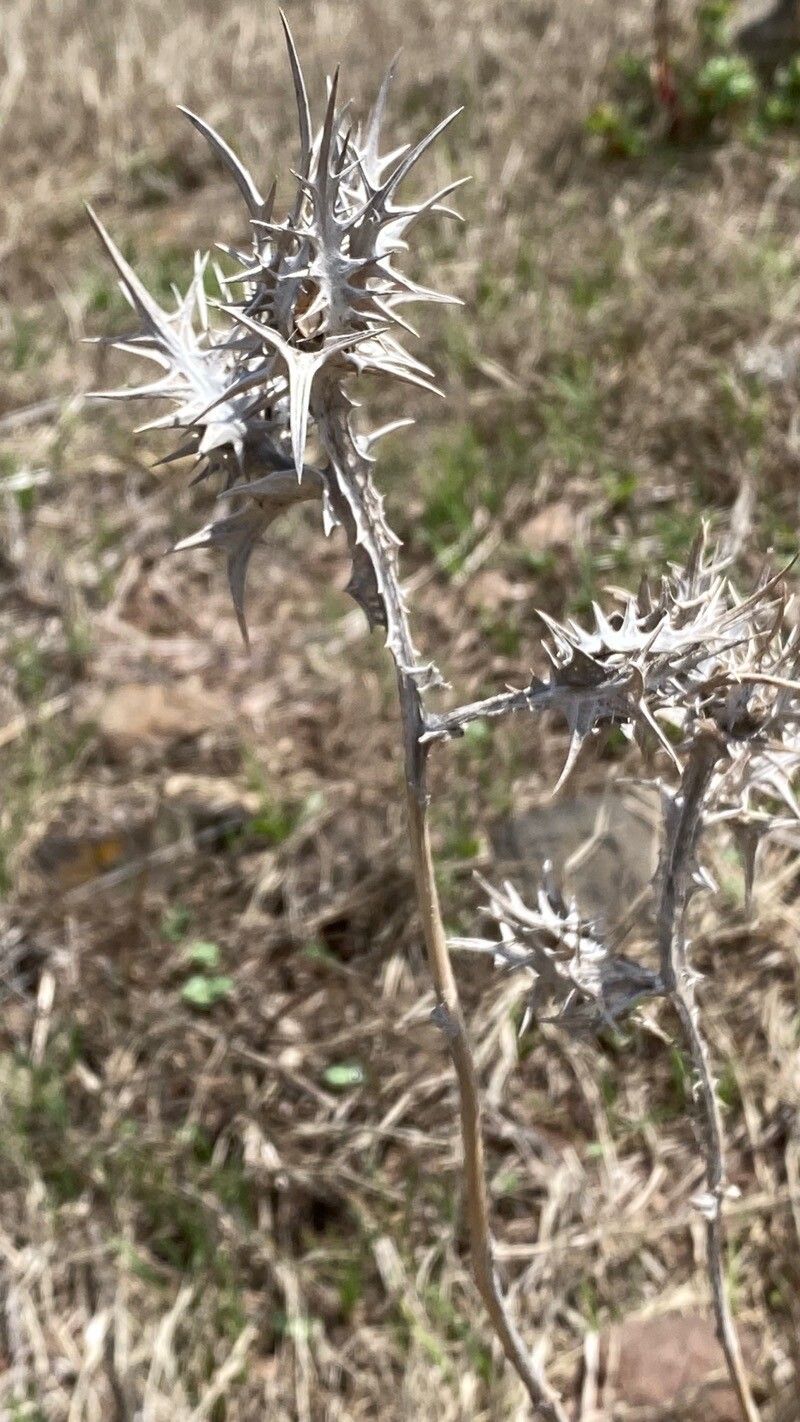
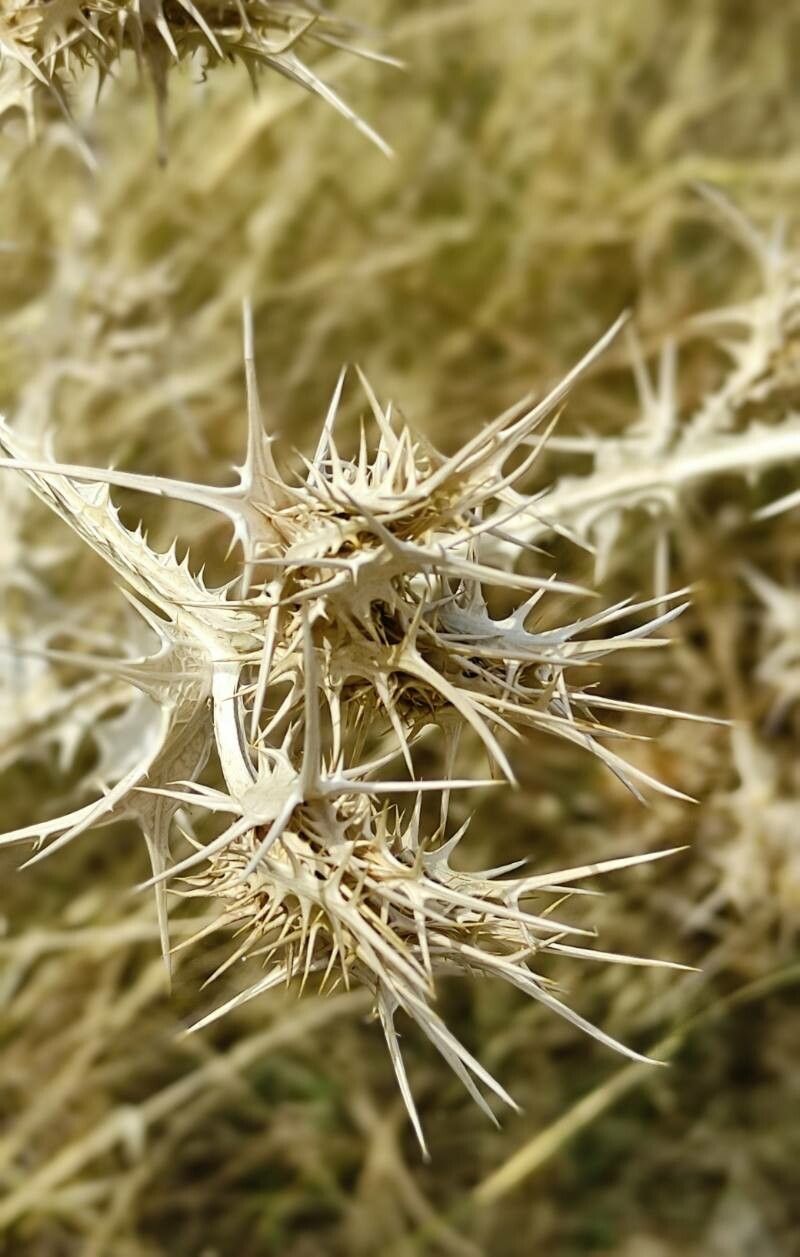
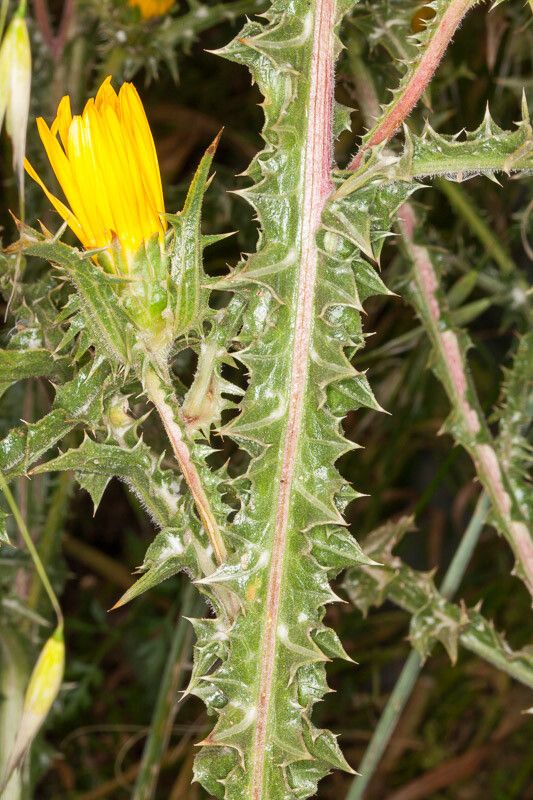
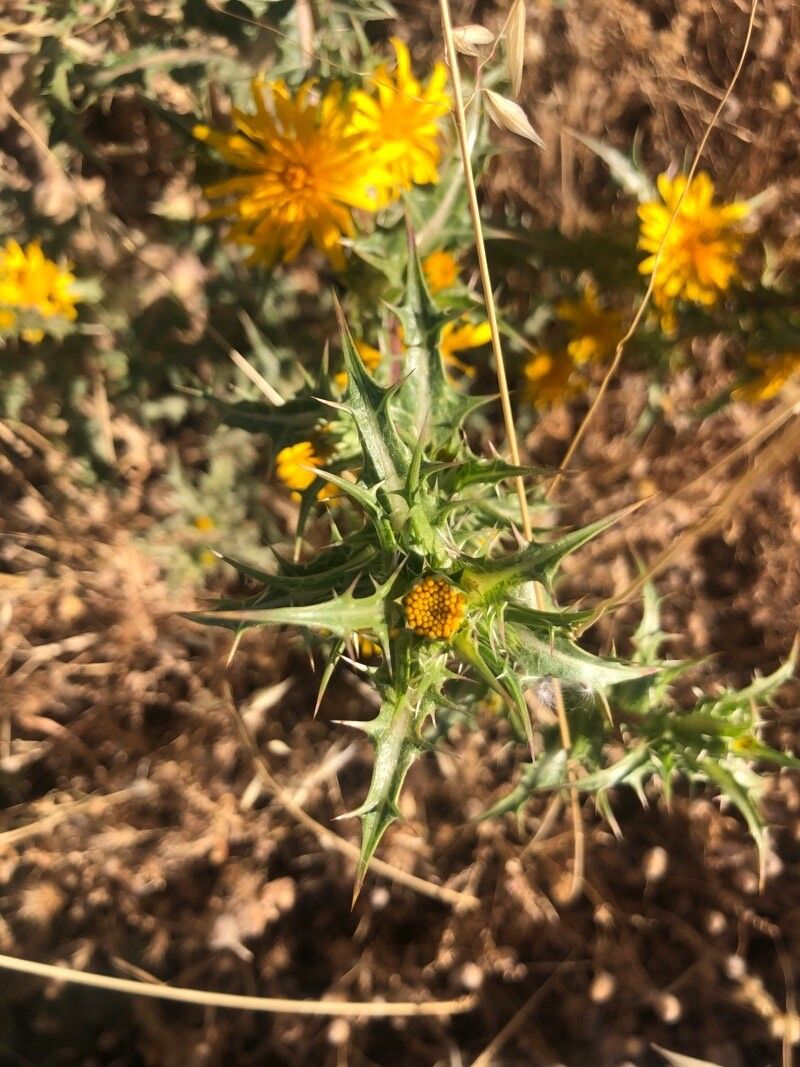
Scolymus maculatus is a spiny annual plant in the family Asteraceae, native to the Mediterranean region in southern Europe, southwest Asia, and northern Africa, and also the Canary Islands. It has pinnately incised prickly leaves and prickly wings along the stems, both with a white marginal vein. The yellow flowerheads stand solitary or with a few together at the tip to the stems, and subtended by more than five leaflike bracts. The plant is known as scolyme taché in French, cardogna macchiata in Italian, cardo borriquero in Spanish, and escólimo-malhado in Portuguese, חוח עקוד in Hebrew and سنارية حولية in Arabic. In English it is called spotted golden thistle or spotted oyster thistle.
Spotted goldenthistle has strong resistance to disease and is generally not prone to illnesses. Nevertheless, it can be vulnerable to pests and diseases present in its surroundings. These infestations are typically mild. For care, this plant requires a moderate level of maintenance. It should be pruned regularly to preserve a good appearance and support healthy growth. Fertilizing can also help encourage flowering. Spotted goldenthistle is suitable for anyone with outdoor space, such as a garden or patio, and does not require much prior care experience. It may need extra attention when kept indoors.
How to keep Scolymus Maculatus.
Light
Spotted goldenthistle comes from sunny, open habitats where it does best in full sun. It can tolerate some partial shade but favors direct sunlight for optimal growth. This plant, which may be annual or biennial, is noted for its sun-loving character.
Water
The spotted goldenthistle, native to the Mediterranean, thrives in well-drained soil with moderate drought tolerance. While it prefers consistent moisture, it benefits from weekly watering during its active growth period. Well-adapted to rocky terrains, the spotted goldenthistle efficiently utilizes water to support its foliage and flowering in the region's dry summers and wet winters.
Temperature
Spotted goldenthistle grows best in a temperate environment with temperatures between 68 and 95 °F (20 and 35 ℃). It prefers warm conditions and may need temperature adjustments during colder seasons.
Fertilizer
After most of Spotted goldenthistle's blooms have opened fully, resume fertilizing. When blooms are at peak output, apply fertilizer every three to four weeks, weather permitting. Then, once Spotted goldenthistle begins producing fewer new blooms, stop fertilizing; there is no need to fertilize when the plant can't produce any more blooms.
Pruning
Pruning the spotted goldenthistle is important for maintaining its shape and encouraging growth. The best time to prune is between early and late spring. To enhance new growth and improve air circulation, remove any dead stems. Always use clean, sharp tools to reduce stress on the plant and prevent infections, ensuring healthy development.
Botanical profile.
- Plant Type
- Herb
- Life Cycle
- Annual
- Genus
- Scolymus
- Family
- Asteraceae
- Hardiness Zone
- 6-9
- Mature Height
- 1.52 m
- Mature Spread
- 30 cm to 61 cm
- Leaf Color
- Green, Light Green
- Leaf Type
- Deciduous
- Flower Color
- Yellow
- Flower Size
- 3.05 cm to 5.08 cm
- Bloom Time
- Summer
- Planting Time
- Spring, Summer
- Harvest Time
- Late summer, Early fall, Mid fall
- Native Area
- Egypt, Turkey, Eritrea, Morocco, Iraq, Ethiopia, Belgium, Portugal, France, Tunisia, Sudan, Cyprus, Bulgaria, Greece, Lebanon, Syria, Italy, Spain, United Kingdom, Algeria
Other names.
Reader questions.
How should I water my Spotted goldenthistle plant to ensure it thrives?
Spotted goldenthistle can be watered using various tools, such as a garden hose with a spray nozzle or a watering can. They are not too particular about the type of water they receive, whether it's rainwater, tap water, or filtered water. It's best to avoid watering this plant from above, as it can harm the leaves and flowers and potentially cause disease. Instead, a drip irrigation system is recommended for watering Spotted goldenthistle, as it ensures even and direct watering of the soil. If you have a container-grown Spotted goldenthistle, the same watering approach can be used, just with different tools like a cup, watering can, or tap, directly applying water to the soil.
What are the sunlight requirements for Spotted Goldenthistle?
Spotted Goldenthistle thrives in environments where it can receive full sun, which means it prefers to be in direct sunlight for more than 6 hours a day. It can also tolerate partial sun, getting about 3-6 hours of sunlight, but its optimal growth occurs in full sun conditions. The varying intensity of sunlight throughout your garden should guide where you plant it to ensure it gets the ideal balance of light and shade.
What is the preferred environment for Spotted goldenthistle?
Spotted goldenthistle, or Scolymus maculatus, flourishes in temperate environments, thriving in temperatures between 68 to 95°F (20 to 35°C). It prefers warm conditions, meaning adjustments might be necessary during colder seasons. Despite its strong cold resistance, allowing it to generally forego special frost protection in winter, precautions should be taken if temperatures are expected to plunge below -25°C by covering the plant with soil or straw. Additionally, to combat potential drought and water scarcity in winter and early spring, it's advised to water the plant abundantly before the first freeze in autumn, ensuring the soil is moist as it enters a frozen state.
What should I do if I give my Spotted goldenthistle too much water or too little water?
To remedy underwatering Spotted goldenthistle, simply water it more regularly. Overwatering, on the other hand, can be a serious issue. It can lead to diseases and the plant's decline and death. To prevent this, choose a growing location with ample sunlight for soil drying and good drainage to prevent waterlogging. If your potted plant is overwatered, consider changing it to a new pot with better drainage. Make sure to use loose soil and an efficiently draining pot during repotting.
How does artificial lighting support indoor growth of Spotted Goldenthistle?
For indoor Spotted Goldenthistle plants, when natural sunlight is insufficient, especially during winter or in less sunny spaces, artificial lights provide a crucial solution. The right type of artificial light, such as LED lights, can be tailored to supply specific wavelengths needed by the plants. Full sun plants require 30-50W/sq ft of light, while partial sun plants need 20-30W/sq ft. Positioning the artificial light source 12-36 inches above the plant mimics natural sunlight, and ensuring it gets 8-12 hours of light daily supports optimal growth.
How does Spotted goldenthistle react to low temperatures?
Spotted goldenthistle is notably cold-tolerant, ideally kept in temperatures above 20°C. Throughout the winter, temperatures should remain above 0°C to avoid damage. When exposed to temperatures below -25°C, Spotted goldenthistle may not show immediate signs of distress; however, you might notice a reduction in sprouting or a complete lack of sprouting come springtime. To address this, it is recommended to remove any parts of the plant that fail to sprout in spring, aiding in its recovery and continued growth.
How frequently should I water my Spotted goldenthistle?
Spotted goldenthistle requires regular watering throughout the growing season. In spring, water the plant once a week. As the season progresses and gets warmer, you may need to water two to three times a week. However, be careful not to exceed this rate as it can harm the plant. Regardless of watering frequency, make sure the soil remains moist but not wet. For potted Spotted goldenthistle, water more often because pot soil can dry out faster than ground soil. Typically, water container-grown plants a few times per week compared to once per week for plants in the ground.
What symptoms indicate Spotted Goldenthistle is getting inadequate light?
When Spotted Goldenthistle does not receive sufficient light, it shows symptoms such as smaller new leaves, leggy or sparse growth, faster leaf drop, reduced or halted new growth, and the development of pale or irregularly colored leaves. It may suffer from chlorosis, where leaves lose their green color, or from sunscald, which damages plant tissue. Leaf curling, wilting, and leaf scorching can also occur due to too much direct sunlight or if the light intensity is too high.
What should be done if Spotted goldenthistle experiences high temperatures?
In the warmer months, it's crucial to ensure that the Spotted goldenthistle does not remain in conditions exceeding 35°C. Exposure to temperatures above 38°C can cause the leaves to lighten in color, become prone to curling, suffer from sunburn, and in severe cases, lead to the entire plant wilting and drying out. To mitigate this, remove any sunburned and dried parts of the plant. Relocating the plant to a shaded area during the midday and afternoon sun or employing a shade cloth can protect it. Ensuring the soil remains moist by watering the plant in the morning and evening is also beneficial.
How many times a week should I water my Spotted goldenthistle?
There are a few ways to determine how much water to give to your Spotted goldenthistle. One method is to feel the soil for moisture and water until the first six inches are moist. Another option is to use a set measurement, like two gallons per week, taking into account the temperature and how quickly the soil dries. However, be cautious not to overwater if your plant needs less. When growing in a container, water until all layers of dry soil are moist, checking with your finger or looking for drainage.
What are the solutions to improve Spotted Goldenthistle's light exposure?
To enhance light exposure for Spotted Goldenthistle, gradually relocate the plants to a sunnier spot, aiming for at least 6 hours of direct sunlight daily. For indoor plants, move them to a south-facing window or use artificial lights such as desk or ceiling lamps for a minimum of 8 hours a day. For outdoor plants, ensure a gradual transition to prevent sunburn. Reducing obstructions like pruning branches, or relocating the plant to a sunnier area with good drainage can also help. It's important to note that while parts of the plant damaged by insufficient sunlight may not recover, new growth will be healthy after light exposure is increased.
How do I know if I am giving enough water to my Spotted goldenthistle?
Avoiding overwatering your Spotted goldenthistle can be a bit tricky due to its deep roots that require weekly moistening. However, these plants are highly susceptible to root rot and may experience browning from overwatering. Underwatering is less of an issue as Spotted goldenthistle can survive without supplemental watering for a while. However, if water is withheld for too long, the plant may wilt and its leaves may become dry.