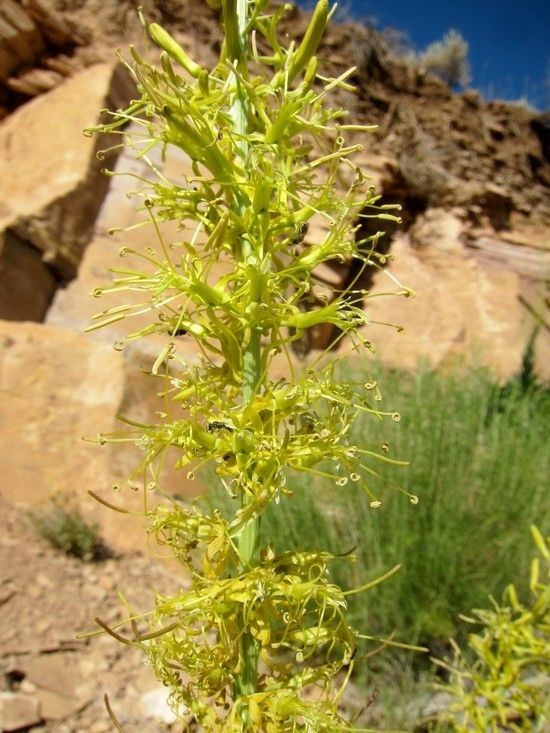
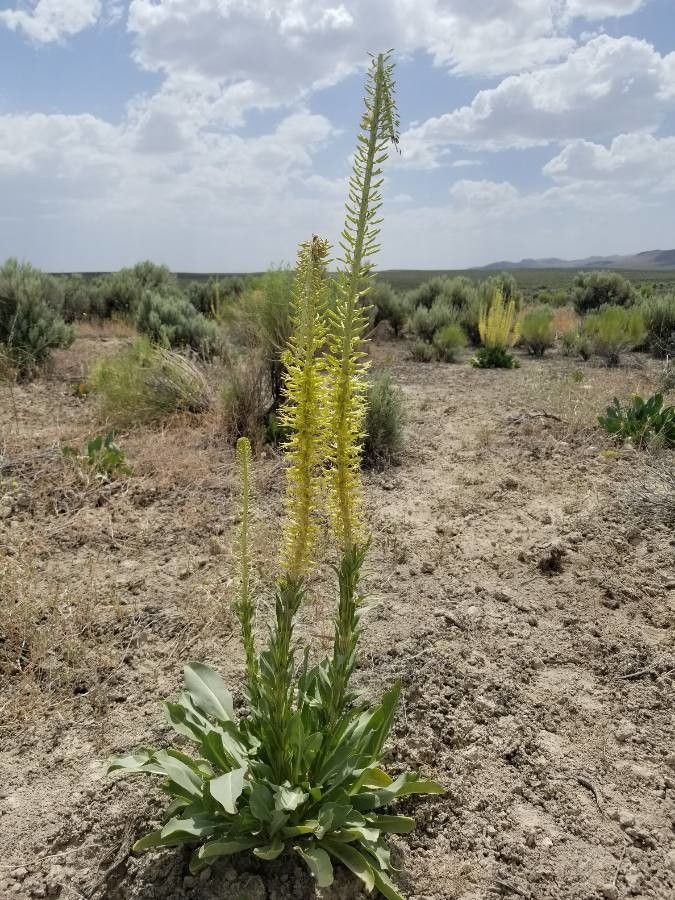
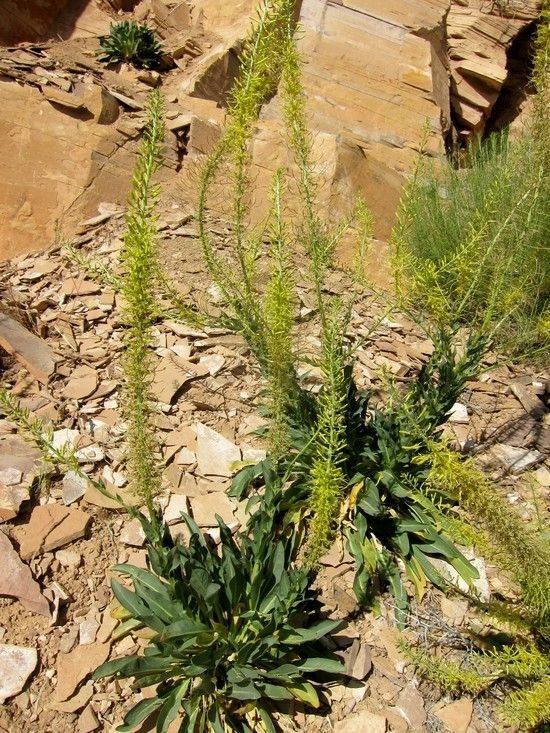
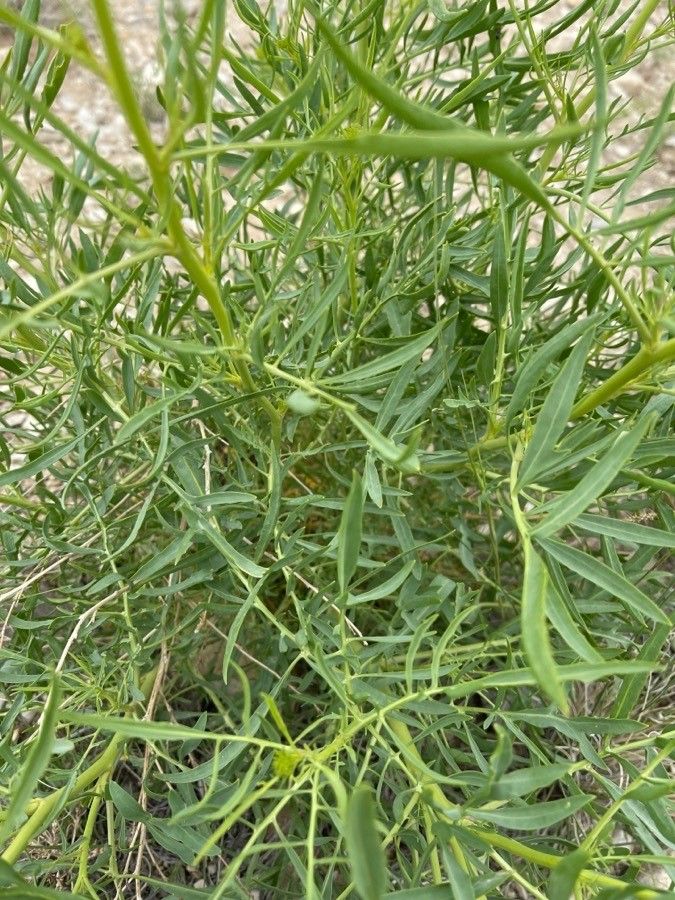
Stanleya viridiflora is a species of flowering plant in the family Brassicaceae known as green princesplume and green-flowered prince's plume. It is native to the western United States, where it occurs in sagebrush and plateau habitat, often on rocky calcareous, sandstone, clay, shale, or volcanic soils. It is a perennial herb producing a stout erect stem which may exceed a meter in maximum height. It is hairless and sometimes waxy in texture. Its base is a caudex which is generally covered in the remains of withered leaf bases. The leaves have lance-shaped or oblong blades which have smooth or toothed edges or may be divided into a few lobes. The blades may be 22 centimeters long. Some are borne on long petioles, while others, especially those higher on the plant, clasp the stem at their bases. The top of the stem is occupied by a long inflorescence which is an open raceme of many flowers. Each flower bud is enclosed in long, thick sepals which open to reveal yellow or whitish petals each measuring up to 2 centimeters in length. The stamens protruding from the flower's center are 1 or 2 centimeters long. The fruit is a curving, wormlike silique 4 to 7 centimeters in length containing tiny seeds.
Green princesplume is fairly disease-resistant and generally not prone to illnesses. However, it can be affected by pests and diseases present in its environment. These problems are usually mild. In terms of care, the plant requires a moderate level of maintenance. It should be pruned regularly to maintain a neat appearance and support healthy growth. Fertilizing can also help encourage flowering. Green princesplume is suitable for people with outdoor space, such as a garden or patio, and does not demand extensive care experience. It may need more attention when grown indoors.
How to keep Stanleya Viridiflora.
Light
Green princesplume is a sun-loving, herbaceous perennial native to open habitats, where it commonly grows in meadows and grasslands. It prefers full sun but can also tolerate partial sun.
Water
The Green Prince's Plume thrives in environments with moderate moisture, needing consistent watering to mimic its natural habitat. It benefits from weekly watering and has adapted to seasonal rainfall patterns, which influence its growth cycles and water uptake efficiency. Maintaining stable moisture levels is essential for the plant's optimal health.
Temperature
Green princesplume can adjust to a wide range of temperatures, but its distribution may still be restricted by different combinations of moisture and heat. It performs best in warm summer climates with sufficient rainfall or watering. Extended stretches of cloudy, rainy weather or prolonged high temperatures can raise the likelihood that Green princesplume will die. In winter, adequate protection from the cold can boost the plant's survival rate.
Fertilizer
The best time to fertilize a Green princesplume is in early spring, as it comes out of dormancy and begins active growth. Fertilization supplies essential nutrients for healthy growth. Although Green princesplume has relatively low fertilizer requirements, applying fertilizer annually can improve its survival and encourage better, longer-lasting flowers.
Pruning
Green prince's plume features vibrant green foliage and tall flowers, and it benefits from specific pruning techniques. To encourage healthy growth and abundant blooms, prune the plant in early to late spring, removing any dead stems and spent flowers. Thinning out crowded areas also enhances air circulation, which promotes the plant's overall health and floriferous display. For the best results, consult guides for tailored pruning methods.
Botanical profile.
- Plant Type
- Herb
- Life Cycle
- Perennial
- Genus
- Stanleya
- Family
- Brassicaceae
- Hardiness Zone
- 4-8
- Mature Height
- 30 cm to 91 cm
- Mature Spread
- 30 cm to 61 cm
- Leaf Color
- Green, Blue
- Leaf Type
- Semi-evergreen
- Flower Color
- Yellow
- Flower Size
- 1.02 cm to 2.03 cm
- Bloom Time
- Late spring, Early summer, Mid summer
- Planting Time
- Spring, Summer, Autumn
- Harvest Time
- Mid summer, Late summer, Early fall
Other names.