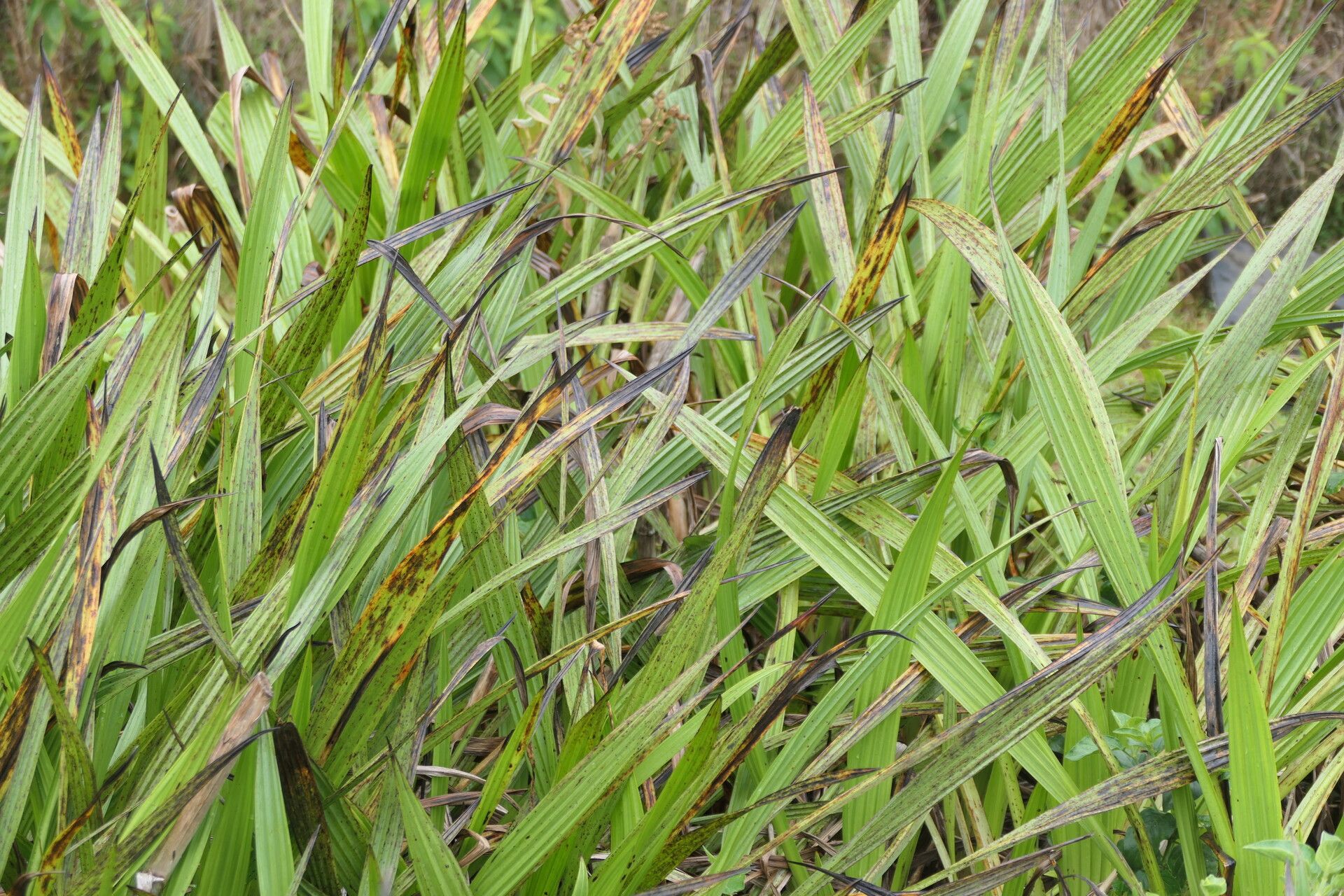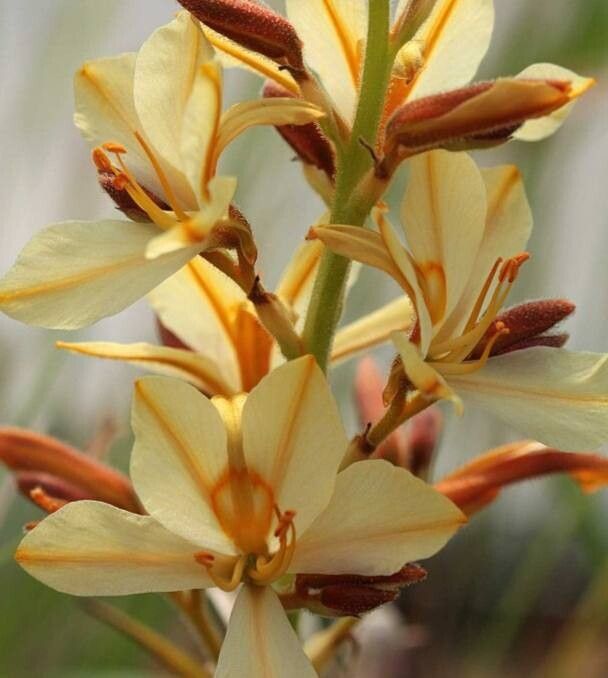
Wachendorfia paniculata, the common butterfly lily, is a species of plant of 10–90 cm (3.9–35.4 in) high, that emerges during the winter from an underground rootstock. It has entire, sword-shaped, mostly hairy, line- to lance-shaped, straight or sickle-shaped leaves, set in a fan at ground level with a lax to dense panicle consisting of pale apricot to yellow mirror-symmetric flowers with six tepals, three stamens and a undivided style that curves either to the right or left. The species is assigned to the bloodroot family. Flowering occurs between August and December at sea level, and until early February at high altitude, with a distinct peak from September to November. It can only be found in the Cape provinces of South Africa. Like other species of Wachendorfia, it is called butterfly lily in English and rooikanol or spinnekopblom in Afrikaans, and this species in particular is also called koffiepit in Afrikaans.
Spider-flower has strong disease resistance and is generally unlikely to suffer from illnesses. However, it can be vulnerable to pests and diseases present in its environment. Such infections are generally mild. Regarding care, this plant requires moderate upkeep. It needs regular pruning to preserve a good appearance and healthy growth. Fertilizing can also encourage flowering. Spider-flower is appropriate for anyone with outdoor space, such as a garden or patio, and does not demand extensive care experience. It may need more attention when grown indoors.
How to keep Wachendorfia Paniculata.
Light
Spider-flower is a sun-loving, perennial herbaceous plant native to open habitats and commonly thriving in meadows and grasslands. It prefers full sun but can also tolerate partial sun.
Water
The spider-flower flourishes in high-humidity environments, needing consistent moisture without becoming waterlogged. To maintain proper hydration, water it weekly. When grown outdoors, it benefits from rainwater during the growing season, which can reduce the need for additional watering and support its natural growth.
Temperature
Spider-flower is fairly adaptable to temperature, able to endure higher heat and wider temperature swings. In hot weather, care should be taken with watering and providing adequate shade to avoid sunburn. However, Spider-flower is relatively sensitive to low temperatures; while it can tolerate some cold, very low temperatures can cause frost damage.
Fertilizer
For Spider-flower, the primary time to apply fertilizer is early spring when the flowers are forming. Using the appropriate fertilizer promotes improved blooms and helps Spider-flower develop attractive flowers. Fertilizing in early spring guarantees strong flowering during the season and supplies energy for dormant growth phases.
Pruning
The spider-flower features vibrant, clustered blooms and lush, grassy foliage. Pruning is essential from early to late spring to remove dead stems, improve air circulation, and control the plant's size. This process promotes healthier growth and blooming. Be sure to use clean, sharp tools to prevent disease.
Botanical profile.
- Plant Type
- Herb
- Life Cycle
- Perennial
- Genus
- Wachendorfia
- Family
- Haemodoraceae
- Hardiness Zone
- 9-11
- Mature Height
- 20 cm to 61 cm
- Mature Spread
- 30 cm to 61 cm
- Leaf Color
- Green
- Leaf Type
- Semi-evergreen
- Flower Color
- Yellow, Gold
- Flower Size
- 2.03 cm to 3.05 cm
- Bloom Time
- Mid spring, Late spring
- Planting Time
- Spring, Summer
- Harvest Time
- Early summer, Mid summer
- Native Area
- South Africa