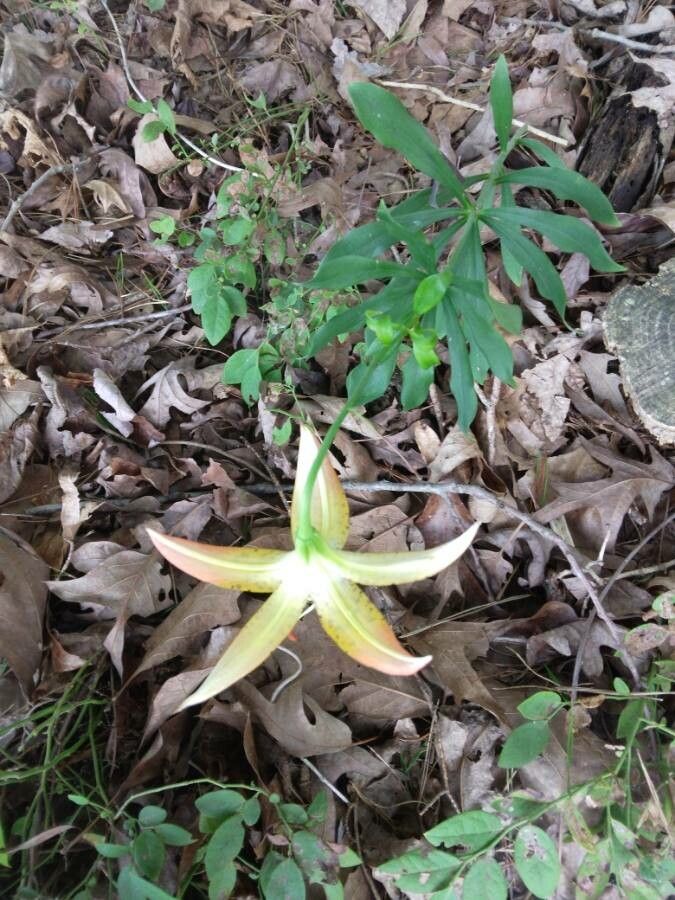
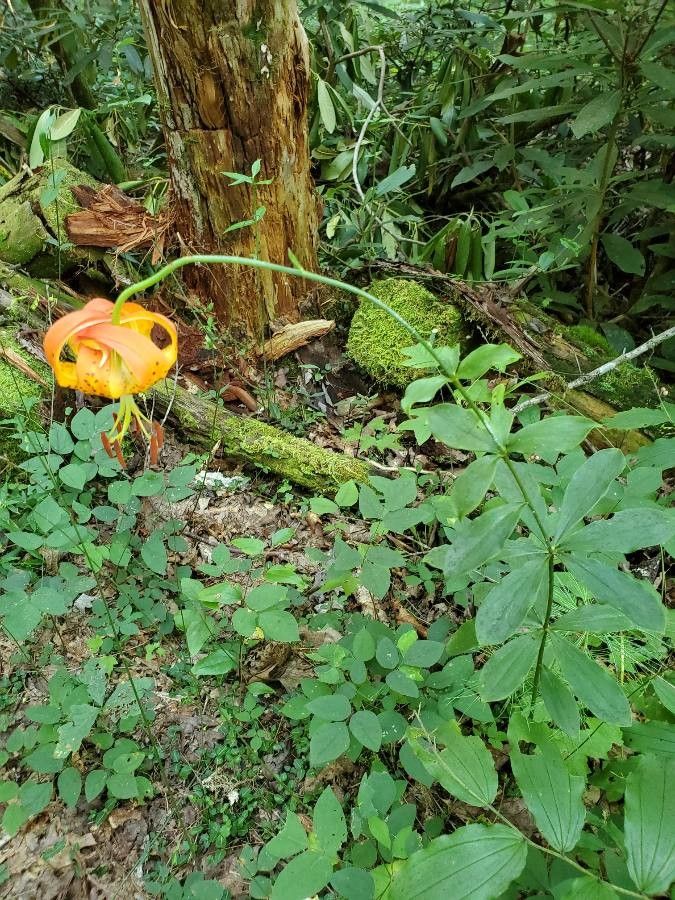
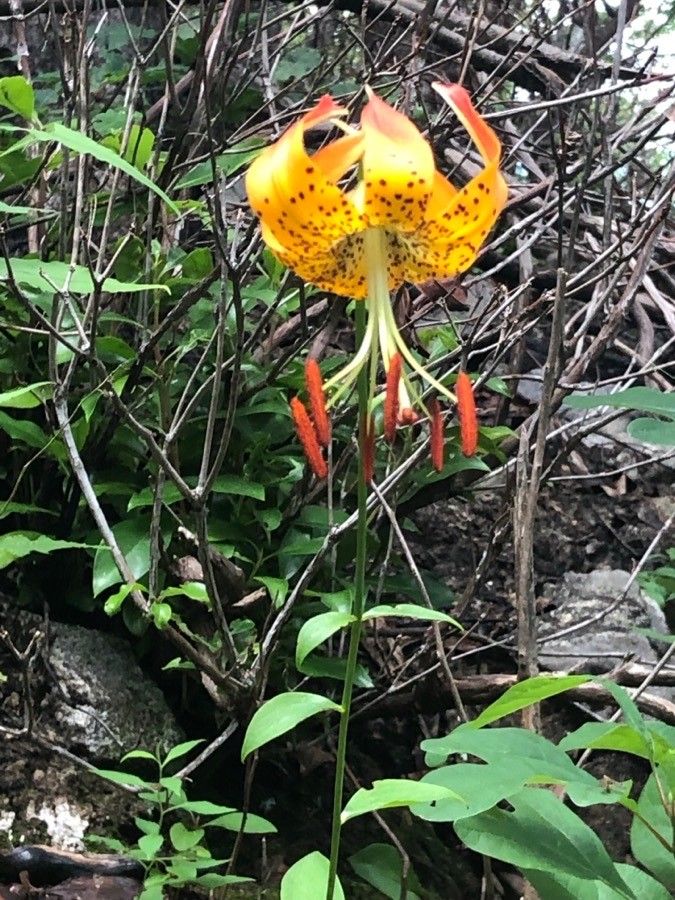
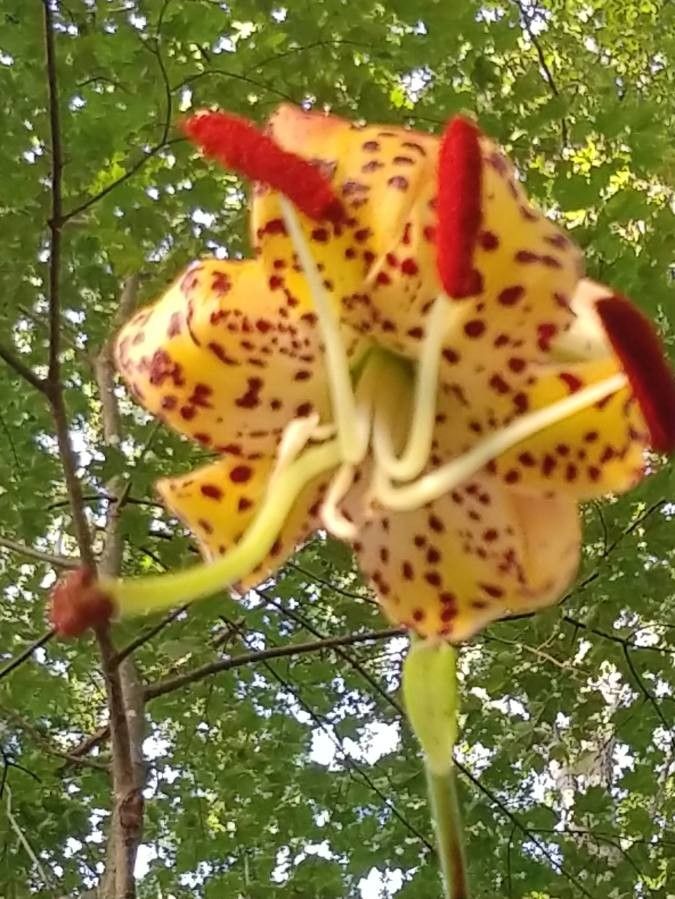
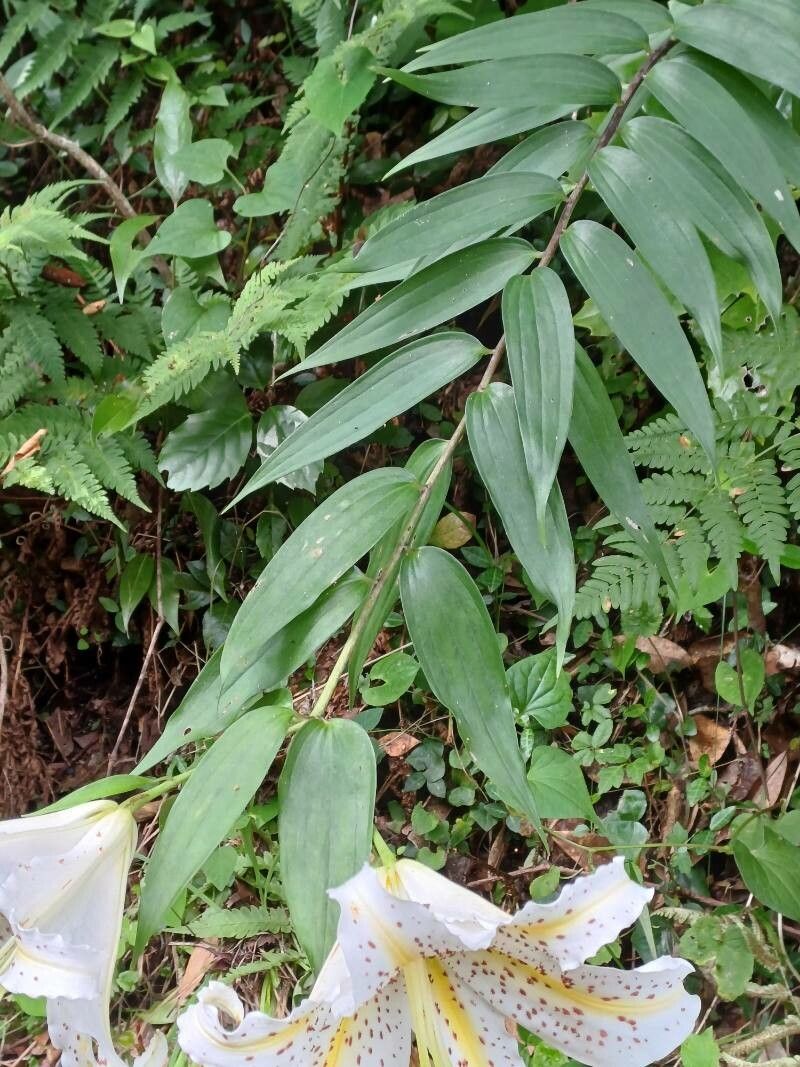
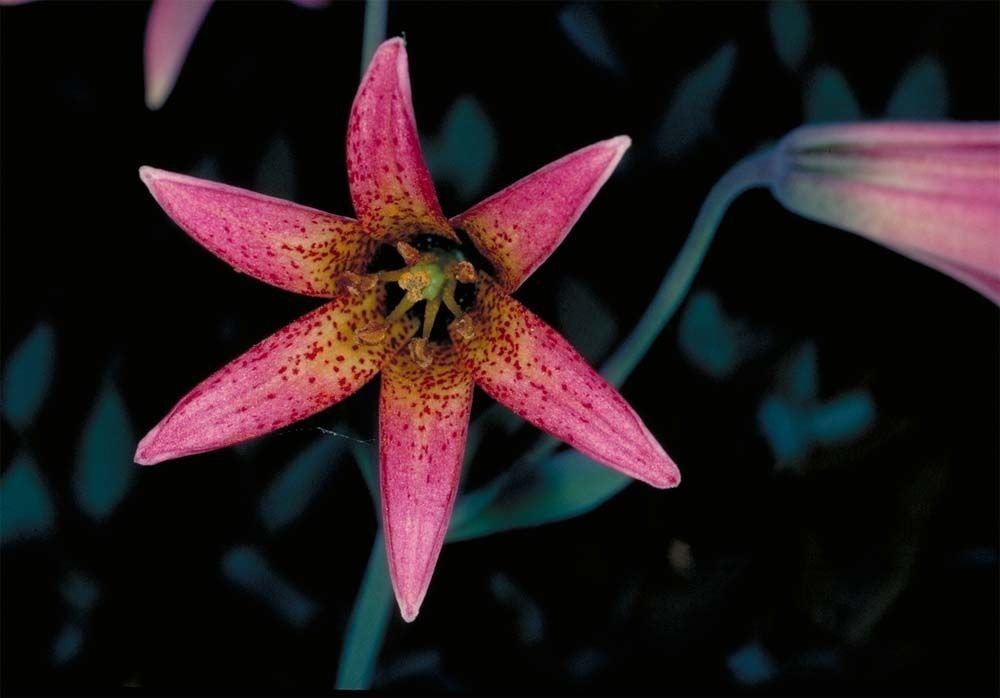
Lilium michauxii, commonly known as the Carolina lily, can be found in the southeastern United States from southern Virginia in the north to the Florida Panhandle in the south to eastern Texas in the west. It is most common in July and August but can be found blooming as late as October. It was named for the French botanist André Michaux, who traveled and did extensive research throughout the Southeast.The common name "Carolina lily" reflects an older taxonomy that used the name Lilium carolinianum for both L. michauxii and L. catesbaei. Another common name, Turk's cap lily, has been listed for L. michauxii, although L. superbum (which is very similar in appearance to L. michauxii) shares this common name.The Carolina lily can grow to 3½ feet tall with flowers 3–4 inches across. It is the only fragrant lily east of the Rocky Mountains. Its petals bend backward and are spotted. Colors range from yellow through orange to red for background petal color and from red through purple to brown for the spots. (Note photo below) The Carolina lily is the official state wildflower of North Carolina.
The Carolina lily is fairly disease-resistant and generally not prone to illness. That said, it can be vulnerable to pests and diseases present in its surroundings. These problems are typically not serious. Regarding care, this plant needs a moderate level of maintenance. It should be pruned regularly to keep a neat appearance and encourage healthy growth. Fertilizing can also help increase flowering. The Carolina lily is suitable for anyone with outdoor space, such as a garden or patio, and does not require much gardening experience. It may need extra attention if grown indoors.
How to keep Lilium Michauxii.
Light
Carolina lily performs best in strong light but can tolerate more moderate illumination. Insufficient light can substantially impede its growth, while excessive exposure may cause sun-scorching. Native to environments with abundant sunlight, all growth stages of the Carolina lily are generally dependent on light.
Water
The Carolina lily thrives in moist environments and prefers well-balanced soil moisture. It is moderately tolerant of drought. To ensure vibrant flowering, it's important to water the plant weekly, especially during its growing season.
Temperature
The Carolina lily comes from environments where temperatures range from 50 to 95 °F (10 to 35 ℃). It does best in places with similar temperatures. In colder months, consider relocating it indoors or to warmer parts of the garden.
Fertilizer
The best time to fertilize a Carolina lily is in early spring, when it is coming out of dormancy and entering active growth. Fertilizing supplies essential nutrients for healthy growth. Although the Carolina lily has relatively low fertilizer needs, annual feeding can improve its survival and promote better, longer-lasting flowers.
Pruning
The Carolina lily is known for its vibrant orange-red flowers adorned with spots. To keep it healthy and promote growth, it's important to prune the plant from early to late spring. Start by removing any damaged foliage, and also cut back the spent flower stalks. This will help prevent disease and encourage new growth. Make sure to sanitize your tools to reduce the risk of infection, which will improve air circulation and boost the plant's overall vigor.
Botanical profile.
- Plant Type
- Herb
- Life Cycle
- Perennial
- Genus
- Lilium
- Family
- Liliaceae
- Hardiness Zone
- 6-9
- Mature Height
- 1.07 m
- Mature Spread
- 30 cm
- Leaf Color
- Forest Green, Dark Green
- Leaf Type
- Deciduous
- Flower Color
- Orange, Red
- Flower Size
- 7.62 cm to 15.24 cm
- Bloom Time
- Early summer, Mid summer
- Planting Time
- Spring, Summer, Autumn
- Harvest Time
- Late summer, Early fall
Other names.
Reader questions.
How frequently should I give water to my Carolina lily?
Carolina lilies are a hardy plant that doesn't require a lot of attention. It is best to plant them directly into the ground in the hottest and brightest area of your garden, although you can also grow them in a pot. Since they are bulbs, it is important to avoid overwatering as it can cause the bulb to rot. After initially watering the lilies, you can leave them be until you see shoots appear. To ensure optimal growth, check the moisture of the soil after new leaves have emerged. Stick your finger about 2-3 inches below the soil surface; if it is still wet, you don't need to water the plant. In potted plants, make sure there isn't any standing water in the drainage tray before watering. For a more accurate moisture reading, use a moisture sensor inserted 2-3 inches into the soil, aiming for a reading in the middle of the 'moist' category. It is recommended to water your Carolina lily once a week.
What are the sunlight requirements for Carolina lily?
Carolina lily requires intense levels of light exposure to thrive, ideally in environments that simulate its natural habitat of ample sunlight. For optimal growth, Carolina lily should be placed in locations that receive full sun, defined as above 6 hours of sunlight per day, or partial sun, with about 3-6 hours of sunlight daily. It's crucial to observe how sunlight moves through your garden or home to find spots that offer a perfect balance of light for the plants. Inadequate light can severely hinder the plant's growth, while too much direct exposure can lead to sunscorching.
What is the ideal temperature range for growing a Carolina Lily?
The Carolina Lily, known botanically as Lilium michauxii, naturally thrives in temperatures ranging between 50 and 95 °F (10 to 35 °C). It is important to maintain this temperature range for the plant to flourish. In regions experiencing colder months, it is advisable to move the Carolina Lily indoors or to warmer spots within the garden to ensure its survival and continued growth.
How does artificial lighting affect the growth of Carolina lily indoors?
When Carolina lily is grown indoors where natural sunlight is insufficient, particularly during winter or in less sunny spaces, artificial lighting becomes crucial. Adequate artificial lighting ensures faster and healthier plant growth by mimicking natural sunlight conditions. It is advisable to choose the right type of light, such as LED, to provide necessary wavelengths of light, with full sun plants requiring 30-50W/sq ft, partial sun plants 20-30W/sq ft, and full shade plants 10-20W/sq ft. The light source should be placed 12-36 inches above the plant, for a duration that mimics natural daylight hours, typically 8-12 hours per day.
Does the Carolina Lily need frost protection in winter?
The Carolina Lily exhibits strong resistance to cold and generally does not require special frost protection measures during winter. However, in extremely cold conditions where temperatures are expected to drop below -25°C, providing cold protection becomes essential. This can be done by covering the plant with insulating materials such as soil or straw. Additionally, watering the plant abundantly before the first freeze in autumn is recommended to keep the soil moist and prevent drought and water scarcity during the winter and early spring.
What are the symptoms of inadequate light exposure in Carolina lily?
Symptoms of inadequate light exposure in Carolina lily can include small new leaves, leggy or sparse growth, early leaf drop, slower or halted growth, paler new leaves, chlorosis (yellowing leaves), sunscald, leaf curling, wilting, and leaf scorching. These symptoms result from either too little light, which limits photosynthesis and growth or too much direct sunlight leading to damage and dehydration. Recognizing these signs helps in diagnosing and addressing light-related issues to support the plant's health.
How does low temperature affect Carolina Lily and what are the solutions?
Carolina Lily is cold-tolerant and prefers temperatures above 10°C. It should ideally be kept above -15°C during the winter. Exposure to temperatures below -25°C can lead to issues such as a decrease in sprouting or a complete lack of sprouting in spring, even though the plant may not show noticeable changes during the winter. The recommended solution for parts of the plant that fail to sprout in spring due to low temperature exposure is to remove those parts.
What solutions can I implement to address light-related issues in Carolina lily?
To optimize growth for Carolina lilies facing light-related issues, consider increasing natural sunlight exposure by gradually moving them to sunnier locations, ensuring they receive at least 6 hours of direct sunlight daily if outdoors, or utilizing south-facing windows for indoor plants. For plants that are large or difficult to move, supplementing with artificial light like professional grow lights or desk/ceiling lamps for at least 8 hours daily can provide additional support. It's important to make adaptations gently to avoid sunlight overexposure and to minimize obstructions by pruning or relocating plants to brighter areas. New growth following these adjustments typically returns to healthy conditions.
What should be done if a Carolina Lily is exposed to high temperature?
In the summer, it's crucial to ensure that the Carolina Lily is kept below 35°C, as exposure to temperatures exceeding 38°C can result in the leaves becoming lighter in color, curling, becoming prone to sunburn, and in severe cases, the plant may wilt and dry out entirely. To mitigate these effects, sunburned and dried-up parts of the plant should be trimmed away. The plant should also be moved to a location that provides shade during the midday and afternoon sun, or a shade cloth can be used to create necessary shade. Additionally, watering the plant in both the morning and evening helps to maintain soil moisture and protect the plant from heat stress.