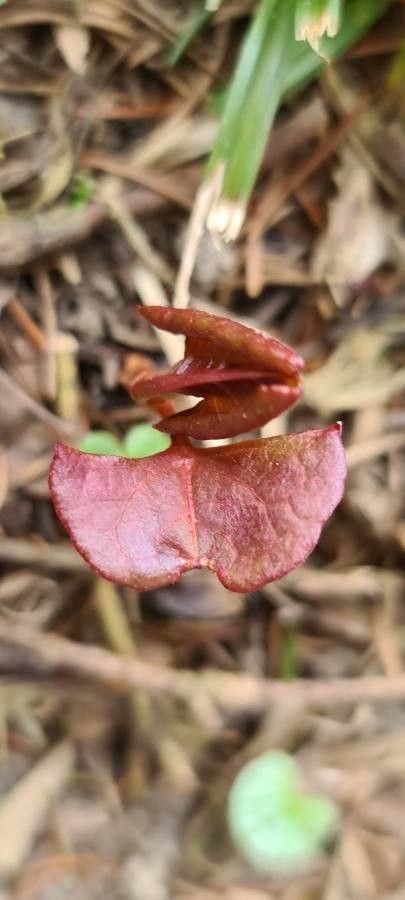
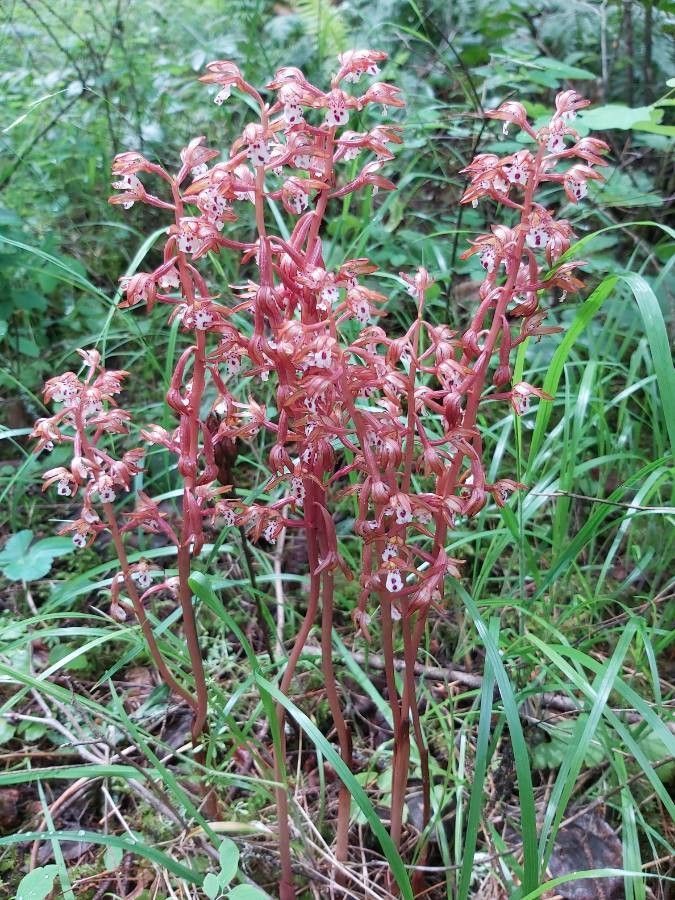
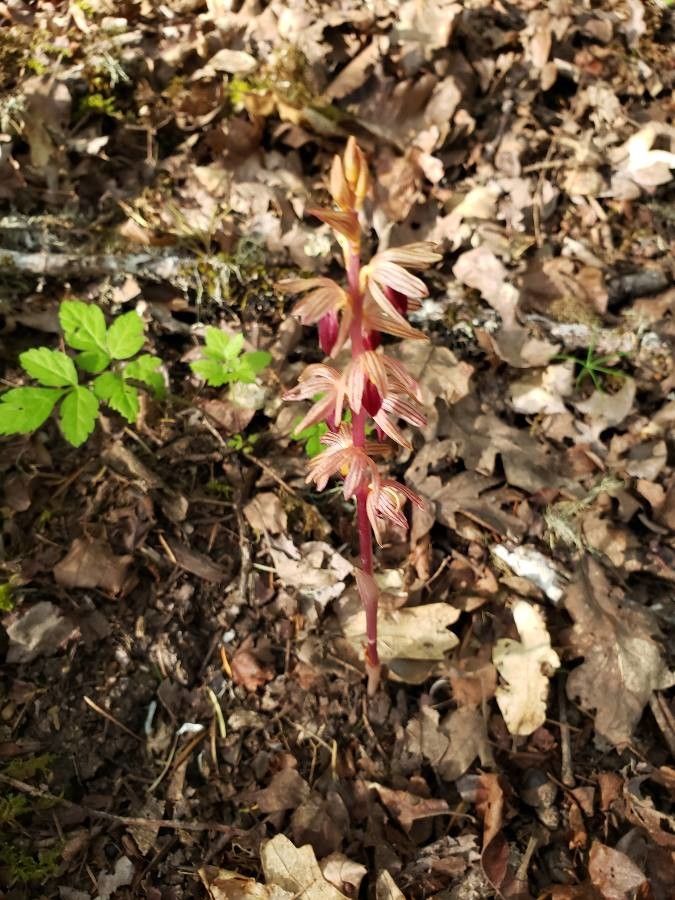
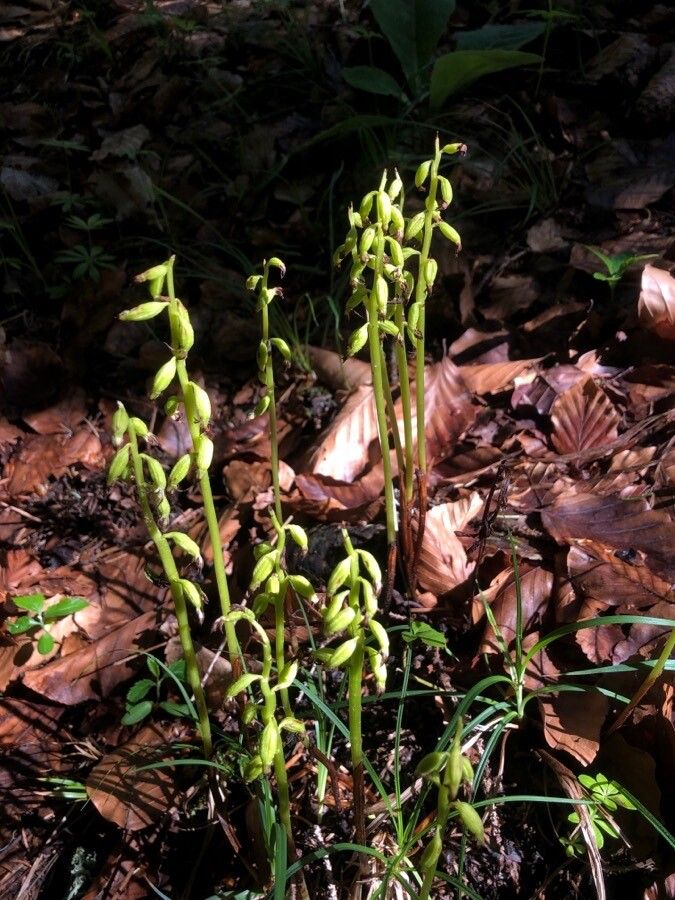
Corallorhiza odontorhiza, common name fall coral-root or small-flowered coral-root, is a species of orchid widespread across eastern and central United States, and reported also from Mexico, Central America, Quebec and Ontario. In North America, it occurs in forested areas up to an elevation of 2800 m (9300 feet).Corallorhiza odontorhiza is a non-photosynthetic species, with no chlorophyll. Hence it relies on fungi in the soil to supply it with nutrients. Stems are yellow to brown, bulbous at the base. There are no leaves. Flowers are typically reddish-purple with a white lip, the lip with small purple spots, though some plants are cleistogamous with non-opening flowers. The plant flowers from August through October in the eastern US.
Autumn coralroot is generally resistant to disease and suffers from relatively few insect pests. Its care is considered challenging because it needs high humidity combined with good ventilation and an environment with few harmful pathogens. Too much watering can result in root rot. Although anyone can grow Autumn coralroot, keeping it healthy and getting it to flower again requires more cultivation experience.
How to keep Corallorhiza Odontorhiza.
Light
Autumn coralroot is native to habitats such as forest understories or rocky sites that offer natural shade. It prefers Full Shade but can tolerate Partial Sun.
Water
Autumn coralroot is an orchid that thrives in environments rich in organic matter, much like forest floors, often flourishing beneath the canopy of trees. While it can tolerate mild drought conditions, it requires weekly watering and benefits from rainfall during its active growth phase, which boosts its potential to produce flowers.
Temperature
Autumn coralroot can tolerate a broad range of temperatures, but its distribution may still be constrained by different combinations of moisture and heat. It does best in warm summer climates with adequate rainfall or watering. Extended periods of cloudy, rainy weather, as well as prolonged high temperatures, can increase the likelihood of Autumn coralroot dying. In winter, appropriate protection from cold can improve the plant's survival rate.
Fertilizer
Usually one fertilizer application in spring is enough for Autumn coralroot, though several feedings can maximize growth. Apply fertilizer every month to month and a half. Fertilizing improves leaf appearance and function, maintaining even color and a healthy texture. It also promotes root development and nutrient uptake, supporting the plant's long-term health.
Pruning
Autumn coralroot is a leafless, mycoheterotrophic plant that requires minimal pruning, ideally performed in early to late spring. To encourage blooming, remove any dead or diseased stems. Keep the area around the plant clear to improve air circulation, and use sterilized tools to prevent the spread of pathogens. This helps maximize nutrient allocation for healthy growth.
Botanical profile.
- Plant Type
- Herb
- Life Cycle
- Perennial
- Genus
- Corallorhiza
- Family
- Orchidaceae
- Hardiness Zone
- 4-8
- Mature Height
- 40 cm
- Mature Spread
- 30 cm
- Leaf Color
- Pale Goldenrod
- Leaf Type
- Deciduous
- Flower Color
- Brown
- Flower Size
- 0.25 cm to 0.51 cm
- Bloom Time
- Late summer, Early fall, Mid fall
- Planting Time
- Autumn
- Harvest Time
- Mid fall, Late fall, Early winter
- Native Area
- Honduras, Mexico, Guatemala, El Salvador, Nicaragua
Other names.
Reader questions.
What is the botanical name of Autumn coralroot?
The botanical name of Autumn coralroot is Corallorhiza odontorhiza.